Insights from HTEC’s Palo Alto Executive Dinner
At HTEC’s ninth AI-First Executive Dinner in Palo Alto, executives from across industries gathered to discuss a topic that is quickly moving to the top of leadership agendas: what it takes to realize value from AI at scale.
Over the past year, these conversations have evolved alongside the technology itself. While each dinner has brought together leaders facing different business realities, priorities, and constraints, a common thread has consistently emerged: no organization is navigating this transition alone.
That’s what continues to make these discussions valuable. They create an opportunity for leaders to step outside their organizations, compare experiences with peers facing similar decisions, and collectively explore a challenge that is still being defined in real time. This year’s Palo Alto gathering was no exception.
Moderated by HTEC’s Chief Strategy Officer, Lawrence Whittle, the discussion featured HTEC CTO Darko Todorovic alongside industry leaders Marcus East (Autodesk), Peyton Sherwood (Condoit), Bruce Baumgartner (Zoox), and physician-scientist Matt Lungren (Stanford), bringing perspectives from enterprise technology, critical infrastructure, and healthcare.
Sustainable value requires a whole-system view
Three years after generative AI entered the mainstream, many organizations have moved beyond experimentation and proof-of-concept projects. What has become increasingly clear, however, is that creating value from AI at enterprise scale requires much more than deploying individual tools or models.
As Darko Todorovic, HTEC’s CTO, observed, organizations are beginning to recognize that successful AI adoption depends on decisions across multiple layers, from the silicon and infrastructure layer where inference takes place, through governance, model orchestration, and data, all the way to the applications that deliver outcomes for users and customers.
Additionally, each layer introduces its own complexity. Data alone is not enough. It needs context, which semantic layers and ontologies provide by connecting information to real-world business meaning.
“We are now realizing that there are a number of layers everybody needs to think about if you want to implement AI in the enterprise. The hardest part is connecting all of the dots. You don’t have the people that can drive decisions across all of these layers, and it’s very hard for enterprises to commit long-term without understanding the bigger picture.” – Darko Todorovic, CTO, HTEC
Rethinking how work gets done
Early experimentation was often driven by curiosity and relatively low barriers to entry. As HTEC’s Chief Strategy Officer, Lawrence Whittle, pointed out, today, organizations are paying closer attention to where AI creates enough value to justify how it is deployed and scaled – i.e., the “tokenomics” behind AI initiatives.
Several executives argued that the greatest returns are unlikely to come from automating existing processes. Instead, they pointed to AI’s potential to fundamentally redesign how work is performed, enabling organizations to accomplish more without merely accelerating existing workflows.
In other words, the goal is not simply to do the same work faster. Organizations that treat AI primarily as a productivity tool may improve existing ways of working. Those who view it as an opportunity to rethink operating models, decision-making, and how value is created are likely to see a very different outcome.
Trust has to be earned
Trust emerged as one of the few themes that transcended industry boundaries. Whether the discussion centered on AI-assisted healthcare, critical infrastructure, supply chain, or autonomous systems, participants arrived at a similar conclusion: adoption depends less on what the technology is capable of and more on how confidently people can rely on it.
Some domains, like autonomous driving, simply do not have the luxury of moving fast and fixing later. In these environments, progress often depends on resisting the temptation to accelerate, repeatedly validating systems, and accepting that trust can take years to build and a single incident to lose.
Leadership sets the pace
With access to AI no longer a meaningful barrier for most organizations, attention is turning to a different question: why are some organizations moving faster than others?
Several participants pointed to leadership as a decisive factor. The organizations making the fastest progress were often described as those where leaders actively engage with the technology, set clear expectations around its use, and are willing to challenge established ways of working. In contrast, even substantial investment can struggle to produce results when adoption is treated as a side initiative rather than an organizational priority.
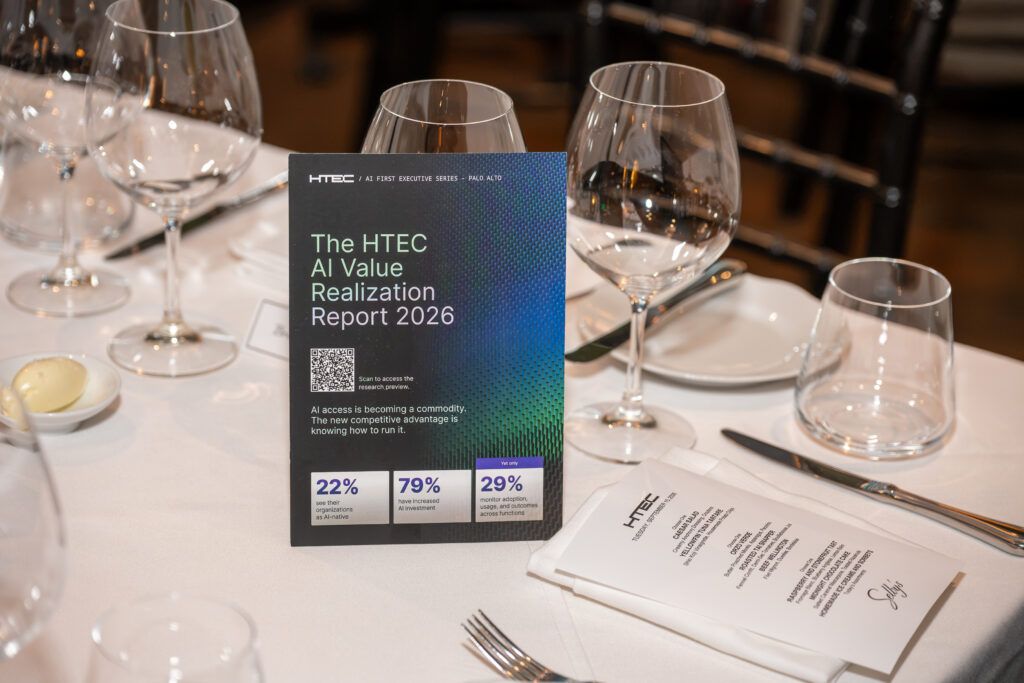
“For all the attention AI receives as a technology challenge, our recently commissioned research suggests a different reality. Seventy-seven percent of executives believe AI value is constrained more by people and processes than technology, highlighting how much of the work still lies beyond the technology itself.” – Lawrence Whittle, CSO, HTEC
Looking ahead
For all the discussion around models, infrastructure, and emerging capabilities, the evening ultimately returned to the question of what it takes to create sustained value from AI.
If there was one point of agreement throughout the evening, it was that no organization has this figured out yet. What made the discussion valuable was the opportunity to compare experiences, challenge assumptions, and learn from organizations tackling similar questions from different angles.
While the path forward remains uncertain, standing still does not appear to be one of the available options. We look forward to continuing these conversations and learning alongside leaders at our upcoming executive dinner in London.