Driver monitoring began with a single question: is the driver paying attention? At Level 3, the vehicle must judge whether the driver is ready to take over, and at Level 4, it needs to understand the entire interior with nobody at the wheel.
That widening scope shaped InCabin Europe 2026 in Barcelona, September 22-24, and it raised a question every OEM and Tier 1 is now weighing: should the industry build one sensing platform that grows with autonomy, or a separate system for every level?
One foundation, many autonomy levels
HTEC’s roundtable “From Monitoring the Driver to Understanding the Cabin” brought together experts from OEMs, simulation, semiconductors, Tier 1 licensing, and cockpit engineering to discuss how in-cabin sensing should evolve alongside increasing levels of vehicle autonomy. Their answer: one sensing platform that scales with autonomy, pairing a camera for visual context with radar for presence detection and steady performance when a view is blocked.
Four conclusions stood out:
- Economics matter as much as technical merit: Sensor and compute requirements should be matched to the needs of each use case to ensure a sustainable business case.
- Trust belongs in the design brief from day one: Successful in-cabin sensing solutions require a clear user benefit and transparent handling of personal data to earn driver and passenger confidence.
- Evidence earns confidence: Simulation and digital twins can help validate rare and complex scenarios, but only when grounded in real-world human data.
- Reuse strengthens the business case: Reusable IP and proven functions allow automakers to spread development costs across vehicle programs and accelerate deployment.
The Demo: Fusion in practice
The same ideas took physical form in a live demonstration that HTEC developed with Tobii, Texas Instruments, and D3 Embedded. Running on Texas Instruments’ TDA4VEN automotive SoC, the system combined camera-based perception with 60 GHz radar for real-time driver and occupant monitoring, with AI models for both running at low latency. The pairing matters for safety. The camera supplies visual context, while radar detects occupants even in darkness or when visibility is obstructed. Together they support child presence detection, intruder detection and broad cabin awareness. The demo also showed that advanced perception workloads can run within the constraints of automotive platforms.
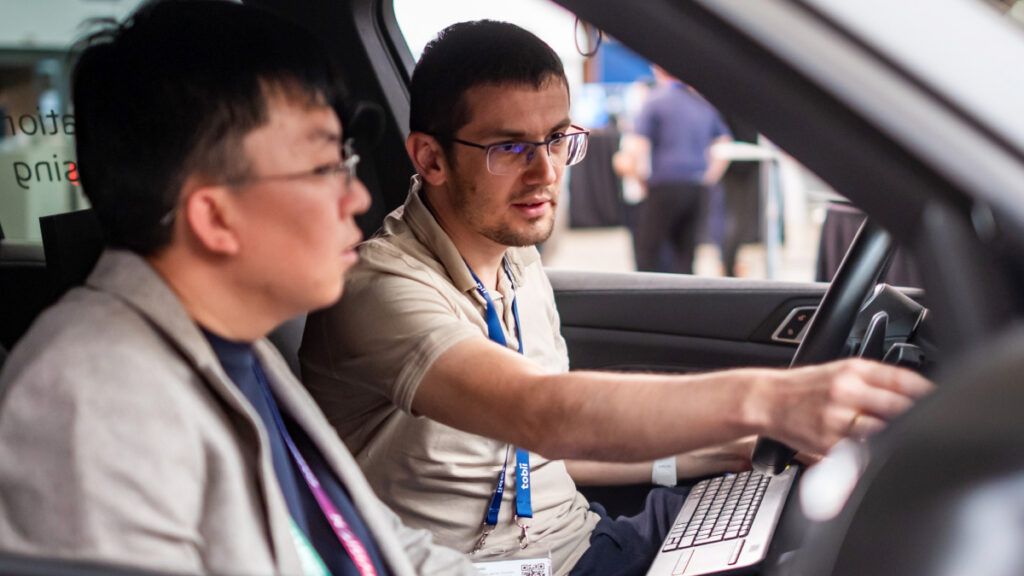
The collaboration among the four companies also offered a practical proof point for conversations about Edge AI, sensor fusion, and production readiness, showing how sensing, embedded hardware, software integration, and AI can be combined into a single in-cabin system.
Where the conversation goes next
The industry is ready to treat the vehicle interior as one coherent system. Camera and radar complement one another on that journey, trust and regulation set the pace of it, and the difficulty of capturing rare safety events makes synthetic data and digital twins valuable complements to real-world evidence. Because semiconductor, sensing, IP, Tier 1, and OEM capabilities still sit in separate places, the field will favor partners who can connect them end-to-end. That is where HTEC’s strength lies: bridging those layers to move customers from sensing technologies and AI models to integrated, production-ready in-cabin systems.