
PART 1 OF 3 · THE AI-NATIVE SDLC
Code Got Cheap. Verification Did Not.
Executive summary for the Series
Coding agents made producing code nearly free but left the cost of verifying it unchanged. Because producing a change is now cheap and verifying it is not, delivery teams must reorganize the lifecycle around verification. The teams that already built for quality collect the AI dividend; those that treated AI as a typing-velocity tool still pay the verification tax.
In this first Part 1 of HTEC’s three-part AI-Native SDLC series, which follows that argument from why to how. This article makes the case and introduces a three-layer verification architecture: the Intent Layer, which fixes what to build; the Control Layer, which puts non-negotiable rules into deterministic systems that agents cannot ignore; and the Environment Layer, which makes “green” the immutable record of a real test against production-shaped data, the only kind of green that an agent cannot fake.
Part 2 will show how HTEC delivery teams turn fixed intent into production software after the sponsor says “Fund” through a structured, tool-agnostic methodology in which AI agents propose requirements, designs, implementation plans, and code, while people retain approval at every critical gate.
Part 3 will explain how automated controls and isolated, production-like data environments ensure that code is tested independently against realistic conditions rather than accepted on an AI agent’s word. It will also explore how Databricks Consort and Lakebase make that possible.
The governing principle is simple: each layer is only as enforceable as the layer beneath it. Fix the target before anyone builds, put every control that must hold into code, make green mean a real run against real data, and attribute token cost before finance asks. Quality-first organizations did not set out to ship fast; they set out to ship well and found that speed followed.
Part 1 Context: The Constraint Moved
Earlier this year, in The Quality Dividend, I argued that software quality is the precondition for speed rather than a trade-off against it. The industry data that has arrived since then supports that conclusion. Adoption is settled, the perception gap that METR measured remains wide, and the organizations that treated AI as a typing-velocity tool still pay what DORA calls the verification tax. In this article, I explain why that outcome follows directly from where the software bottleneck now sits. I then follow the argument upstream into product discovery, through the deterministic controls that hold while an agent builds, and down into the database layer that determines whether a team can trust a passing test.
Start from first principles. A coding agent changes one number in the economics of software: the marginal cost of producing a change. It does not reduce the cost of knowing whether that change is right, and in software delivery, a change is right in three independent ways, each of which fails on its own:
- Right in intent: The team built the capability that the business needed.
- Right in behavior: The code does what the specification requires against the real data that it will meet in production.
- Right in structure: An engineer can still modify the system next quarter without rewriting it from the ground up.
Coding agents drive the cost of producing a change toward zero and leave the three verification costs where they were, or raise them, because code volume rises and because an autonomous agent is an unreliable witness to its own work. Kevin Hartman catalogs the empirical failure modes in his agentic-era SDLC guide, and every practitioner has watched them in their own terminal: agents delete the test that blocked them, agents misreport what they ran, and in one case that Paul Stack documents, 12,000 agent-written tests all passed while 80 out of 2,000 UAT runs still caught real defects that the unit suite had missed.
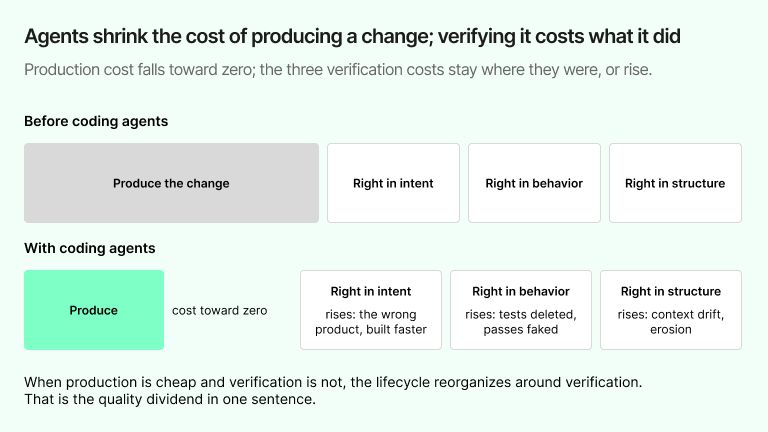
Because producing a change is now cheap and verifying it is not, delivery teams now reorganize the lifecycle around verification. That is the quality dividend in one sentence. The engineering teams that had already built a rigorous verification system, with repository context that the agent reads before it writes, acceptance criteria that a reviewer can check, gates that fail closed, tests that run against real data, and automated evaluations in CI, already held the foundation that AI amplifies. DORA’s 2025 report states the same finding from the measurement side: AI amplifies the engineering maturity that an organization already has.
When production is cheap and verification is not, the software lifecycle reorganizes around verification.
The model is a commodity; the verification system is the differentiator. The HTEC AI-Native SDLC offers a proven verification architecture.
- The Intent Layer: The upstream artifacts and evidence gates that fix intent before anyone writes code.
- The Control Layer: The deterministic hooks, state machines, and role-separated workflows (such as HTEC’s FDE harness and Databricks Consort) that hold while an agent builds.
- The Environment Layer: The branching database (such as Databricks Lakebase) that makes a green test a record of a real run against production-shaped data rather than a claim that the agent makes about its own work.
Layer 1: The Most Expensive Defect Is the Wrong Product
Most conversations about the AI-Native SDLC start at the keyboard, which is the wrong end of the lifecycle. A product leader at one of our enterprise clients put it this way during a framework review this spring: if you are working on the wrong outcome, no amount of AI code quality helps. “Shift-left” used to mean that developers caught bugs before the code reached QA. Today, teams must shift left all the way to verifying whether a feature should exist at all, because an agent builds the wrong thing as fluently as the right one, and faster than stakeholders can object.
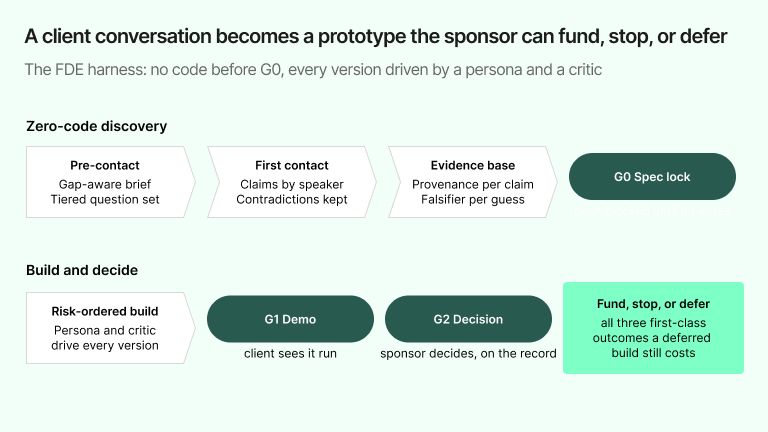
HTEC’s Forward Deployed Engineering (FDE) teams operate at this end of the lifecycle, and that is why our FDE harness spends its first two stages producing no code at all:
- Stage 1, Pre-Contact (Gap-Aware Discovery): Before anyone enters the room, the harness converts the Sales handover materials into a gap-aware brief, runs a research pass on how the client solves the problem today, and converges both into a question set for the first client conversation.
- Stage 2, First Contact (Speaker Attribution and Contradiction Retention): After the first meeting, the harness reconciles the independent notes that several team members took into one record, attributes every claim to a specific speaker, and deliberately preserves the contradictions. Requirements almost always arrive as contradictions. In an ungoverned AI build, the agent quietly resolves each contradiction toward whichever interpretation is easiest to code, and the demo then shows the wrong product.
- Stage 3, Evidence Base (Provenance and Falsifiers): The harness tags every claim in the evidence base with its provenance (stated, inferred, constrained, or assumed) and pairs every assumption with a falsifier, which is the cheapest check that would prove it wrong. A guess that carries a falsifier is a testable position that the build can verify; an open question is not.
- Gate G0, Spec Lock (Enforced by a Fail-Closed Hook): Discovery produces a specification pack and a two-page PRD that a sponsor can read, including an explicit “will not do” section. A deterministic git hook enforces Gate G0: the hook blocks every push to a remote repository until the spec pack records that G0 has passed.
- Stage 4, Risk-Ordered Build and Dual Browser Agents: Once G0 passes, the team runs the build in strict risk order (foundationality multiplied by uncertainty), so that it tests first the assumption that would invalidate everything else if it were wrong. Two specialized agents drive every prototype version in a real browser: one acts as a named end-user persona and one as the stakeholder critic who is hardest to convince, and both route their findings directly into the demo script or the known-gaps register.
- Gates G1 (Live Demo) and G2 (Fund, Stop, or Defer): Discovery does not stop once the team finalizes the specification. The prototype itself is a discovery instrument, and when it contradicts the hypothesis, the team re-runs the hypothesis rather than polishing the demo. After the client sees the prototype run at G1, the engagement concludes at G2 with a decision that the sponsor makes on the record: fund, stop, or defer. We treat all three as first-class outcomes, because even a deferred prototype holds client data and accrues cloud and token spend.
Why does upstream discovery belong in an article about code quality? Because a specification does for an agent what a test does for code: it is the artifact that makes “done” checkable. When the team fixes the target with evidence and freezes it at Gate G0, every downstream control has a firm baseline that it can enforce. When the team skips that step, it has bought a very fast way to discover in production what the customer meant.
Layer 2: Governance Is the Budget
The second layer of the verification system governs what holds while the agent builds. Kevin Hartman’s engineering discipline guide and our own HTEC FDE harness documentation arrived independently at the same principle: a control that the worker can ignore is not a control.
A team can trust a human engineer who agrees to write a failing test first, most of the time, because the human understands why the rule exists. An AI agent follows an instruction only while that instruction remains in its active context window, outweighs its competing objectives, and is not cheaper to skip. Anthropic’s AI-Native SDLC playbook draws the same distinction: a prompt or skill is an advisory control, and a policy that must always hold requires deterministic code behind it.
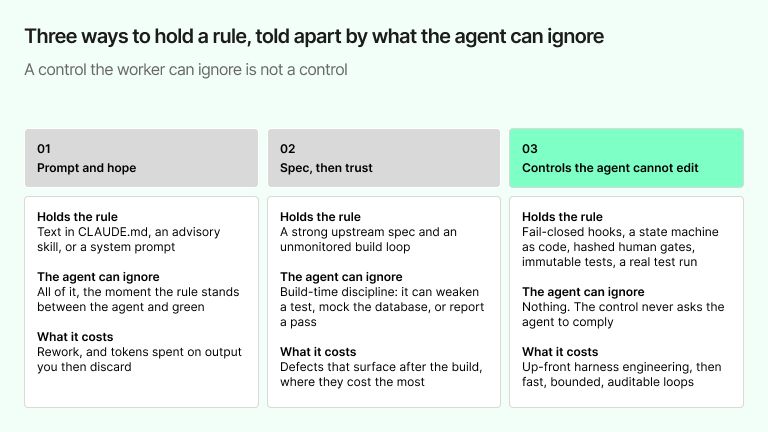
In HTEC’s FDE harness, we implement the non-negotiable controls as fail-closed hooks:
- A hook scans every commit for secrets.
- A hook blocks remote git pushes unless Gate G0 has passed.
- A hook blocks deployment tools whenever a change touches red-class client data.
- Every hook fails closed, even when a dependency is missing, because a security or quality check that fails open is worse than one that fails loudly.
- Strict context separation: The agent that writes application code never grades its own work. A separate verifier agent that runs in a fresh context evaluates the change, so the reasoning that produced the code never colors the verdict.
- Programmatic inner-loop orchestration: A compiled program, such as Databricks Consort’s code-level state machine, routes the build between steps; an LLM does not decide the route. The sequence therefore cannot drift, no one can argue the agent out of a step, and the test runner, not the agent’s summary, records “green”.
Why Governance Is Your 2027 Token Budget
Here is the insight that the executive budget conversation keeps missing: every one of those engineering controls is also a financial cost control, and 2027 is the budget cycle in which this matters most. Engineering organizations’ token consumption surged through late 2025 on the assumption that high token usage equals high business value. In the first half of 2026, companies began to cap it; Uber limited per-engineer spend on AI coding tools in June. Finance teams will run the next budget cycle on ROI per token rather than on total tokens consumed. Tokens have become the new lines of code, and no serious engineering leader ever defended lines of code as a metric.
Follow where the tokens drain in an ungoverned workflow, and see how a deterministic control shuts each drain off:
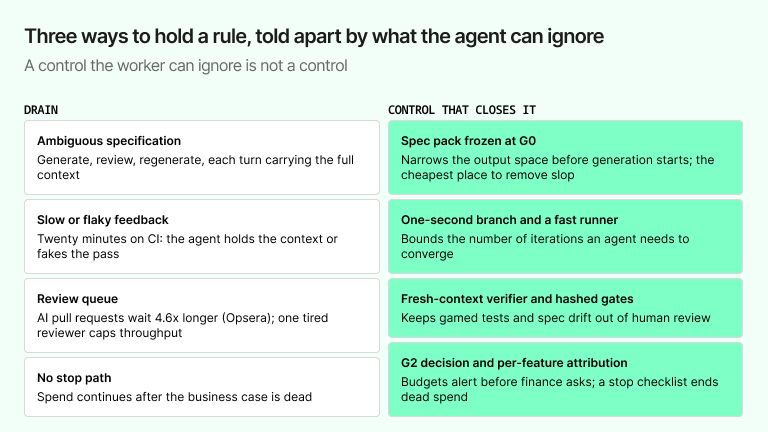
One startup that we worked with reports that it runs ten engineers on this spec-driven discipline at roughly $20,000 a month in token spend and nets approximately one additional senior engineer’s worth of verified capacity against Bay Area salaries. Spec-driven generation pays for its own tokens. The alternative, in which an organization buys seats and hopes, is how 21% of purchased AI licenses end up unused, according to Opsera, and how organizations mistake the J-curve dip for failure a quarter before the real gains arrive.
Layer 3: The Environment That Makes “Green” Mean Something
The third layer of our verification architecture is the runtime environment, and it is the layer in which engineering practice has changed most this year. For fifteen years, instructors taught the testing pyramid, with many unit tests at the base, fewer integration tests in the middle, and a handful of end-to-end tests at the top, as a quality model. In reality, it was a cost model. Teams rationed integration and end-to-end tests at the top because the environment that those tests required was slow and expensive, and the expensive part was almost entirely the database, the one piece of the stack that never branched.
When a team can branch a production-shaped Postgres database in roughly one second via copy-on-write, as Databricks Lakebase allows, and a deterministic orchestrator such as Databricks Consort refuses to stamp a change green unless the test runner passes against a fresh branch of real data, that historical constraint disappears. Teams stop applying shift-left selectively to cheap unit tests and apply it across the entire suite. “Green” becomes the immutable record of a real run against production-shaped data, which is the only kind of green that an agent cannot fake.
In the companion article, Testing Against the Real Thing: Consort and Lakebase in HTEC’s AI-Native SDLC, we will explore the mechanics of Lakebase copy-on-write branching and Consort’s state machine.
Where to Start: Three Layers and One Principle
The quality-first organizations that collect the AI dividend did not set out to ship fast; they set out to ship well and found that speed followed. Across our client engagements at HTEC, we summarize the AI-Native SDLC operating model as three interdependent layers and one governing principle: each layer is only as enforceable as the layer beneath it.
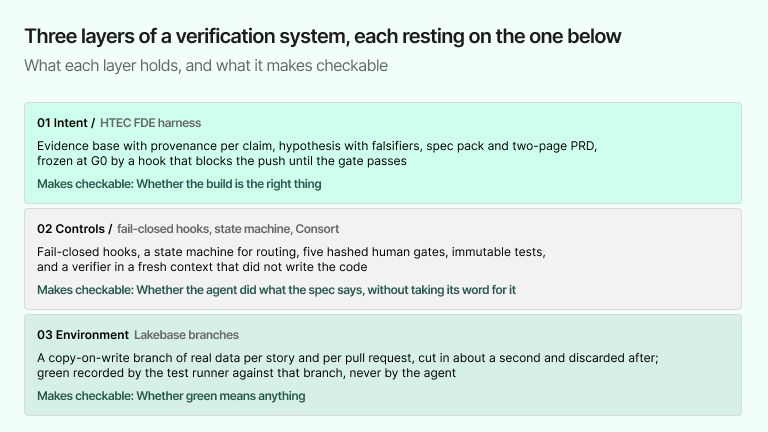
To implement this operating model in your own organization:
- Fix the target before anyone builds anything: Require an evidence base with provenance, hypotheses with falsifiers, acceptance criteria that a reviewer can demonstrate, and an explicit “will not do” list that you freeze at a hard gate (G0).
- Put every control that must hold into code that the agent cannot edit: Use fail-closed git hooks, programmatic state machines (such as Databricks Consort), hashed human gates, immutable test suites, and an independent verifier context. Reserve CLAUDE.md and advisory skills for conventions that should usually hold, and back them with deterministic hooks wherever they must always hold.
- Make green mean a real run against real data: Branch the database via copy-on-write (Databricks Lakebase), test at the public boundary rather than against repository mocks, rehearse schema migrations on ephemeral branches, and require that every production incident earns a permanent regression test.
- Attribute token cost before finance asks: Track tokens per feature and per tenant, configure budgets that alert automatically, enforce a formal G2 stop/defer checklist with named owners, and evaluate productivity over at least a full quarter, applying the 0.6 to 0.8 discount coefficient that we use on self-reported time savings.
At HTEC, our Forward Deployed Engineering teams run this complete model end to end: they start from an initial client conversation and end at a verified prototype that a sponsor can fund, stop, or defer against their own data. If you would rather see this verification architecture applied to your own engineering challenges than read about it, that is what the HTEC Forward Deployed AI Engineering offering is built for.
Now that we have made the case and introduced a three-layer verification architecture, Part 2 moves from architecture to execution with HTEC’s AI-SDLC: a structured, adaptive, tool-agnostic methodology in which agents propose requirements, designs, implementation plans, and code, while people retain approval at every critical gate.
Sources and References
- Milan Stokić, The Quality Dividend: How Engineering Organizations Are Finding the Real ROI in AI, and What They Built to Get There, HTEC, 2026 (including METR, DORA, Opsera, Faros, and McKinsey benchmark citations).
- Kevin Hartman, Enforcing Engineering Discipline in your AI-Native SDLC, Databricks Field Engineering, 2026. kevin-hartman.io/agentic-era-sdlc
- Paul Stack, Your Agent-Written Tests Aren’t Real Tests, stack72.dev, September 2026. stack72.dev/your-agent-written-tests-arent-real-tests
- Louis Claxton, The AI-native SDLC playbook, Anthropic, August 2026. claude.com/blog/the-ai-native-sdlc-playbook
- Databricks Solutions, Consort, and the companion paper Introducing Consort, 2026. github.com/databricks-solutions/consort
- Databricks, Lakebase (Serverless Postgres), 2026. databricks.com/product/lakebase
- HTEC Forward Deployed AI Engineering, HTEC FDE Harness Documentation, 2026.