
A room of executives in Antigua was asked how many would trust AI to approve or deny a loan on its own. One hand went up.
The room had spent three days energized about AI. Banks in the region have used machine learning to inform credit decisions for years. The hesitation was not about whether the technology works. It was about something harder to name, and naming it was what the AI-Ready Banking panel at Volcano Summit set out to do.
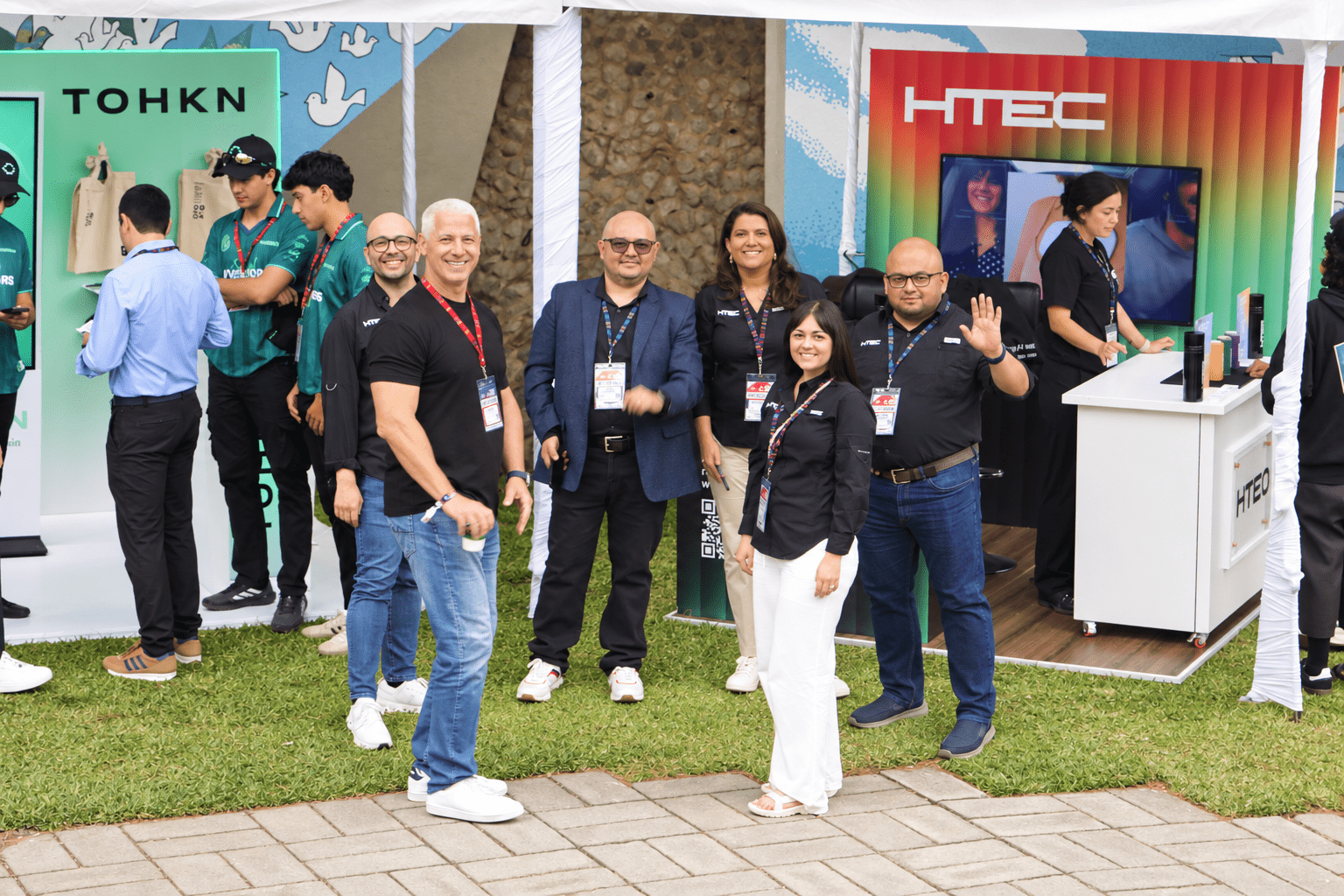
Volcano Summit ran September 5 through 7 in Antigua Guatemala under the theme Echoes of Expansion, gathering founders, investors, and business leaders from across Latin America. HTEC attended as an event partner. Alex Dukic, HTEC’s Chief Digital Officer, led the banking panel with Alejandro Zarate Santovena, Chief Data and AI Officer at Banco Santander Mexico, and Daniel Pérez Umaña, Senior Corporate VP of Legal and Public Relations at BAC LATAM.
Three questions, not three workstreams
The panel organized itself around a single equation. AI Ready = Data x Infrastructure x Governance. Behind each term sits a question that any executive can ask about any system in their organization.
Data: can it work? Data quality sets the ceiling on everything built above it. No model compensates for data that cannot be traced or trusted, and that constraint gets sharper when the data belongs to customers rather than to the institution itself.
Infrastructure: can it scale? A pilot that works once is not the same as a system that runs in production, at volume, for years. Most organizations can build the first. Far fewer have built the second.
Governance: can you stand behind it? Governance designed in from the start is a different thing from governance added as a compliance checkpoint near the end. Organizations that treat it as the latter end up carrying risk they never decided to take on.
The reason it is multiplication rather than addition is the part worth sitting with. Pick two of the three and the result is not two thirds of an AI strategy. If any one term goes to zero, the product goes to zero, no matter how strong the other two are.
The largest echo machine ever built
The panel framed AI as the largest echo machine ever built. A small error does not stay small. It repeats at institutional scale until it becomes a very large problem, and by then it is embedded in decisions already made about real people.
That framing explains the single raised hand better than any argument about model accuracy could. What is changing in banking is not whether machines participate in credit decisions, because they already do. What is changing is how much authority gets delegated to automated systems, and whether the institution can explain and stand behind what those systems produce. Readiness is not whether the first decision is correct. It is whether the institution can defend the millionth one.
Why this is not a banking story
Nothing in that equation is specific to financial services. Swap the loan decision for a diagnosis, an insurance claim, a hiring decision, a dosage recommendation, and the three questions hold without modification. Can it work, can it scale, can you stand behind it.
Banking is simply the industry where the consequences are legible enough that people take the questions seriously. Regulation forces the conversation early. In sectors without that pressure, the same failure modes exist, but organizations tend to discover them later, at higher cost, and with less institutional memory for how to respond.
That pattern showed up across the summit well beyond banking. Attendees from industries far outside the traditional early-adopter sectors were asking the same underlying question the panel wrestled with. Not whether to use AI, but how to build the foundation to use it responsibly at scale.
Guatemala as a platform for regional ambition
For years the conversation about Latin America’s technology sector centered on delivery capacity and cost efficiency, framing the region primarily as a source of skilled talent for companies headquartered elsewhere. That framing is increasingly out of step with what is happening on the ground.
Guatemala is emerging as a strategic anchor within that broader story, offering the talent base and business momentum companies need to scale past their home markets and into the wider region. Global technology leaders still tend to underestimate how prepared Latin America is for this next phase. The region is not waiting for innovation to arrive from elsewhere. It is building the capabilities, the governance discipline, and the ambition to compete on its own terms.
The room in Antigua was not behind on AI. Most of those organizations are past experimentation and into scaling. What stood out was the honesty about the distance between what these systems can already do and what an institution can currently stand behind.
That distance is the actual work.