

The next competitive advantage in retail won’t come from deploying the most AI. It will come from knowing where intelligence creates value, where it doesn’t, and designing the business accordingly.
Retailers have spent the past few years experimenting with copilots, automation and AI-enabled productivity. The next phase will be more consequential. The question is no longer simply where can we use AI? It is where should we use AI, what should it cost, and what business outcome should it improve? At retail scale, that distinction matters.
Decisions are made continuously across products, stores, inventory, pricing, promotions, supply chains, and customers. Applying sophisticated AI reasoning indiscriminately across all of them risks adding cost and complexity without corresponding value. The smarter model is not AI everywhere. It is AI where it makes economic sense.
Move from copilots to outcomes
Much of the first wave of enterprise AI has focused on individual productivity: equip merchandisers, planners, and supply chain teams with their own copilots. Useful, certainly. Transformational, not necessarily. Because faster silos are still silos.
The bigger opportunity is to organize intelligence around the business outcome. Getting the right product into the right location, at the right time, and at the right price can span forecasting, inventory, procurement, supply chain, merchandising, and pricing. The opportunity for agentic AI is not simply to make each activity faster. It is to help coordinate work around the outcome the retailer is trying to achieve.
That shifts the conversation from “how can AI help people perform today’s processes?” to “how should this work happen if we designed it around the outcome?” That is a much bigger transformation.
Not every decision deserves an AI agent
This is where a more pragmatic approach to AI is needed. Retail has decades of investment in algorithms, optimization, statistical modeling, and deterministic systems. AI should complement that intelligence, not automatically replace it.
We believe the more powerful model for retail is hybrid: deterministic where you can, predictive where it pays, and agentic where it matters.
Deterministic where you can. Use established technology for predictable, repeatable, and high-volume activity where additional reasoning adds limited value.
Predictive where it pays. Apply more sophisticated models where greater precision, seasonality, variability, anomalies, or changing behavior justify additional computation.
Agentic where it matters. Bring in deeper AI reasoning when the system encounters an exception, ambiguity, or a decision important enough to justify it.
The principle is simple: use the right level of intelligence for the value of the decision. This isn’t about limiting AI. It is about applying AI with greater economic discipline. Across a retail enterprise, that distinction becomes essential.
From AI adoption to AI economics
Users, licenses, prompts, and agents deployed tell us about adoption. They don’t tell us enough about value. At HTEC, we think a more useful economic lens is emerging: cost per decision versus value per outcome.
Consider how that plays out across the business. Large volumes of predictable decisions can be handled efficiently using established systems and models. A smaller number may benefit from greater predictive sophistication. A smaller set again, involving high-value, complex or unusual situations, may justify advanced agentic reasoning. The objective becomes matching computational effort to economic value.
This moves the discussion beyond AI adoption towards something much more important: AI economics. And it puts architecture firmly on the CFO agenda, because at enterprise scale, architecture is economics. The value of AI ultimately depends on whether its capabilities justify the economics of using it.
You cannot build an agentic enterprise without redesigning the operating model around it
When AI starts coordinating work across functions, the technology may change faster than the organization around it. Who owns the outcome? Who owns the economics? Where are decisions made? What remains a human responsibility? How should performance be measured? What needs to change about roles, processes, and governance?
These aren’t primarily model considerations. They are operating model decisions. AI transformation, therefore, has to connect business strategy, process redesign, engineering, change management, governance, and economics. And change management cannot be something that happens after the AI is built. It needs to be part of the architecture of the transformation itself.
The same is true of governance. Transformation needs to balance offense and defense: creating new value while establishing the legal, security, data, infrastructure and governance boundaries necessary to operate AI responsibly at scale. Building the technology is only part of the challenge. Intelligent systems also require the organization itself to evolve. You cannot simply place an agentic technology layer on top of yesterday’s operating model and and expect everything else to fall into place.
Strategy and engineering can no longer live apart
Traditional transformation programs often separate strategy from implementation. One group decides what should happen. Another builds it. AI makes that separation increasingly difficult because organizations don’t know everything before they begin.
Real deployment creates new evidence. How are people actually using the technology? Where are the unexpected exceptions? Which assumptions were wrong? Where is value emerging? Which processes need redesigning? That learning needs to flow back into strategy.
The model becomes:
Strategy → Engineering → Deployment → Evidence → Strategy
And then around again.
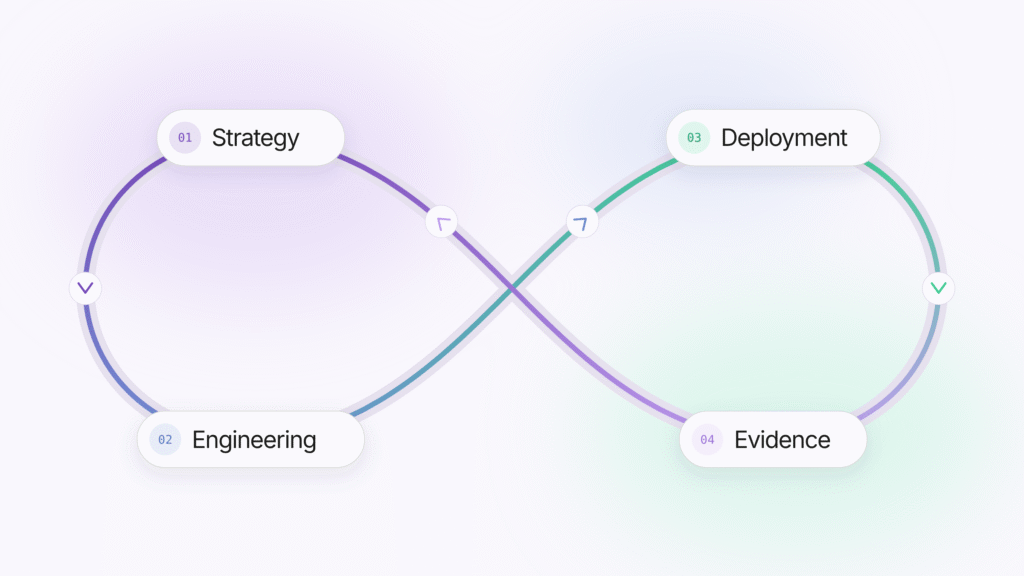
This requires a different relationship between business strategy and engineering. It needs people capable of operating between the two: understanding business outcomes, challenging assumptions, working alongside technology teams, and translating what is learned through deployment back into strategic decisions. At HTEC, this is central to how we think about Forward Deployed Experts. Their most valuable question isn’t always “what AI can we build?” Sometimes it is “should we be using AI here at all?”
AI started as a productivity conversation. It is becoming a business strategy conversation.
For the past few years, much of the focus has been on individual productivity and operational efficiency. That was a natural place to start. But once AI begins changing how work is organized, how decisions are made, how capital is allocated, how operating costs behave and where value is created, it can no longer be treated simply as another technology program.
The implications extend considerably further. How should the organization work? Where should decisions sit? Where should humans remain in control? How does the business allocate intelligence to opportunities? And ultimately, how does that intelligence translate into growth, margin and enterprise value?
For senior retail leaders, the conversation therefore needs to move beyond “where can AI make us more productive?” towards “how would we design this business differently if intelligence were embedded into how it operates?” That is not simply a CIO or CTO question. It is a CEO, CFO and board-level question about how the retailer competes.
The HTEC perspective
At HTEC, we believe success in retail will depend less on the number of agents deployed, the size of the models used, or the level of AI adoption, and more on knowing where intelligence creates real value.
Our approach starts with four principles:
- Start with the outcome, not the technology.
- Use deterministic systems where you can, predictive models where they pay, and agentic reasoning where it matters.
- Measure the economics of intelligence, not simply the adoption of AI.
- Redesign the operating model around the outcomes AI makes possible.
This means bringing strategy and engineering together. It means measuring economics alongside technical performance. And it means continuously using what is learned from deployment to determine where intelligence should be applied next.
We are seeing this firsthand in our work with large enterprise retailers in the US and UK. As organizations recognize that strong technology is necessary but only delivers value when people, processes and operating models evolve with it, success increasingly means bringing multiple disciplines together to address the business and technology challenge as a whole – an approach reflected in how HTEC’s Forward Deployed teams work.
This also invites us to consider what comes next: what does the P&L of an AI-driven retailer eventually look like when the economics of work can increasingly be traced from the cost of intelligence to the value of an outcome? That is where the conversation is heading.
Retail doesn’t need AI everywhere.
It needs the right intelligence everywhere.
Knowing the difference may become one of the most important competitive capabilities a retailer can build.