
PART 3 OF 3 · THE AI-NATIVE SDLC
The database was the last part of the stack that did not branch. Here is what changes when it does.
Executive summary
AI has dramatically accelerated software production, but confidence in what it produces still requires deliberate engineering. Across this three-part series, HTEC examines how teams can preserve that confidence by establishing clear intent, constraining how agents work, and validating the outcome under realistic conditions.
Part 1 traced the delivery bottleneck from code generation to verification. It introduced a three-layer architecture that defines the right outcome before development begins, embeds non-negotiable controls into the build process, and tests the resulting software in an environment that reflects production.
Part 2 showed how this architecture becomes a repeatable delivery practice. HTEC’s AI-SDLC gives agents room to propose requirements, designs, implementation plans, and code, while keeping people responsible for the decisions that move work through each critical gate.
This final article brings the three layers together and shows how teams can turn confidence into evidence. It explores how Consort keeps the development and testing process disciplined, while Lakebase gives teams realistic, isolated data environments whenever they need them. Combined with HTEC’s FDE harness, they connect validated business intent with software tested under real-world conditions. In this way, HTEC and Databricks help teams trust that faster AI-assisted delivery does not come at the expense of quality, control, or confidence in the final product.
Part 3 Context: The Database Assumed a Human
Lakebase For Dummies opens with an observation that explains why so many AI engineering initiatives hit a wall: every traditional database was “built around the core assumption that a human was in the loop.” For four decades, that assumption held. A person logged in, ran a query, applied a change, or filed a ticket to get a test environment.
That assumption does not hold for AI agents. A coding agent creates a database, runs an experiment, sets up several test environments in parallel, and discards all of it in seconds, with no schedule, no administrator, and no ticket. The figures behind this shift are large. According to the 2026 State of AI Agents telemetry that Lakebase For Dummies cites, AI agents now create 80 percent of all databases on Neon, the engine underneath Databricks Lakebase, up from 27 percent two years earlier and 0.1 percent in 2023, and they create 97 percent of all database test and development environments. The human in the loop is no longer the common case; it is the exception.
In Part 1 of this series, Quality First Wins: Code Got Cheap. Verification Did Not, we explained how coding agents move the bottleneck of software delivery from writing code to checking it, and how HTEC’s AI-Native SDLC organizes around three layers of verification:
- The Intent Layer (HTEC FDE harness): The harness fixes business intent at Gate G0, before anyone writes code, using evidence whose source is clear and assumptions that the team can test.
- The Control Layer (hooks and state machines): Automated checks that the agent cannot edit or bypass hold while it builds.
- The Environment Layer (delivery stack and branching database): The delivery stack gives every change its own realistic copy of production: trunk-based development, a CI/CD pipeline, short-lived test environments, feature flags, and a database that branches like code. In that environment, a passing test is a record of a real run rather than a claim that the agent makes about its own work.
This article focuses on how the second and third layers work together in practice, and how two engineering solutions from Databricks, Lakebase and Consort, fit into HTEC’s delivery model so that a green build means what it says.
The Testing Pyramid Was Always a Cost Model
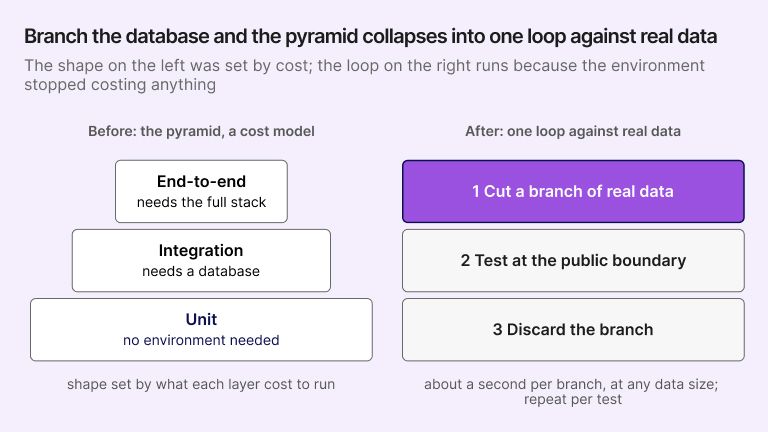
For fifteen years, instructors have taught the testing pyramid as a quality model: thousands of small, fast unit tests that check one function at a time at the base, fewer integration tests that check how components work together in the middle, and a handful of end-to-end tests that exercise the whole system at the top.
It was never a quality model. It was a cost model. Teams put unit tests at the base because those tests needed no environment and were cheap, fast, and predictable. Teams rationed the realistic tests at the top because those tests were slow, flaky, and expensive, and the database accounted for almost all of that expense. Code got version control, compute got containers, and infrastructure became code that a team can recreate on demand, while the database remained a single shared copy that teams tiptoed around with three workarounds:
- Stand-ins for the database: The test code talks to a fake database that answers as the developer expected. It proves that the code asked the right question, not that the real database would give the right answer.
- Hand-made sample data: Engineers write small sets of sample rows by hand. Those samples drift from the shape and volume of real production data on the day someone writes them.
- One shared staging environment: Every developer and every agent waits in line for the same test environment, and it still fails to resemble production because its data is synthetic or stale.
Teams tolerated those compromises because the alternative, in which they copied terabytes of production data for every test run, took hours to set up and cost too much to store. For a human team that shipped once a week, that was a manageable trade-off. For an agent that runs experiments in parallel, throws them away, and repeats hundreds of times a day, a shared database is a brick wall.
Databricks Lakebase: A Database That Branches Like Code
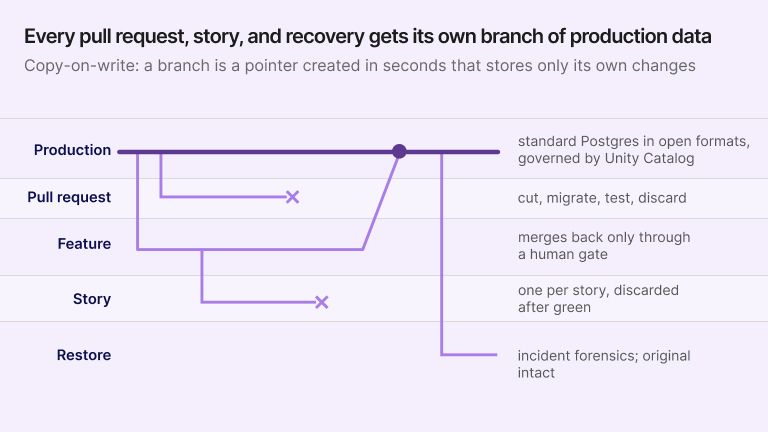
Databricks Lakebase removes the database constraint rather than working around it. Lakebase treats a database the way version control treats code. A team can take a copy of the production database in about a second, however large it is, work on the copy, and throw it away. The copy shares the original’s data until something changes, and stores only the differences, which is why it costs almost nothing to create and to keep.
Because a copy takes about a second whether the database holds a gigabyte or several terabytes, a team can give every change its own copy. Each copy is fully isolated, carries the same access permissions as the original, and costs nothing in compute while idle, which the Consort documentation and Kevin Hartman’s guide both describe.
Lakebase creates an isolated, production-like database in seconds and uses zero compute when idle.
When a realistic copy of production costs one second and almost no storage, the reason to test against stand-ins disappears. You test where the real information lives: against real rows, through the same interface that the application uses. You prove that the system handles a duplicate record in the only way that you can: you insert the duplicate and watch the application deal with it.
Lakebase is standard Postgres rather than a modified version of it, so every tool that a team already uses with Postgres works unchanged.
Every Kind of Test Moves Earlier
Collapsing the pyramid does not mean turning it upside down. It means that teams stop reserving early, frequent testing for the cheap tests and apply it to every kind of check:
- The team rehearses database changes: Before a change to the database structure touches production, the team runs it against a copy of real data and confirms that it can reverse every step.
- The build checks structural rules: Rules about how the system is organized and how data must stay consistent run on every build, and they stop the build when they fail.
- The team measures performance on real data: The team measures how fast queries run against the real volume and distribution of data, not against a test box that someone loaded with made-up rows.
- The team tries design choices instead of arguing them: A team can build two competing versions on two copies, run the same tests against both, and keep the one that wins, cheaply enough to do it as a matter of routine.
Some limits remain, and they are worth stating plainly: tests still take time to run, an agent’s output still varies from run to run and needs a fixed process around it, and outside services and the system clock still need stand-ins because nobody can copy them.
What is gone is the constraint that shaped testing for fifteen years: the cost of a realistic environment. With Databricks Lakebase, the shape of a test suite can now follow where the information is rather than where the infrastructure budget was.
Databricks Consort: The Controls the Agent Cannot Edit
A realistic environment does not stop an agent from manipulating its tests. The failure modes that the industry has documented, in which an agent deletes a test that blocks it, weakens a check until the code passes, or reports a pass when the tests failed, happen just as readily against a copy of real data as against a stand-in if the agent controls the tests. The rule from the companion article applies in full: a control that the agent can ignore is not a control.
Databricks Consort is the enforcement layer that Databricks built on top of the branching database. It holds the controls outside the agent’s reach:
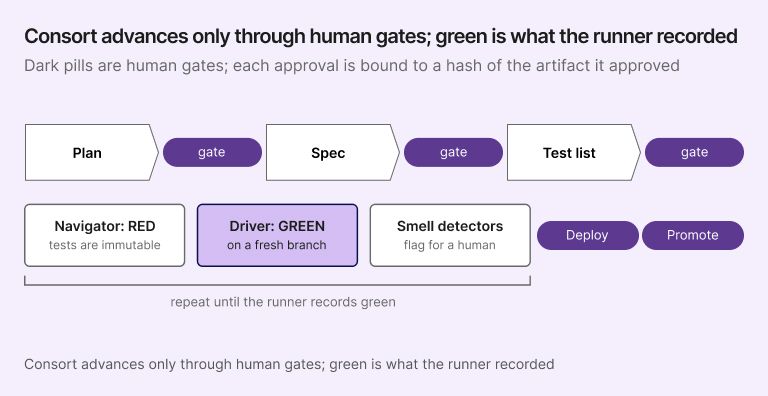
- Separate agents that cannot see each other’s reasoning: Consort splits the work among single-purpose agents. One agent writes the test that defines done; a different agent writes the code to pass it. The agent that writes code never grades its own work.
- A fixed sequence, not a conversation: Databricks wrote the process that moves work from step to step as ordinary program code rather than as instructions to a model. No one can talk it out of a verification step, and it does not forget where it is when a long session runs out of memory.
- Five approvals that a named person gives: Five points in the process, the plan, the specification, the list of tests, deployment, and promotion to production, stay locked until a human approves them. Consort records each approval against the exact document that the person saw. If anyone changes that document afterward, the record shows it.
- Tests that the coding agent cannot touch: Within a unit of work, nobody changes the tests. The agent that writes the code cannot edit or delete them, and automated checks catch any attempt to manipulate them and raise it to a person rather than fixing it quietly.
- Green that only the test runner can award: A change counts as passing only when the test runner passes against a fresh copy of real data that Consort takes for that check. Every production incident earns a permanent test so that it cannot recur unnoticed.
The result, as Kevin Hartman puts it, is that testing stops being a separate phase that happens after the code is written. Writing the code and proving that it works against real data becomes the same event.
Where This Fits: HTEC, Consort, and Lakebase Together
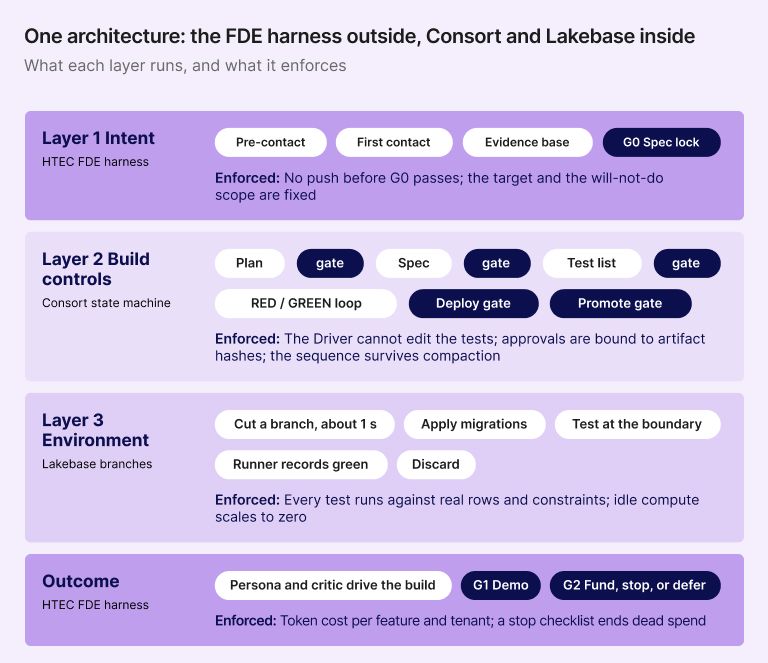
How do HTEC’s FDE harness, Databricks Consort, and Databricks Lakebase fit together?
- HTEC’s FDE harness governs the engagement: It runs client discovery, records who said what and keeps the contradictions, fixes the specification at Gate G0, orders the build by risk, drives every prototype version with two review agents that play a named user and the hardest critic in the room, attributes token cost per feature, and ends with the sponsor’s decision to fund, stop, or defer.
- Consort governs the build: Once Gate G0 fixes the specification, Consort enforces the five human approvals and the separation between the agent that writes the tests and the agent that writes the code.
- Lakebase provides the environment: It supplies the one-second copies of production data that give Consort’s test runner and HTEC’s demos a signal that an agent cannot fake.
What the Pair Unlocks, and Two Points to Note
Consort’s fixed process and Lakebase’s one-second copies together let an agent run on its own for longer without loosening any control. When a team combines them with a modern delivery pipeline, in which the pipeline gives every proposed change its own copy of production data, rehearses the database changes, runs the full test suite, and throws the copy away, and in which agents deploy freely to development but cannot approve a production release, the build loop stops waiting on anything that moves at human speed except the five approvals. The agent runs unattended for longer because every control that it meets is fast, automatic, and runs against real data.
Two points about the tools themselves:
- Focused scope: Databricks built Consort for the kind of application that reads and writes records in a Postgres database, not for large batch data pipelines, and it is a young project.
- No vendor lock-in: Neither tool traps your architecture. Consort runs against standard Postgres and does not require Lakebase, and because Lakebase is standard Postgres, a team can develop and test on Lakebase copies today and deploy the same application to any Postgres database tomorrow with nothing from Databricks in what ships.
The pattern carries over to every technology stack:
- The team fixes intent with evidence and testable assumptions before anyone writes code (HTEC FDE Gate G0).
- The database branches like code (Lakebase).
- A test runner, not the agent, decides what passes, against real data, and the rules of the build live in program code rather than in instructions to a model (Consort).
Where you buy your branching database is a purchasing decision. Whether you build your AI-Native SDLC on those three properties is an engineering decision and it determines whether your coding agents produce verified software or expensive volume.
At HTEC, our Forward Deployed Engineering teams run this model end to end: they start from an initial client conversation and end at a working prototype that a sponsor can fund, stop, or defer, which the team builds and tests against the client’s own data rather than a synthetic stand-in. If you would rather see a concept turned into verified code against your own business problem than read about it, that is what the HTEC Forward Deployed AI Engineering offering is for.
Sources and References
- Stephanie Diamond, Lakebase For Dummies, Databricks Special Edition, Wiley, 2026 (including the 2026 State of AI Agents database provisioning telemetry).
- Kevin Hartman, Enforcing Engineering Discipline in your AI-Native SDLC, Databricks Field Engineering, 2026. kevin-hartman.io/agentic-era-sdlc
- Databricks Solutions, Consort, and the companion paper Introducing Consort, 2026. github.com/databricks-solutions/consort, arxiv.org/abs/2609.09671
- Databricks, Lakebase (Serverless Postgres), 2026. databricks.com/product/lakebase
- Louis Claxton, The AI-native SDLC playbook, Anthropic, August 2026. claude.com/blog/the-ai-native-sdlc-playbook
- Milan Stokić, Quality First Wins: The AI-Native SDLC from Why to How (Code Got Cheap. Correctness Did Not.), HTEC, 2026 (Part 1 of this series).
- HTEC Forward Deployed AI Engineering, HTEC FDE Harness Documentation, 2026.