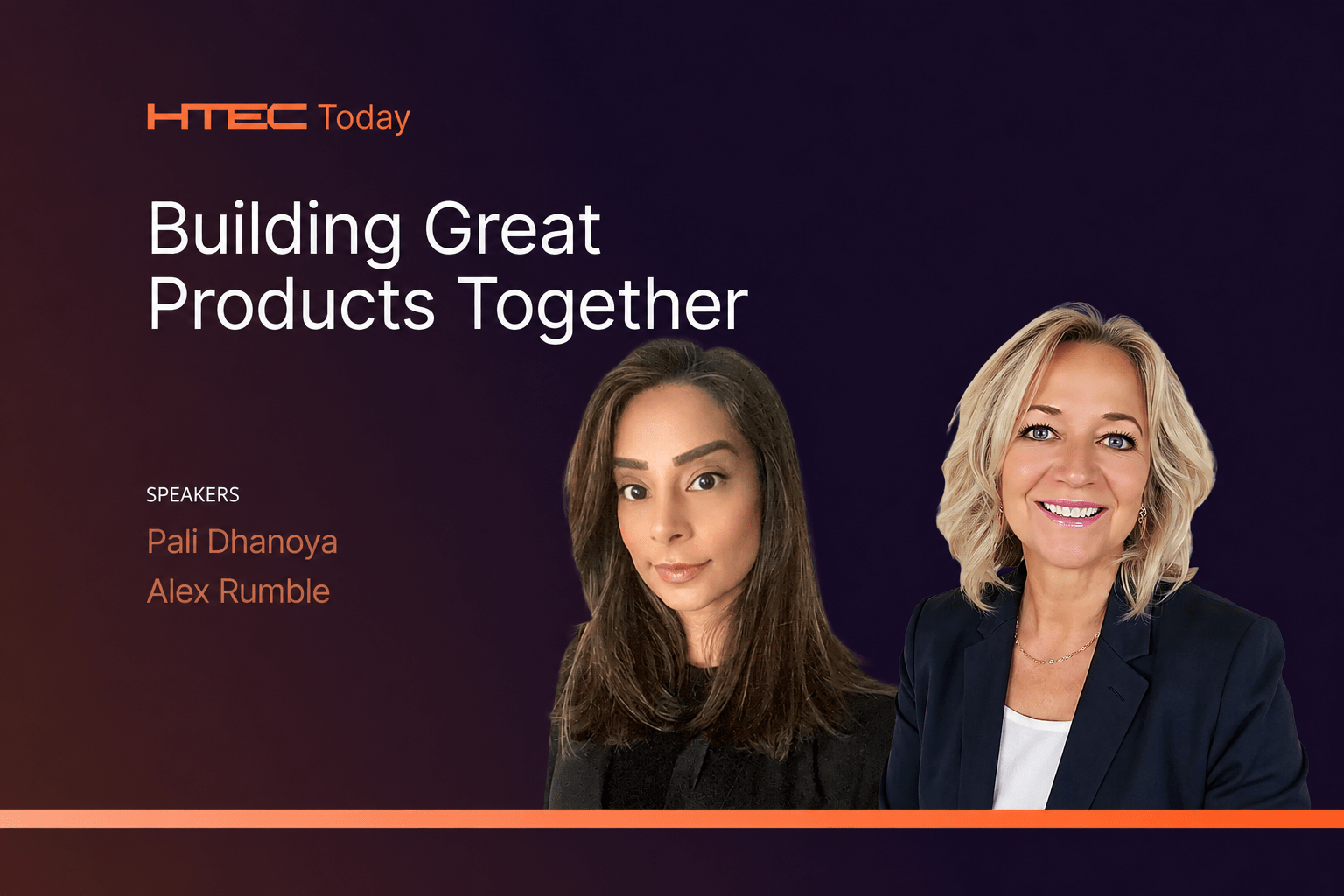
In a recent conversation with HTEC Today, Pali Dhanoya, Head of Product Management, lays out a principle that sounds almost too simple on the surface, yet holds a surprising amount of structural weight once you dig into it: bring every function into the room from day one. Product, design, engineering, and the client working side by side, with no relay-style handoffs and no discovery phase that happens off to the side before quietly dropping a brief into everyone else’s lap. It reads like a straightforward operating rule, but underneath it is a much bigger claim about how products actually get built, and why organizations still relying on sequential workflows keep losing ground without quite pinpointing the cause.
Alignment as an architectural choice
According to Pali, the non-negotiable ingredient is a shared mental model, a collective understanding of what “good” actually means, agreed on before anyone writes a line of code or places a single pixel. That means real consensus on what quality looks like in a given context, whether that’s speed, clarity, or a sense of emotional reassurance for the person using the product, and it needs to exist before work starts, not after.
Fragmented, inconsistent digital products are rarely the result of any one team executing poorly. Far more often, the real cause is that different teams are each chasing their own private interpretation of the goal, everyone working hard, just toward slightly different endpoints. Getting that shared understanding locked in early is what keeps the final product from revealing its internal seams to the end user.
How AI is shrinking the gap between insight and action
The classic development cycle keeps a wide gap between a user insight and a tested, working concept, often stretching across weeks or even months. Insights get synthesized, then handed off to become concepts, which get handed off again into prototypes, which get handed off once more for validation. Each transfer costs momentum, and the original context gets a little blurrier every time, so by the time a decision actually gets made, what started as a fresh insight has become secondhand information.
Embedding AI simultaneously across discovery, design, and delivery closes much of that gap. Synthesis happens faster, pattern recognition can run alongside discovery instead of waiting for it to finish, and concepts get pressure-tested against current data much earlier in the timeline. Pali is precise about where AI actually adds value: it strips out the mechanical, repetitive work so human judgment can operate on sharper information with far less delay. But the pivotal moments in a product’s life are still fundamentally human territory, choosing a direction at a critical juncture, winning over a skeptical stakeholder, or navigating a tradeoff no algorithm or prioritization matrix can fully resolve on its own. What actually shifts is how much low-value execution work surrounds those moments, and consequently, where your strongest people end up spending their time.
Designing for targets that keep moving
Pali is openly skeptical of the reassurance a fixed roadmap seems to offer, and it’s not simply a preference for staying agile. A roadmap anchored to one source of truth, be it a single stakeholder’s view, one dataset, or a research sprint wrapped up months earlier, will accurately describe a reality that has already moved on. The pace of technological change is fast enough now that assumptions baked into a sprint plan in Q1 can be flatly wrong before that sprint even wraps.
Deliberate, ongoing discovery keeps new insight flowing into the process continuously, rather than dumping it all into an early phase the rest of the project gradually drifts away from. Our teams operate in close proximity to the client, frequently embedded directly within their environment, which means signals arrive in real time instead of surfacing weeks later in a scheduled check-in.
That closeness isn’t incidental, it’s a deliberate part of the operating model, and it functions as a genuine strategic edge, one that lets organizations make sharper decisions, adapt more quickly, and keep their products coherent even as the ground shifts underneath them.
The strongest products don’t emerge from a sequence of handoffs. They come from the right people tackling the right problem together, starting on day one. If that’s the kind of collaboration you’re after, let’s talk.