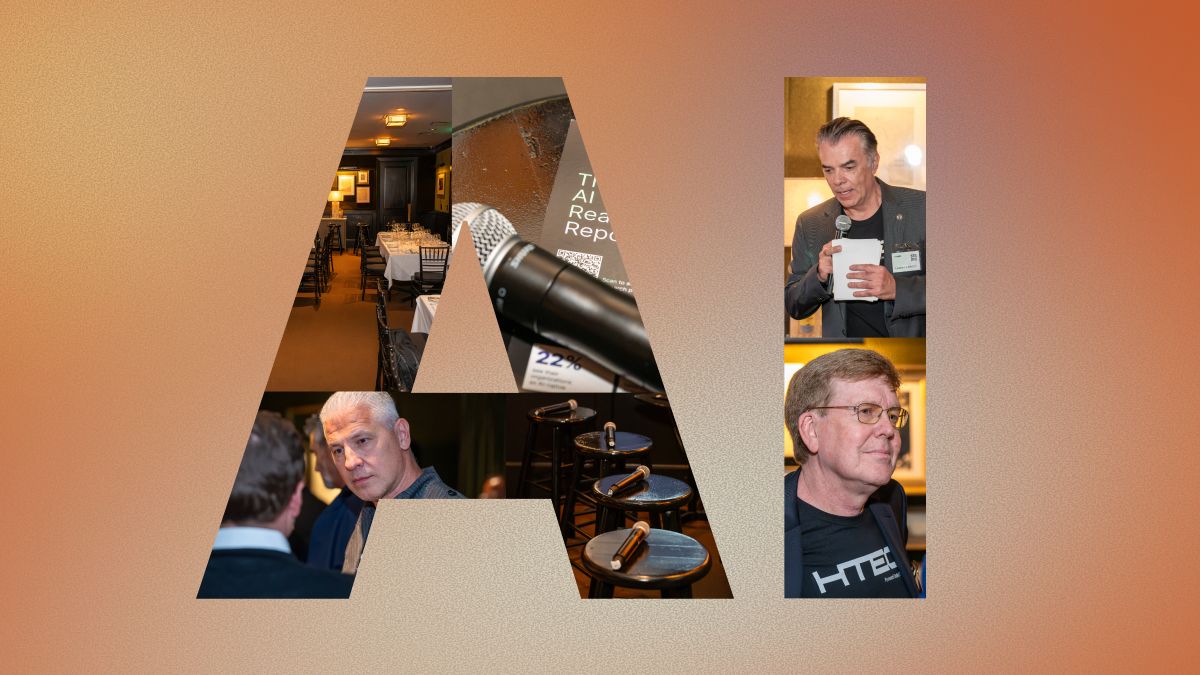

While the industry debates whether AI will replace developers, Tim Sears, HTEC’s Chief AI officer, shares the story of how HTEC quietly built something more disruptive: a system that makes the entire argument irrelevant.
AI-powered transformation has become the most expensive theater in business today.
Consulting firms lead lengthy discovery phases that produce beautiful slide decks—which promptly gather dust. Prototypes dazzle business leaders and then get rebuilt from scratch when engineering starts. Requirements are translated and retranslated at every handoff until the final product bears little resemblance to what anyone originally asked for.
The dirty secret of enterprise software? Most programs fail not because of bad technology, but because insight evaporates between stages. Context is dying in the gaps. And companies pay for it—in extended timelines, in stakeholder trust, in the erosion of competitive position.
Now multiply that dysfunction by the speed of AI.
The market is awash in tools that promise to accelerate everything. Prototype in a weekend. Generate code in minutes. Ship faster than ever before. The benefits are real, but don’t accrue to the companies that pay for them. The tools have the power to create coding cowboys, but how much does the team benefit?
But here’s what the breathless press releases don’t mention: speed without structure is just failure at scale.
A prototype built on shallow understanding isn’t a shortcut—it’s a technical debt instrument. And AI is making it possible to accumulate that debt faster than ever.
HTEC looked at this landscape and asked a different question. Not “how do we go faster?” but “how do we make speed trustworthy?”
The HTEC answer is a delivery engine that’s quietly redefining what’s possible in enterprise software development.
The $25 Problem
Here’s the uncomfortable truth the AI industry doesn’t want to discuss: execution has been commoditized.
A developer with a $25 Cursor license can generate working code in one weekend. A product manager with ChatGPT can produce requirements documents in hours instead of weeks. The raw act of creation has never been cheaper.
But cheap execution is a trap.
When anyone can generate artifacts at machine speed, the bottleneck shifts. It’s no longer about can we build this—it’s about should we build this, and can we trust what we built. Those are judgment questions. And judgment doesn’t scale with computing power.
Most organizations responded to the AI moment by buying tools. HTEC responded by building a system—one that treats AI as infrastructure, not magic. The difference is everything.
Inside the Engine
What HTEC created isn’t a product. It’s a delivery pipeline that carries context from the first stakeholder conversation to production code, with governance embedded at every stage. With execution time reduced, the focus shifts to maintaining clarity.
Five phases. Each with defined outputs. Each validated before the next begins. Each traceable back to its origin and forward to its dependencies. If there’s a misstep, development can resume from a known good place. In the tech world, that’s known as checkpointing.
Discovery doesn’t just produce insights—it produces a structured business narrative with quantified pain points, validated personas, and an ROI model that can withstand board-level scrutiny. Clarity.
Prototyping doesn’t just produce screens—it produces implementation-aware designs where every element traces to a requirement, and accessibility is built in from day one, not bolted on at the end. Accountability.
Specifications don’t just describe what to build—they hand engineering a sprint-ready backlog with API contracts, test cases, and story points already sized. No reinterpretation required. Efficiency.
Architecture doesn’t just document decisions—it surfaces technical risks before they become production incidents. Responsibility.
Implementation doesn’t just produce code—it produces code with 97%+ task completion, automated tests at every layer, and a validation report that proves the pipeline works. Trust.
The secret sauce isn’t any single stage. It’s the traceability that connects them all. A test case can be traced to the screen it validates, to the requirement that demanded it, to the job-to-be-done that justified it, to the interview where a stakeholder first described the pain.
In an era of AI-generated everything, that chain of evidence is the difference between an artifact and an asset.
The Proof That Silenced the Skeptics
Theory is cheap. HTEC proved the engine on a real modernization: a recruitment platform supporting 85 hiring managers across multiple departments, with workflows fragmented across the applicant tracking process, an outdated career site, and all that friction that implies.
What emerged wasn’t a demo. It was a complete, validated chain of artifacts—and working production code.
The discovery phase produced what most technical projects never achieve: an executive-ready business case. Six personas. Thirty-four jobs-to-be-done. Quantified goals—candidate status visibility in under 2 clicks, offer generation under 90 seconds, 58% reduction in recruiter administrative overhead. And the number that matters in boardrooms: $720K+ annual benefit from reduced time-to-fill and eliminated agency dependency, 89% three-year ROI, 16-month payback.
That’s not a slide deck estimate. That’s a traceable calculation built into the pipeline itself.
The prototype delivered 16 screens across mobile and desktop, with accessibility requirements baked in—swipe-to-advance for recruiters reviewing candidates between meetings, interview scheduling flows calibrated to real calendar chaos. The prototype becomes the first artifact in the delivery chain, not a throwaway demo that engineering ignores.
The specifications produced a sprint-ready backlog: 14 modules, 19 API endpoints with contracts, 78 test cases, 210 story points. Engineering hit the ground running. The Jira import took hours, not weeks.
The implementation delivered 52 source files, 34 React components, 71 passing tests. P0 completion: 96.4%. The code includes real-time pipeline sync and SLA tracking codified—not documented, implemented.
This isn’t vaporware. It’s not a pitch deck. It’s proof that the engine works at enterprise scale.
Why Global Technology-Enabled Enterprises Should Pay Attention
Every year, global leaders gather to debate the future of AI. Will it replace jobs? Augment workers? Destroy industries? Create new ones?
Those debates miss the point.
The real question isn’t whether AI will transform business—it’s who will capture the value when it does.
Right now, most enterprises are experimenting. They have innovation labs running pilots. They have teams building impressive demos. But ask them to ship to production with SOC 2 compliance, audit trails, and team continuity—and watch the silence.
The gap between AI experiment and AI capability is where competitive advantage lives. And most companies are stuck on the wrong side of it.
HTEC’s engine isn’t just faster. It’s auditable—with GDPR and SOC 2 data collection, as an example, built into the workflow, not bolted on after. It’s governable—with validation gates that prevent garbage from cascading downstream. It’s scalable—with outputs consistent enough to replicate across domains, industries, and teams.
For CEOs: this is the difference between digital transformation as theater and digital transformation as strategy. When discovery takes days instead of months, you can validate hypotheses before committing serious capital.
For CFOs: this is ROI you can trace. Not projections—calculations linked to validated requirements, linked to quantified pain points, linked to actual stakeholder interviews.
For Chief AI Officers: this is what responsible AI deployment actually looks like. Not governance as a checkbox—governance as architecture.
For CTOs: this is how you staff projects with confidence. The framework guides quality. The traceability enables impact analysis. The risks surface before implementation, not after.
The Strategic Inflection Point
Here’s what makes this moment different from every previous wave of enterprise technology.
In the past, competitive advantage came from having capabilities others lacked. Better tools. Better talent. Better processes.
In the AI era, the tools are commoditized. The talent market is chaotic. And processes built for human-speed execution break down at machine speed.
The new advantage comes from operationalizing AI at enterprise scale—not just using it, but integrating it into delivery systems that preserve judgment, governance, and accountability.
HTEC has built that system. The foundation is proven. The next phase is scaling across domains—healthcare, finance, logistics—and deepening integration with enterprise ecosystems.
But the strategic insight is simpler than the technology: treat this as a market-facing asset, not an internal efficiency play.
The enterprises that figure out AI-powered delivery will set the pace for their industries. The ones still running pilots will find themselves explaining to boards why competitors are shipping in weeks what used to take years.
The Bottom Line
The AI discourse is dominated by two camps: utopians who believe the technology will solve everything, and skeptics who believe it’s mostly hype.
Both are wrong.
AI doesn’t solve problems. It amplifies whatever system it’s embedded in. Feed it chaos, and you get chaos at scale. Feed it structure, and you get leverage that was previously impossible.
HTEC chose structure. The result is a delivery engine that resolves the oldest trade-off in enterprise software: speed versus accountability.
The enterprises that adopt this model won’t just move faster. They’ll move faster in the right direction—with governance that satisfies regulators, traceability that satisfies auditors, and outcomes that satisfy boards.
The ones that don’t will keep running transformation theater. And they’ll keep wondering why the results never match the slide decks.
The engine exists. The proof is documented. The question now is simple: which side of the disruption do you want to be on?