

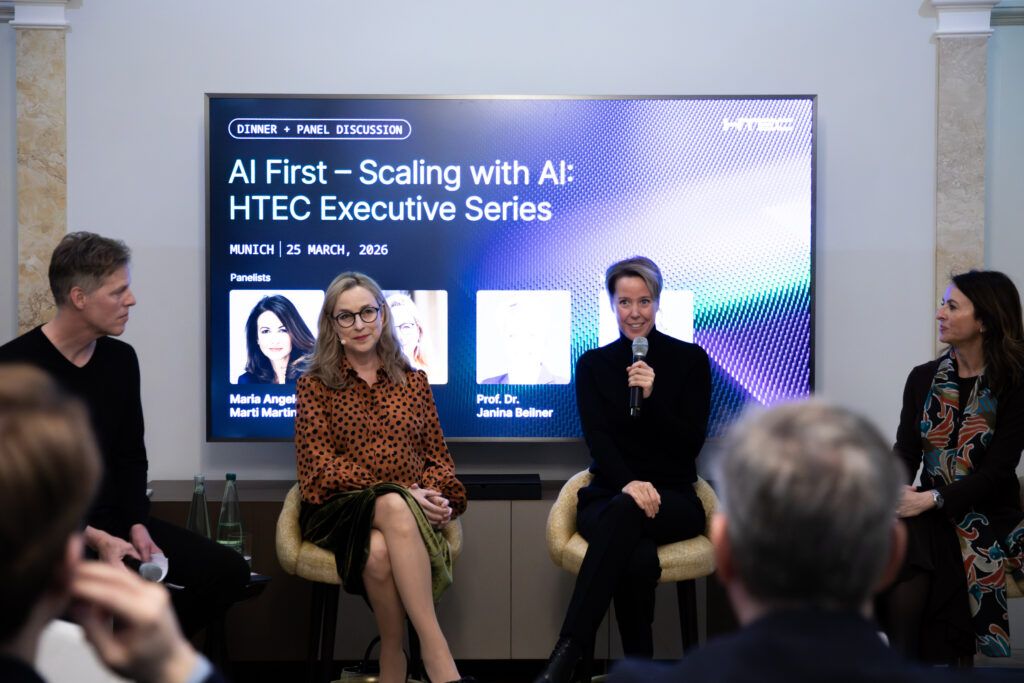
Following a successful 2025 series — where more than 245 executives across the US, UK, and Germany came together for peer-led dialogue and board-level insight — the HTEC AI First Executive Series is back for 2026. The 2026 edition opened in Munich, bringing together a stellar panel, moderated by Ronny Fehling, Chief AI Transformation Officer at HTEC:
- Prof. Dr. Janina Beilner, Senior VP, Healthcare at Siemens, Global Senior Executive – AI & Quantum in life science, and cardiothoracic surgeon
- Maria Angeles Marti Martinez – SVP Head of Tanker, Transport and Mission Programs at Airbus
- Isabel Hartung – Former CEO of Trumpf Industrial Laser and non-executive board member & AI advisor
Perspectives diverged across aerospace and defense, healthcare and life sciences, and industrial manufacturing — industries that, while distinct, share a common reality: high stakes, heavy regulation, and mounting pressure to scale AI responsibly.
Scalability challenge – and what other industries can teach us
If there is one thing last year’s AI First series put beyond doubt, Munich reaffirmed it: building pilots is “the easy part”. Scaling it is where most organizations stall.
Nevertheless, Maria emphasizes the power of local pilots:
“A massive revolution in how we govern our processes and get further intelligence from there may still be ahead of us. But the gains we make today from projects and pilots based on local servers and local data – that innovation is already very tangible.” – Maria Angeles Marti Martinez
Every strong pilot starts with a forward-thinking idea. In Janina’s view, those ideas take shape when stakeholders with different backgrounds come together around a shared problem. In healthcare, that often means starting with a condition to treat and then exploring the technologies available to address it.
Over time, this dynamic has reshaped fields like cardiothoracic surgery, where advances in imaging and less invasive techniques stem from close collaboration between device companies, surgeons, and imaging experts. As procedures evolve, they drive demand for new technologies, which in turn enable greater precision – creating a continuous cycle of progress.
“Most valuable ideas don’t come from a single perspective. They emerge when people with different expertise sit together, challenge each other, and work toward a shared problem. That’s where you begin to see what’s possible, and what still needs to evolve.” – Prof. Dr. Janina Beilner
In Isabel’s experience, the most effective ideas often come from adapting proven approaches from other industries. Still, moving from pilot to production is not always the goal. Some initiatives deliver strong returns at a smaller scale, and scaling success depends as much on organizational readiness and priorities as it does on the technology itself.
“Some of the best pilots come from translating ideas across industries, not reinventing them. But scaling isn’t just a technical question; it’s about whether the organization is ready to support it and make it a priority.” – Isabel Hartung
AI under guardrails: constraint or catalyst?
In highly regulated industries like aerospace, defense, and healthcare, AI adoption is shaped by strict safety, legal, and data rules. Fragmented, location-specific regulations, including export laws, privacy acts, and local databases, make scaling AI especially complex. As both safety and cybersecurity requirements intensify, Maria argues that human accountability must remain central.
Companies need to find a way to overcome these challenges, or else they will be left behind. We increasingly need dual strategies – local innovation that will enable immediate wins, but also an overarching strategy that will guide a broader transformation. That’s where initiatives like Centers of AI Competence can help translate local successes into shared learning across the enterprise. – Maria Angeles Marti Martinez
Healthcare is one of the most regulated industries in the world — and rightly so. But regulation and innovation don’t have to be at odds, as Janina observed. Frameworks like the European Health Data Space (EHDS) show that secure, governed data environments can actually catalyze progress: giving researchers, clinicians, and AI systems access to the data they need, while keeping patients in control.
The infrastructure for better decisions already exists. The question is how we use it.
Overcoming resistance with upscaling
Resistance to AI is real and widespread; however, it is not insurmountable. The organizations making the most progress are those where leadership and practitioners move together. Technology teams may already be deploying AI, running pilots, and finding efficiencies in everything from contract reviews to clinical workflows. But without alignment at the top, those efforts stay small.
Boards and executives don’t need to become technical experts — but they do need enough understanding to ask the right questions, back the right investments, and create the conditions for innovation to scale.
This is why upskilling is not a one-off exercise. AI is evolving too fast for a single training session to be enough. As Isabel put it:
“Learning to use AI is not like getting a driving license and putting it in a drawer. It is a practice — ongoing, evolving, and worth the effort at every level of the organization.” – Isabel Hartung
The Power of Interdisciplinary Thinking
“It may seem surprising,” Maria pointed out, “but the Beatles helped bring the first CT scanner to life”. Namely, the profits from the Beatles’ record sales funded EMI’s electronics division, which in turn gave their engineer Godfrey Hounsfield the resources to develop the first CT scanner. Nobody planned that connection: it emerged from curiosity, funding, and the freedom to explore.
Similarly, as AI automates routine tasks, it creates space. Space for the kind of research, experimentation, and cross-disciplinary thinking that leads to breakthroughs nobody saw coming. The future won’t just be about job titles; it will reward those who know how to synthesize diverse competencies to think alongside AI, across disciplines and boundaries.
Our job now is to create those conditions — and stay curious enough to follow where they lead.