

Insurance is a uniquely difficult terrain for AI. Legacy systems, siloed data, long underwriting and claims cycles, and strict regulatory oversight make large-scale AI adoption far more complex than in many other industries.
At HTEC, these are the challenges we help insurance organizations navigate every day. In a recent HTEC Today conversation, Gary Duggan joined us to discuss why insurers are still stuck in pilot mode, where AI is already delivering measurable value, and what separates firms that are scaling AI successfully from those still struggling to move beyond experimentation.
According to HTEC research involving 250 finance and insurance executives across six major markets, 85% of them have deployed AI somewhere in their business. Yet only 42% have managed to scale it across functions.
“Heavily regulated industries like insurance naturally take a more cautious approach to new technologies,” Duggan explained. “The approach is very much more of a test-and-learn model with small pilots before building it up.”
That caution is understandable. Insurance decisions directly impact customers’ financial well-being, which means governance, explainability, and risk mitigation must remain central to any AI strategy.
But excessive hesitation also carries risk. As Duggan warned, insurers that fail to embrace AI could find themselves falling behind in the same way some firms missed the opportunity presented by digital transformation years ago.
Why scaling AI in insurance is uniquely difficult
Unlike many industries, insurance organizations are often deeply fragmented.
Claims, underwriting, pricing, servicing, and distribution functions frequently operate on different systems, different data structures, and even different business timelines.
That fragmentation makes enterprise AI adoption significantly harder.
For example:
- Customer-facing AI initiatives can show ROI almost immediately through shorter call times, higher conversion rates, and improved personalization.
- Underwriting and claims decisions may take years to validate because insurers only fully understand pricing accuracy once claims mature over time.
This mismatch creates different priorities across the organization, reinforcing siloed decision-making and slowing enterprise-wide transformation.
At the same time, many insurers still rely on decades-old legacy systems that were never designed for modern AI integration. Multiple acquisitions and mergers have further complicated the technology landscape, leaving carriers with disconnected data sets, duplicated customer journeys, and inconsistent operating models.
Human-in-the-loop will remain essential
For all the excitement around AI automation, insurance leaders are not ready, nor should they be, to remove human oversight entirely.
Duggan emphasized that “human in the loop” governance will be critical, particularly in underwriting and claims decisions where customer outcomes are at stake.
The concern is not simply whether AI can make decisions, but whether those decisions consistently produce fair, explainable, and compliant outcomes.
This becomes especially important under frameworks like the UK’s Consumer Duty regulations, where insurers must demonstrate they are acting in customers’ best interests. In practice, that means AI is more likely to augment insurance professionals rather than replace them entirely.
Instead of manually gathering and analyzing large volumes of information, underwriters and claims professionals can increasingly focus on validation, oversight, and higher-value decision-making while AI handles repetitive and data-heavy tasks.
Where AI is already creating measurable value
While enterprise-wide transformation remains a work in progress, certain use cases are already proving their value.
Accelerating underwriting decisions
One of the clearest opportunities lies in underwriting automation. Duggan referenced recent developments in life insurance, where AI is beginning to automate traditionally lengthy medical questionnaires and underwriting assessments. For insurers, this can dramatically reduce processing times and operational costs. For customers, it removes friction from the application journey and delivers pricing decisions much faster.
The same principle applies even more strongly in commercial insurance, where underwriters often deal with highly complex risks requiring extensive data gathering and analysis. AI can streamline these workflows and surface insights more efficiently than traditional processes alone.
Improving fraud detection
Fraud detection is another area where AI is becoming increasingly valuable. Insurance fraud evolves constantly, with fraudsters continuously testing new tactics and exploiting new vulnerabilities, especially in cyber-related claims.
AI’s ability to process real-time behavioral data and identify unusual patterns gives insurers a significant advantage over traditional rule-based systems.
“What AI will do is enable firms to detect frauds far more quickly,” Duggan noted, particularly through access to real-time data and more sophisticated behavioral analysis.
Supporting post-merger integration
AI may also help solve one of the industry’s longest-standing operational challenges: post-M&A integration.
As Duggan explained: “One of the challenges for insurers that have gone through acquisitions is that you end up with multiple data sets, multiple customer journeys, and different pricing capabilities. That creates friction in the customer journey, increases cost, and leads to long consolidation and integration programs.”
AI-driven automation and modular platform architectures could significantly accelerate that process, helping insurers streamline operations and modernize faster.
The next frontier: Multi-agent AI systems
Looking ahead, Duggan sees multi-agent AI systems as the industry’s next major shift.
These systems can coordinate multiple AI agents across workflows, enabling more autonomous processing of tasks that previously required extensive human coordination.
In insurance, that could mean:
- AI agents gathering and validating underwriting data
- Automated claims triage and resolution workflows
- Intelligent customer servicing across channels
- Faster fraud investigations using connected data sources
However, Duggan believes insurers will likely adopt these systems gradually, particularly in customer-facing operations where efficiency gains can be realized quickly without fully removing human accountability.
The industry’s biggest challenge may be AI literacy
HTEC’s recent industry research revealed a striking contradiction: while 82% of insurance leaders report strong alignment around AI transformation, only 38% rate AI literacy within their executive teams as high. At the same time, just 22.6% believe their organizations are truly prepared to adopt and scale AI rapidly, while nearly a third remain stuck in a “learn and experiment” phase with limited value realization.
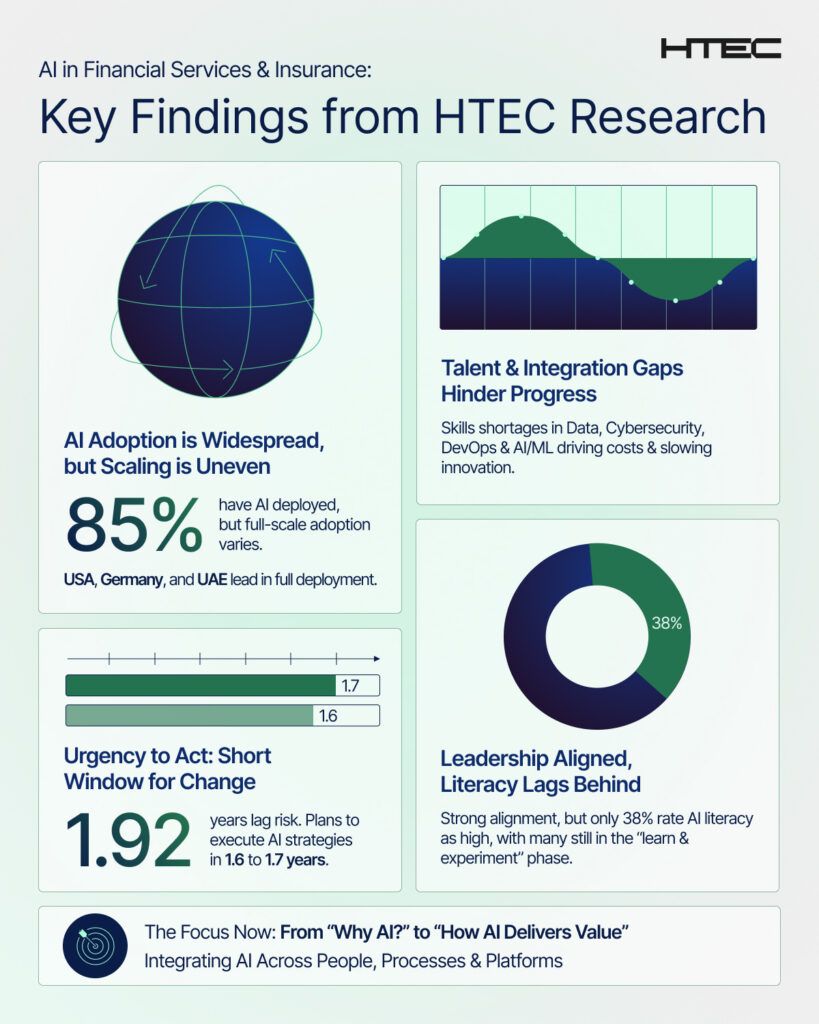
That gap between strategic intent and actual understanding is becoming a major obstacle to enterprise-wide transformation.
Without stronger literacy and shared understanding at the leadership level, alignment alone is not enough. Decision-making slows down, priorities become fragmented, and organizations struggle to move beyond isolated pilots into scalable AI programs.
Duggan sees this challenge firsthand across the industry.
“There’s a huge need now for AI training courses to teach boards and leadership what AI is, what the opportunities are, and what the risks are associated with AI in the insurance sector.”
Part of the problem, he argues, is that many insurance executives have spent most of their careers within the industry itself, limiting exposure to how AI is already reshaping sectors such as retail, technology, and financial services.
As a result, insurers risk learning too slowly while other industries accelerate ahead.
Duggan believes the solution requires a combination of:
- AI education and training,
- external partnerships,
- cross-industry learning,
- and incremental experimentation tied to specific business problems.
He also believes insurers need to look beyond their traditional peer groups for inspiration. “We’re not very good, frankly, at looking at other industries. AI is blurring those industry-specific capability lines, so there’s never been a better time for insurance executives to look at other sectors and see what’s being done.”
For insurers, improving AI literacy is no longer simply an L&D initiative. It is rapidly becoming a competitive necessity.
Why insurers shouldn’t navigate AI transformation alone
Technology is only one part of successful AI adoption, with organizational readiness, operating models, governance, and internal capabilities being equally critical.
That is why many insurers are increasingly looking beyond internal teams and partnering with external technology providers to accelerate their AI journey.
According to Duggan, partnership is often the most practical starting point for organizations still building AI maturity.
“My starting point would be to partner with somebody. The boards I sit on are starting to look at how they can improve their knowledge and understanding of AI and the opportunities it can bring to the insurance sector.”
For many insurers, the challenge is not simply deploying AI tools. It is understanding where AI can create measurable value, how to integrate it into existing operations, and how to do so responsibly while maintaining customer trust and regulatory compliance.
External partners can help insurers move faster by bringing:
- cross-industry AI expertise,
- implementation experience,
- technical capabilities,
- and a clearer understanding of where ROI can realistically be achieved.
At the same time, Duggan emphasized that insurers should not rely entirely on external support. The most effective approach is often a hybrid model that combines strategic partnerships with internal capability building.
“We’re looking to build an approach where we partner with somebody to start with and then build that in-house capability.”
This is particularly important because AI adoption in insurance does not happen uniformly across the organization.
Some teams, especially pricing functions, are already more advanced due to years of experience working with machine learning models.
“Pricing teams in UK personal lines have been working with machine learning models for 10 or 15 years. AI is a natural evolution from machine learning into AI.”
That existing foundation creates an opportunity for insurers to scale more quickly when supported by experienced technology partners who can help bridge capability gaps, modernize infrastructure, and accelerate experimentation.
Ultimately, insurers that successfully cross the AI transformation chasm are unlikely to do it entirely alone. The winners will be the organizations that combine industry expertise with external innovation, while simultaneously building the internal literacy and operational maturity needed to scale AI responsibly.
The insurers that move now will shape the future
The insurance industry is unlikely to adopt AI recklessly, nor should it. But waiting for perfect certainty is no longer a viable strategy.
The firms making progress today are not necessarily the ones deploying the most advanced AI models. They are the ones building organizational understanding, modernizing data and platforms, testing meaningful use cases, and developing a programmatic approach to adoption.
As AI capabilities continue evolving at extraordinary speed, the competitive gap between leaders and laggards could widen quickly. And in insurance, two years may already be too long to catch up.