
The concept of digital twins – digital replicas of products, processes, or systems – has been around for quite some time. These complex systems go beyond static models by continuously reflecting the behavior of their real-world counterparts, using data to simulate performance, predict outcomes, and test changes before they are applied in practice.
Despite sustained interest in digital twins over many years, stringent compliance requirements in the healthcare and life sciences domain have somewhat slowed down their full-scale adoption. The FDA’s recent approval of digital twins for testing purposes marks a significant step forward in integrating the technology from drug development and personalized treatments to medical device testing and patient monitoring.
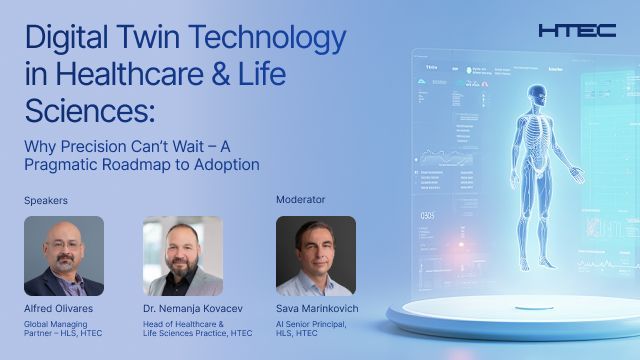
In a recent webinar, HTEC’s experts Alfred Olivares, Global Managing Partner, HLS, Nemanja (Nick) Kovačev, Head of HLS Practice and trauma surgeon, and Sava Marinkovich, AI Senior Principal, HLS, explored the opportunities and challenges with digital twins, offering a pragmatic roadmap to successful adoption. The key takeaways include:
- Digital twins are gaining momentum in healthcare, but adoption is gradual
- Success depends on connecting clinical, engineering, and business perspectives
- A pragmatic, multidisciplinary framework is needed for sustainable outcomes.
Let’s take a closer look at what this looks like in practice.
Market optimism still outpaces reality
With compliance frameworks catching up and the technology maturing – driven in particular by unprecedented processing power accelerated with AI, the progress of integrating digital twins into real-world healthcare settings remains slower than many had anticipated. Alfred outlined some of the key reasons for this gap between potential and adoption:
“Healthcare operates on a ‘zero trust’ principle. Data privacy concerns, especially in the EU, and a rapid pace of technology innovation that outpaces regulators create a cautious environment that slows the adoption of digital twins, even as their value becomes more evident. Finally, high upfront investment requirements and a limited pool of skilled professionals capable of developing, validating, and operating these complex systems hinder the transition from experimentation to large-scale, real-world deployment.”
The barrier, however, is not capability alone, but alignment across technology, clinical priorities, regulatory expectations, and business strategy. Progress will increasingly depend on tighter alignment between regulators, clinicians, and technology teams. This requires upskilling the workforce, resolving data interoperability and governance challenges, and modernizing legacy systems to ensure they are ready to support digital twin adoption at scale.
Overcoming system disconnection
No technology can be successfully implemented without integrating it into the full company lifecycle – from product development and core processes to operating models and data. If used in fragments, it will likely not show the real value.
Up until recently, regulations around digital twins weren’t clear, limiting the application to isolated pilots. The FDA’s approval of the use of in-silico digital replicas for certain aspects of pre-clinical testing is a clear signal that the industry is ready for broader adoption.
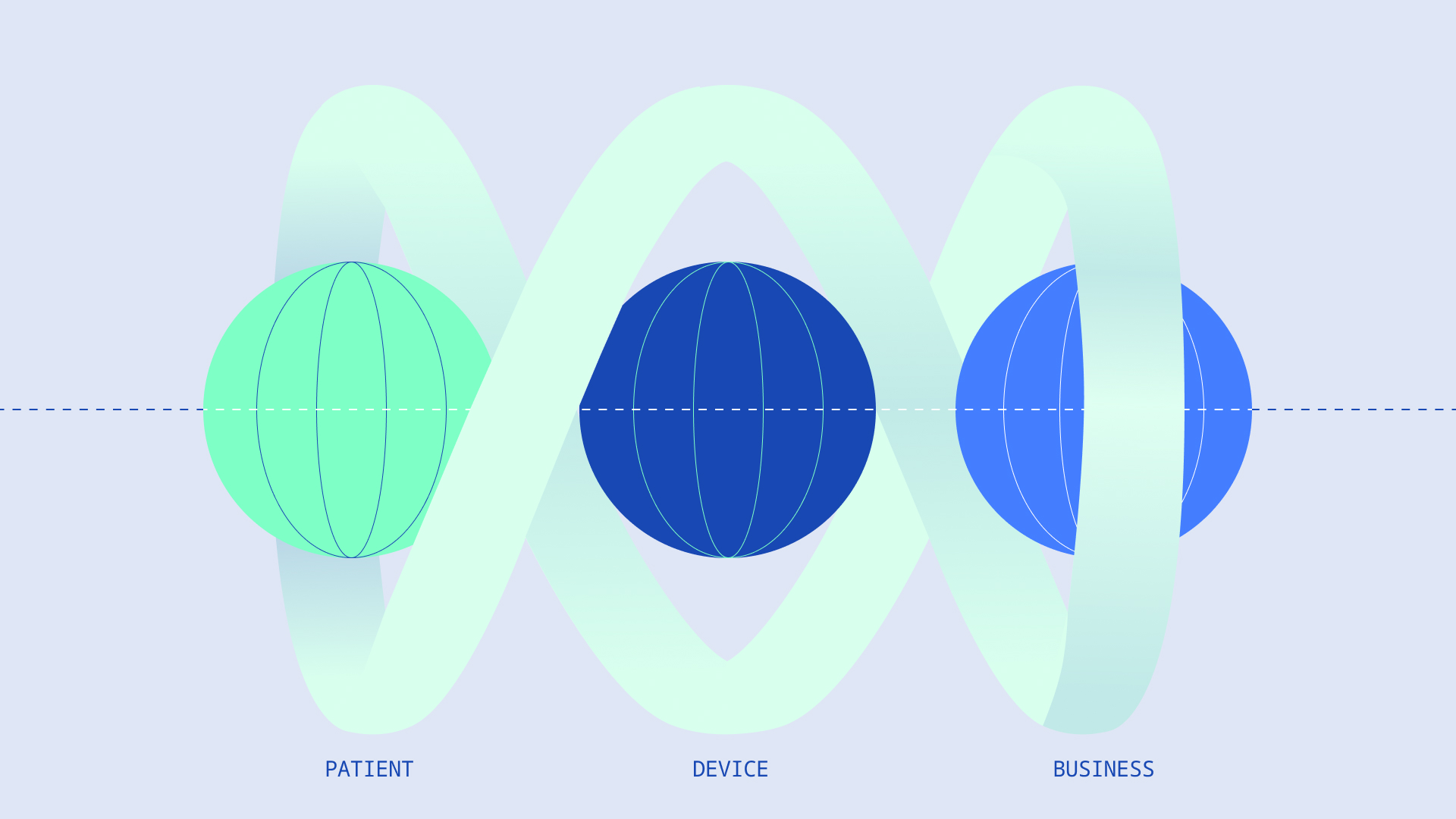
To ensure effective adoption, Nick emphasizes that the crucial step is to connect three historically siloed aspects – the patient, device, and business.
Let’s explore what this looks like in practice and how these can be connected via the digital twin technology.
The patient twin: a digital model of the patient’s data footprint
The patient digital twin (PDT) integrates real-world data and simulated patient data footprint. Unlike a static Electronic Health Record (EHR), the patient twin integrates data from various sources, like radiological images (CT, MRI), lab results, and continuous data from wearable sensors.
A PDT can speed up trials by simulating large, realistic virtual cohorts (reducing recruitment time and control-arm size) while letting researchers sample and test outcomes across under-represented demographic groups. In addition, using PDT allows researchers to simulate and monitor treatment or device efficacy in everyday environments, enabling earlier insights and shorter evidence-gathering cycles than conventional trials
The device twin: a virtual replica of a medical device
Device digital twins of a physical medical device or its component can be applied across the device’s lifecycle – from building prototypes to test and validate design, to collecting operational data and enabling predictive maintenance post-deployment.
By simulating thousands of scenarios in silico, companies can test and refine features without building as many physical prototypes and enable predictive maintenance post-deployment, thereby saving significant development time and cost. In this way, the device stops being a static piece of hardware and becomes a dynamic platform that improves over time.
The business twin: connecting clinical and engineering insights with business reality
For Dr. Nick, the impact of the patient and device digital twins is becoming increasingly evident. However, the crucial question is aligning that impact to the overall business strategy. In other words, companies need to start asking questions like, “How would a change in a drug or medical device affect business outcomes?”
Today, those answers come late. A design or software change is introduced, the device goes through certification and rollout, and the teams are able to see the impact only after it’s in the market. This could lead to a dip in market share, higher-than-expected costs, or weaker performance against commercial or clinical targets.
A business digital twin is designed to shorten this turnaround by connecting patient and device insights with financial, operational, and market data into a single predictive model. Instead of learning from outcomes after a change has already been made, companies can simulate “what-if” scenarios in advance – testing how design decisions, feature changes, pricing, or deployment strategies might affect revenue, costs, adoption, and risk.
The triple loop – orchestrating patient, device, and business digital twins
The triple loop bridges the gap between clinical evidence, engineering validation, and business viability in digital health by bringing together patient, device, and business digital twins.
Although we see early implementations of digital twins across parts of the HLS landscape, these efforts remain fragmented and well short of a full-scale, integrated approach. Barriers range from technical constraints—such as limited interoperability between EHRs, wearables, and other data sources—to regulatory complexity and ethical concerns around data ownership, patient privacy, and algorithmic bias.
Dr. Nick notes:
“The Triple-Loop framework requires multidisciplinary excellence – not just engineers or clinicians, but integrated teams who speak all three languages, aligning technology, clinical practice, and business strategy.”
A pragmatic framework for sustainable outcomes
Digital twins are designed for speed, confidence, and real value, but to succeed, organizations must be able to measure and track these benefits. Is your model explainable enough to build trust? Is compliance built in from the start, rather than being treated as an afterthought? In practice, the complexity of the new technology often means that very few organizations can do it on their own. For Alfred, the priorities are clear:
- Clarify your strategic intent for digital twins, defining where their precision can create the greatest impact in clinical, engineering, or commercial workflows
- Assess the readiness across data, models, and governance to examine your organization’s capacity for introducing, scaling, or accelerating Digital Twin initiatives
- Find the right partner for your roadmap, seeking partners who integrate the clinical, technical, and regulatory expertise to provide strategic guidance, deep domain insight, and hands-on engineering expertise.
Explore how digital twins enable precision in MedTech and reach out to our experts to learn how to apply real-time data, AI, and simulation without compromising speed, regulatory compliance, or cost-efficiency.