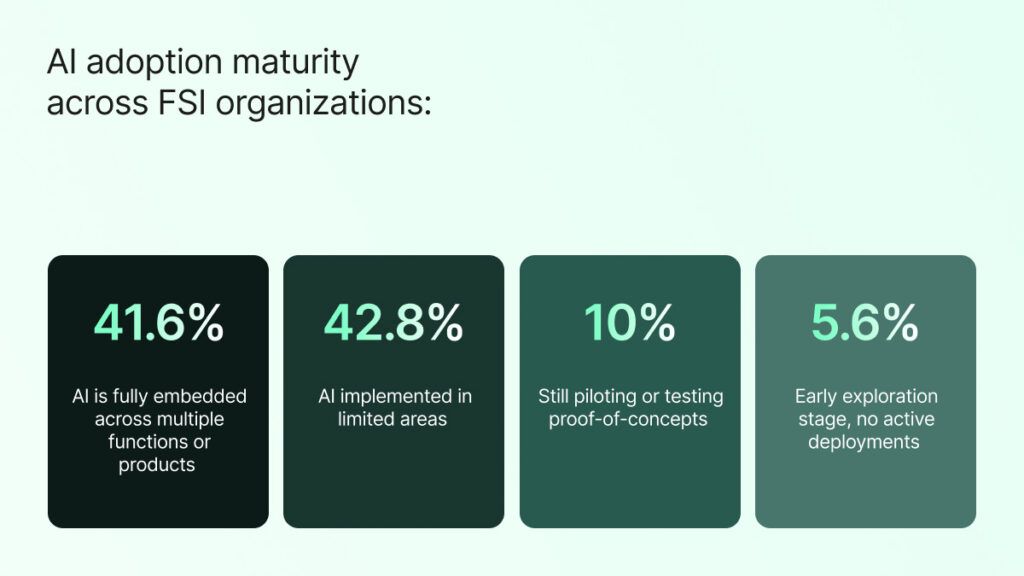
Insurers are broadly aligned on the importance of artificial intelligence, but far less confident in operationalizing it. According to HTEC’s State of AI in Financial Services and Insurance survey, not a single surveyed C-level executive said AI was not a current priority, while 41.6% said they were embedding it across multiple functions and products. Even so, most respondents (58.4%) placed their organizations between isolated use cases, pilots, and early-stage exploration—highlighting a persistent gap between strategic intent and enterprise-wide impact.
This article explores how AI can materially improve insurer economics across the insurance value chain—from distribution and underwriting to servicing and claims—and why connecting these capabilities end to end is now critical to unlocking sustainable financial impact.
Distribution: From Manual Intake to Intelligent Front Doors
In distribution, AI is transforming the front door of insurance. Instead of relying on manual intake, re-keying, and static broker workflows, insurers are deploying intelligent ingestion layers that automatically classify submissions, perform initial triage, enrich incoming data, and route prospective customers to the right product, channel, or agent in near real time.
These capabilities are increasingly delivered via digital broker and agent portals, API-driven integrations with placing platforms and risk marketplaces, and embedded insurance models that offer coverage directly within broader commercial transactions. By standardizing distribution through APIs, insurers can support multiple channels without duplicating logic or introducing operational friction.
AI also enables dynamic product recommendations at the point of engagement. Machine learning models analyze customer and broker inputs to guide prospects toward the most relevant products and coverage options, improving relevance, conversion, and speed.
For standard risks, the submission is fast-tracked directly into automated quoting. For more complex cases, it is routed to the appropriate underwriting team with enriched data already in place. In both cases, brokers receive near-immediate feedback, reducing delays at the point of entry and improving conversion without introducing friction downstream.
Underwriting: From Manual Assessment to Decision-Ready Workflows
Underwriting is where AI delivers its most immediate operational impact – and the most valuable AI use case in the insurance domain, as confirmed by HTEC’s global C-level survey.
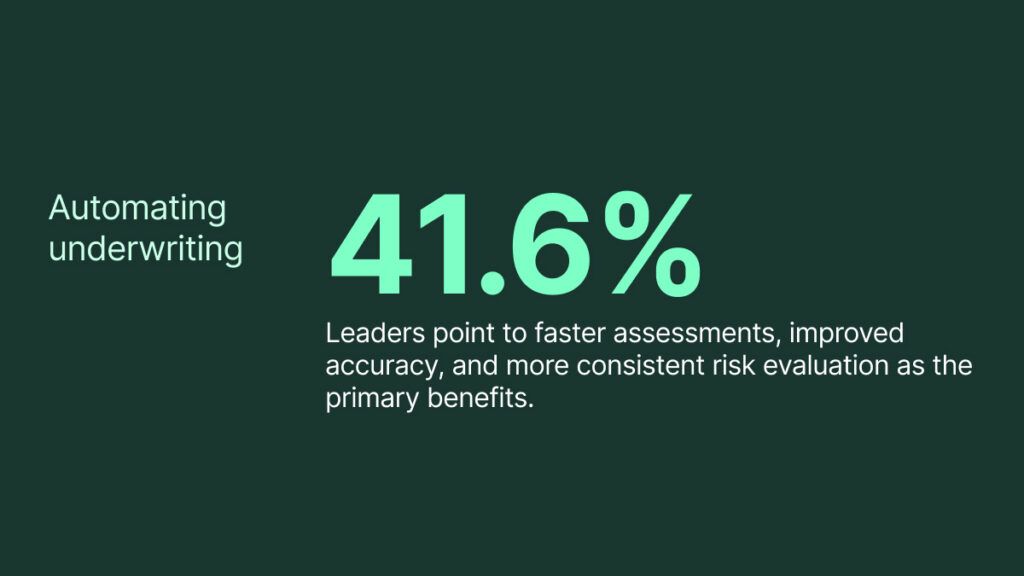
Rather than treating underwriting as a linear sequence of manual steps, insurers are using AI to convert submissions into decision-ready risks through automated triage, data enrichment, and real-time risk scoring. Modern underwriting workbenches consolidate these capabilities into a single decision environment, combining rules, predictive models, and external data sources with human judgement where required. The result is faster, more consistent underwriting decisions—with straight-through processing for standard risks and controlled escalation for complex cases.
In property insurance, AI can incorporate satellite imagery, weather data, and historical claims information to assess exposure to natural catastrophes for a given location. This allows underwriters to evaluate risk more quickly and consistently, accelerating time to bind while maintaining portfolio discipline.
Servicing: Extending Intelligence Beyond the Point of Bind
AI is also reshaping policy servicing, blurring the traditional boundary between underwriting and post-bind operations. Self-service capabilities allow brokers and insurers to manage routine changes digitally, while continuous underwriting models use real-time data to reassess risk throughout the policy lifecycle.
In practice, this is visible in how mid-term policy changes are handled. When a broker submits a request to add a new asset or update coverage, AI can classify the request, enrich it with relevant policy and exposure data, and determine whether it can be processed automatically or requires underwriter review. Standard changes are completed through self-service with real-time controls applied, while higher-impact requests are routed to the appropriate teams with full context already assembled.
By embedding intelligence into servicing workflows, insurers move from reactive handling to proactive risk management. Automated classification and routing of service requests reduces manual effort, while predictive triggers enable timely engagement around renewals, coverage changes, or emerging risk signals. The result is improved customer experience and operational efficiency — while maintaining underwriting discipline beyond the point of bind.
Claims: Orchestrating Speed, Fairness, and Control
In claims, AI enables faster resolution without compromising fairness or control. Intelligent first notice of loss captures structured data across digital channels, while automated triage prioritizes claims by severity, complexity, and fraud risk — ensuring each case is routed to the appropriate workflow from the outset.
This orchestration becomes visible early in the lifecycle. When a claim is submitted with supporting photos or documentation, AI can assess damage severity, cross-reference external data sources, and flag potential anomalies in near real time. Straightforward claims are fast-tracked for automated settlement and payment, while complex or high-risk cases are escalated to adjusters with predictive insights, fraud indicators, and relevant context already assembled.

By coordinating intake, investigation, settlement, and recovery within a single claims workflow, insurers reduce resolution times and operational friction while maintaining governance and auditability.
Moving Beyond Isolated Use Cases: End-to-End Value
Many insurers have already proven that AI works in specific parts of the business. The greater challenge—and the greater opportunity—lies in connecting those capabilities across the insurance lifecycle. When AI is orchestrated end to end, insights generated in one function can inform decisions in another, turning isolated gains into compound value.
A lifecycle-wide approach to AI delivers tangible benefits:
- Consistency: Decisions are guided by shared logic and data, reducing variation across teams, regions, and channels.
- Speed: Automation shortens cycle times across functions, improving responsiveness without sacrificing control.
- Governance and compliance: Built-in auditability and explainability ensure that scale does not come at the expense of regulatory oversight.
Taken together, end-to-end orchestration shifts AI from a series of tactical improvements to a structural capability that supports efficiency, control, and sustained enterprise-level performance.
From AI Ambition to Enterprise Execution
Realizing this end-to-end value is more than a technology challenge. It requires changes to operating models, clearer ownership of decisions, and the ability to embed intelligence into core workflows rather than layering it on top.
For many insurers, the gap lies in execution. While commitment to AI is widespread, progress is often slowed by fragmented initiatives, unclear priorities, and data and engineering foundations that were never designed for continuous decisioning at scale. Moving from experimentation to an AI-first operating model demands discipline as much as innovation.
HTEC supports insurers in closing this gap by combining deep insurance domain expertise with engineering, data, and AI capabilities. The focus is on embedding AI into day-to-day operations in ways that are secure, scalable, and measurable, while reducing manual effort and allowing teams to focus on complex decisions where human judgement remains essential.
How HTEC supports AI execution:
- Tactical consulting that pinpoints operational blockers, clarifies delivery priorities, and accelerates near-term execution paths.
- Experience design grounded in human-centered principles to ensure AI-enabled workflows are usable and adopted.
- Technical strategy and architecture aligned to business objectives and regulatory requirements.
- Product engineering practices that support scalable, value-driven digital products and platforms.
Whether defining an AI roadmap, modernizing core and edge infrastructure, or embedding automation and analytics into operational processes, HTEC provides the delivery discipline required to turn AI strategy into sustained enterprise progress.
Get in touch to fast-track your organization’s AI transformation.