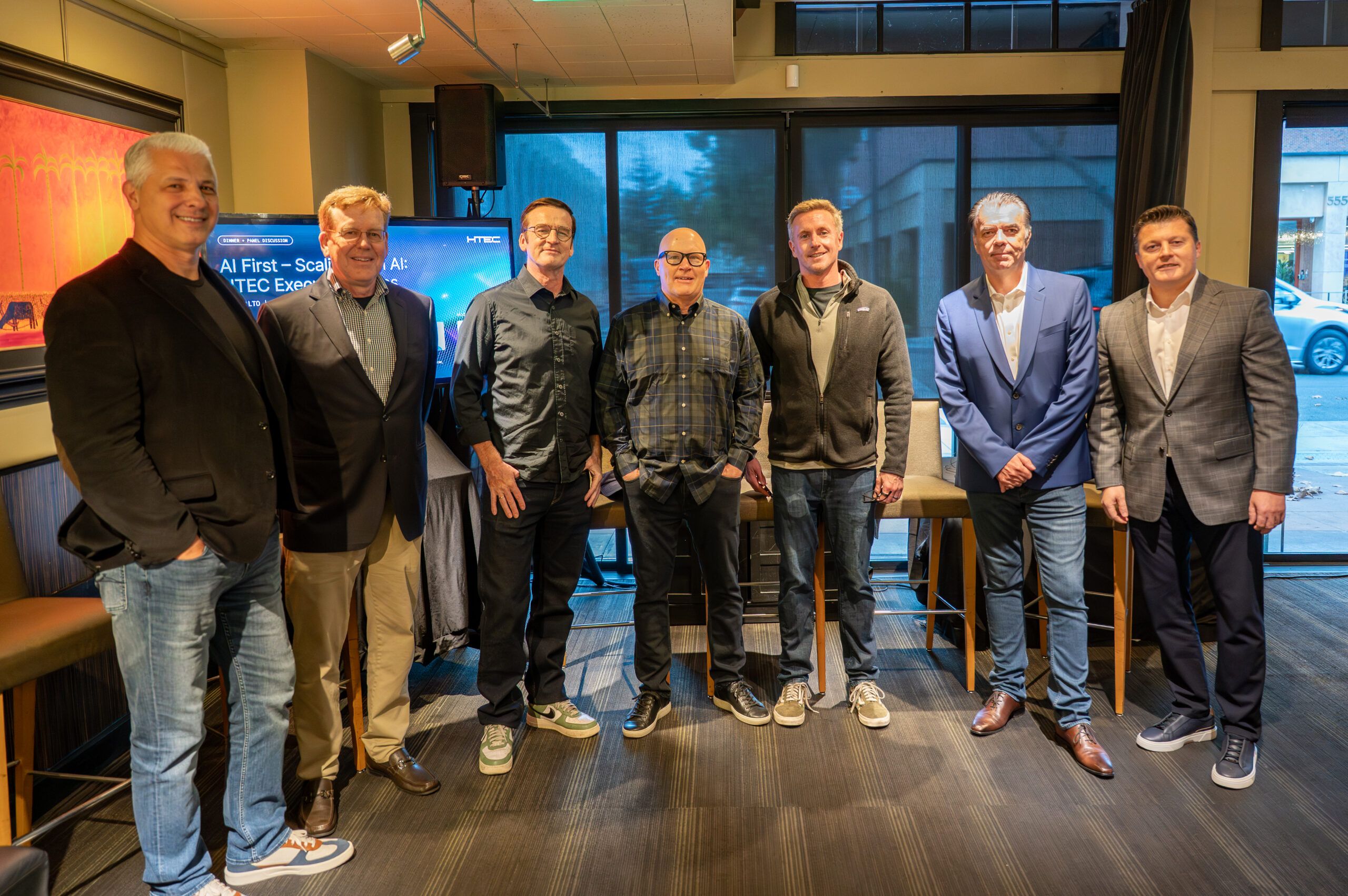
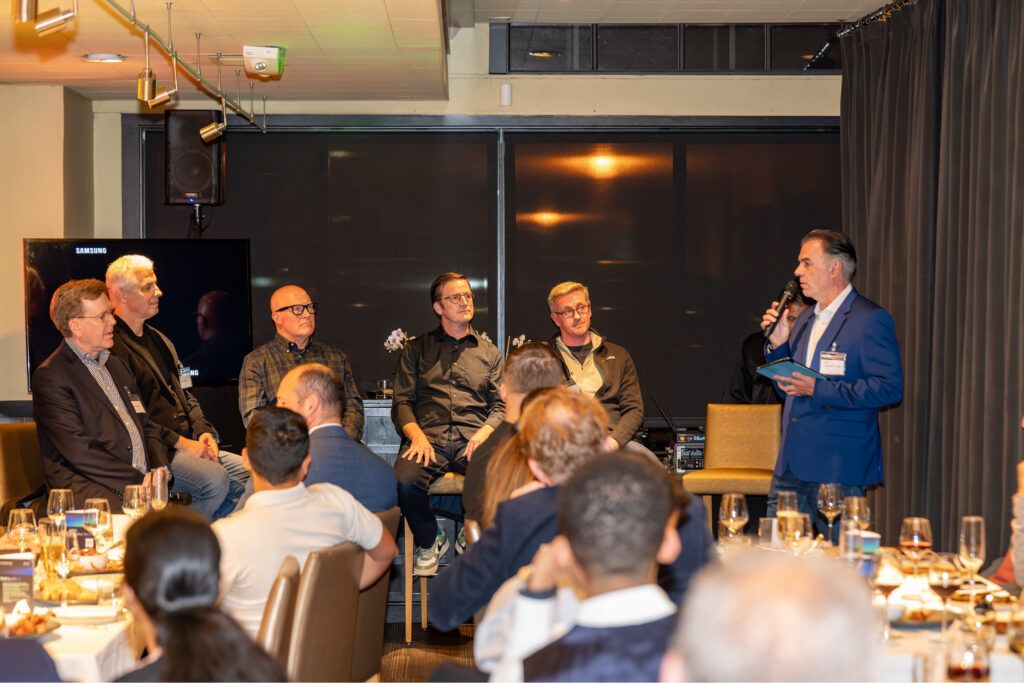
Following the success of HTEC’s AI-first executive series in London, New Jersey, San Diego, and Munich, the series continued in Palo Alto. Led by Lawrence Whittle, HTEC’s Chief Strategy Officer, the panel included two more HTEC executives – Alex Dukić, Chief Digital Officer, and Tim Sears, Chief AI Officer – as well as renowned technology and business leaders, Jeff Kleck, Senior Advisor to the Department of Defense and Government, Matt Lungren, GM and Technical Advisor, Office of the CTO, Microsoft, and Noel Kenehan, Lead, AI Center of Excellence, Google Cloud partnership.
As Lawrence noted, in any business discussion today, it doesn’t take long for AI to come to the forefront. Yet with so much noise, it’s easy to lose sight of what truly drives value. With several years on its AI-first path, HTEC launched this series to cut through the noise and focus on the strategic decisions that turn AI from concept to competitive advantage.
Innovations across industries – where does Health and Life Sciences stand?
With several panelists bringing deep experience in the Health and Life Sciences (HLS) sector, we turned the conversation to where the industry stands today. Persistent challenges emerged: workforce shortages, overloaded clinicians, and fragmented systems that can sometimes leave both staff and patients underserved.
One point hit particularly close to home for everyone: during a single patient exam, a clinician might click a mouse up to a hundred times. That’s a striking illustration of how much valuable time is lost to administrative friction. Reducing that burden through smarter systems and more thoughtful automation isn’t just about efficiency – it’s about reducing the cognitive load, freeing clinicians to concentrate on diagnosis, treatment planning, and the judgment calls that depend on their expertise.
When asked whether HLS lags behind other sectors in terms of AI adoption, HTEC’s CDO, Alex Dukić, made the following observation:
“I wouldn’t agree that the HLS sector is slow to adopt AI. Only, I wouldn’t think of the industry as ‘AI-first’, but rather ‘safety-first’, which is where we want it to be.”
Regulation versus innovation
One topic that often emerges in AI debates (and has been central to all HTEC’s AI-first executive panels so far) is regulatory compliance. With panelists having extensive experience in both private and government sectors, we explored whether public institutions are shifting their stance on AI. The consensus was that attitudes are changing. Regulators are more open to collaboration and quicker to explore new frameworks, even if progress remains cautious. That openness is encouraging – but it still requires companies to move responsibly and stay aligned with evolving expectations.
In terms of industries showing the strongest momentum in AI adoption, the panel pointed to finance and insurance and HLS as sectors that seem to be ahead of others.
How AI agents are changing the execution game
AI agents have quickly become one of the most talked-about concepts in the broader AI conversation. With panelists from two of the world’s largest technology companies – Google and Microsoft – we explored how these systems are actually being deployed in real operational environments.
Across industries, AI adoption generally falls into three categories: automation of routine tasks, augmentation of human decision-making, and, increasingly, autonomous workflows that reshape how organizations operate. AI agents sit across these stages: automating predictable work, assisting employees with context-aware guidance, and orchestrating multi-step processes with minimal oversight.
One point that must be emphasized is the importance of context. Effective use of AI agents depends on tailoring them to specific workflows, constraints, and decision structures – and on understanding how people will work alongside them. The real inflection point isn’t just technical; it’s about how the workforce adapts as these systems take on a larger share of operational load.
The future of workforce in the AI era
Any major technological shift (think the rise of the internet and the dot-com era) sparks questions about the role of people in the workforce. AI is no different. Some tasks will be automated, and certain roles may disappear – but new opportunities will emerge, requiring new skills and ways of working. The challenge for leaders is to anticipate these changes and guide their organizations and people through the transition.

As Lawrence points out, HTEC has been on the AI-first course for a few years now. The company has comprehensive, skill-based internal AI enablement programs, making sure the entire workforce is equipped with what it takes to remain competitive in this AI-led climate.
“As leaders, we must ensure that human judgment, creativity, and oversight remain central, even as machines handle more routine or data-intensive tasks.”
Powering AI Responsibly
The panel also addressed a growing concern: the energy demands of AI and the data centers that power it. Training large models and running AI at scale is resource-intensive, raising both cost and sustainability questions.
Panelists emphasized nuclear energy as a promising path forward, providing reliable, low-carbon power to support AI growth. They stressed that meeting this challenge will require collaboration across industries, governments, and energy providers, highlighting that sustainable AI is as much about leadership alignment as it is about technology.
We thank our panelists for sharing their insights and perspectives throughout the evening. We look forward to continuing these conversations and exploring how to scale AI effectively, covering both technology and organizational strategy, in upcoming events – including London and Minneapolis.