
Artificial intelligence (AI) has already transformed the financial services industry in profound ways. A recent global survey of C-level FSI executives published by HTEC revealed that more than 85% of organizations in the sector have AI solutions either fully embedded or deployed in specific areas, spanning fraud detection, compliance monitoring, customer service, and risk management.
While the enthusiasm for AI adoption is high across the board, many organizations are struggling to move beyond pilots into scaled deployments. However, 2025 has firmly established that AI is no longer a futuristic experiment but increasingly a mainstream operational tool.
This sets the stage for 2026, where the industry aims to shift decisively from experimentation to execution.
It’s Time for AI Heavy Lifting
Financial institutions are entering 2026 with a pragmatic reset. The era of scattered pilots and “let a thousand flowers bloom” experimentation is ending. With various AI pilots consuming potential millions in cloud costs without producing usable outcomes, we are bound to see boards demanding accountability: every AI initiative must tie directly to revenue, compliance, or efficiency.
Banks and insurers are increasingly focusing on top-down programs with measurable, compliant outcomes. Larger institutions have already built AI studios and centers of excellence to consolidate expertise, signaling that the winners will be those who can scale both quickly and responsibly.
The Rise of Multi-Agent Systems
One of the most exciting developments in 2026 will be the rise of agentic AI. Multi-agent systems are set to automate complex back- and middle-office workflows once thought untouchable. Loan origination is a prime example: gathering income statements, verifying documentation, and processing approvals can now be orchestrated by AI agents.
Multi-agent AI has the potential to reduce average approval cycles from weeks to days and even hours, while significantly reducing manual errors. This results in increased customer satisfaction and frees up staff to focus on relationship management and other relevant areas rather than the previously necessary pedestrian work. However, the challenge isn’t just technology – it is changing established workflows while managing pressure to reduce the headcount before efficiencies are realized. Institutions that successfully navigate these challenges will be set for long-term success.
Data Quality: The Foundation of Scalable AI
AI is only as good as the data it runs on, and in 2026, data quality will be one of the main factors separating industry leaders from laggards. The world’s biggest financial institutions have embraced the concept of “data as a product,” with embedded ownership in the business for data maintenance and consistent API exposure.
Companies with data silos and poor-quality data are building AI on quicksand, with imperfect data leading to imperfect results. A 90-95% accuracy may seem good on paper, but for high-stakes use cases like tax preparation, a five percent error rate is a serious liability. There is not a quick fix solution to this challenge – for most organizations the road to clear and accurate data pipelines is a seven-to-ten-year journey.
In 2026, the gap will be clear between firms that invested early in data governance and those that deferred it.
ChatGPT Tax Chaos: The Compliance Risk of Generic LLMs
Generative AI is powerful, but not purpose-built for compliance-heavy tasks like tax preparation. In 2026, we could potentially see audit failures at scale caused by individuals using Chat GPT for tax returns.
“There’s genuine risk around people plugging their information into ChatGPT for tax returns in 2026. While undoubtfully convenient, LLMs are prone to bias and can give answers that feel right rather than compliant — creating significant exposure.” – George Brady, HTEC Advisory Board Member
Governments lack the capacity to process AI-generated returns riddled with inaccuracies, and those flagged may face costly settlements or court battles with little legal defense.
Tax authorities in the UK and U.S. have already issued warnings that AI-generated returns will not be considered reliable. There’s a lesson here for financial institutions as well: generative AI must be deployed with domain-specific safeguards, not as a one-size-fits-all solution.
Legacy Modernization: The Divide Between Front-Runners and Followers
Legacy systems remain a massive barrier to innovation. Banking and trading systems with 30, 40, 50-year histories built on mainframes can’t be transformed to support AI at scale overnight. Modular, API-first cores are essential, but modernization is a decade-long journey.
In fact, HTEC’s above mentioned global survey of C-level FSI executives reveals that legacy infrastructure is one of the main obstacles to advancing AI in finance and insurance institutions.
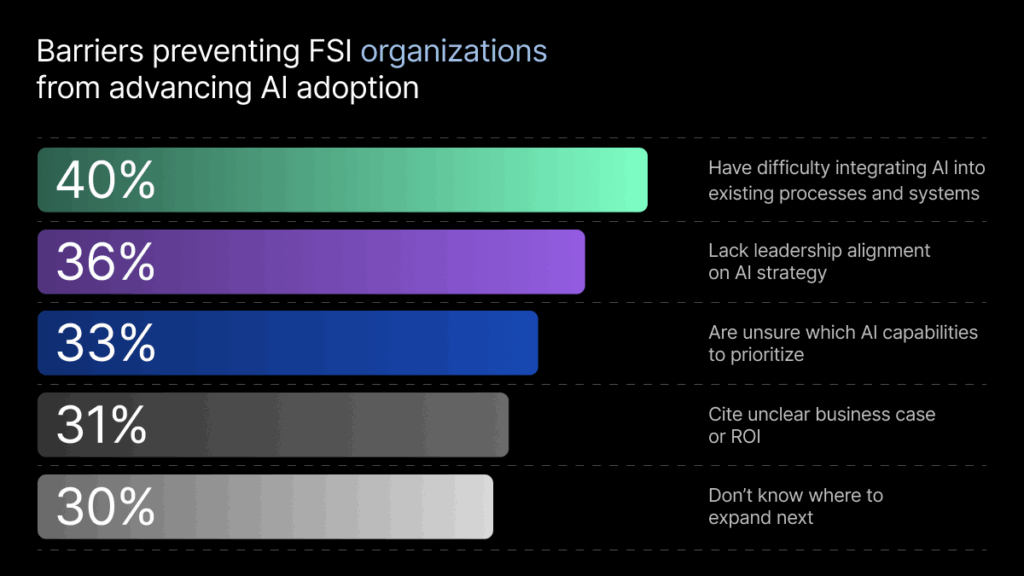
Institutions that began this work five years ago are now reaping benefits. Meanwhile, competitors still running monolithic systems often struggle to integrate even basic AI chatbots in systems where one wrong move could break a wide variety of functions.
Fraud Detection: Where ROI Is Immediate
Fraud remains one of the most effective AI use cases. Financial institutions lose hundreds of billions annually to fraud, and every dollar saved flows directly to the bottom line. AI-driven fraud detection has matured over the past decade, but 2026 will see even more robust deployment.
Insurers are also investing heavily, using AI to spot fraudulent claims in real time. The ROI is immediate and measurable, making fraud detection one of the safest bets for AI investment – and one that nearly 40% C-level executives identify as the priority AI use case, according to HTEC’s research.

Personalization Unlocks Revenue—For Trusting Customers
The customer experience frontier in 2026 is hyper-personalization. Banks will proactively offer tailored products, such as home renovation loans based on spending patterns. The key is trust. Without it, personalization feels invasive.
Institutions must balance data leverage with cybersecurity and transparency. Those who build trust will unlock new revenue streams, while those who don’t risk losing customers forever.
2026 as the Year of Execution
The financial services industry enters 2026 with optimism and urgency. AI pilots are giving way to scaled programs. Multi-agent systems will transform workflows. Data quality and legacy modernization will remain the key differentiators, while fraud detection and personalization will deliver measurable ROI.
The message is clear: the AI party is over, and now is the time for accountability. While AI is not a quick one-size-fits-all solution to any problem, it is a powerful tool for the FSI sector.
To navigate the changing landscape successfully, FSI organizations will need:
- Clear and realistic AI strategies heavily focused on ROI
- Clean and orchestrated data environments that accurately tell the whole story
- Modern, modular infrastructures that can support a wide range of AI-powered functions
- Effective internal and people processes to support the necessary transformation
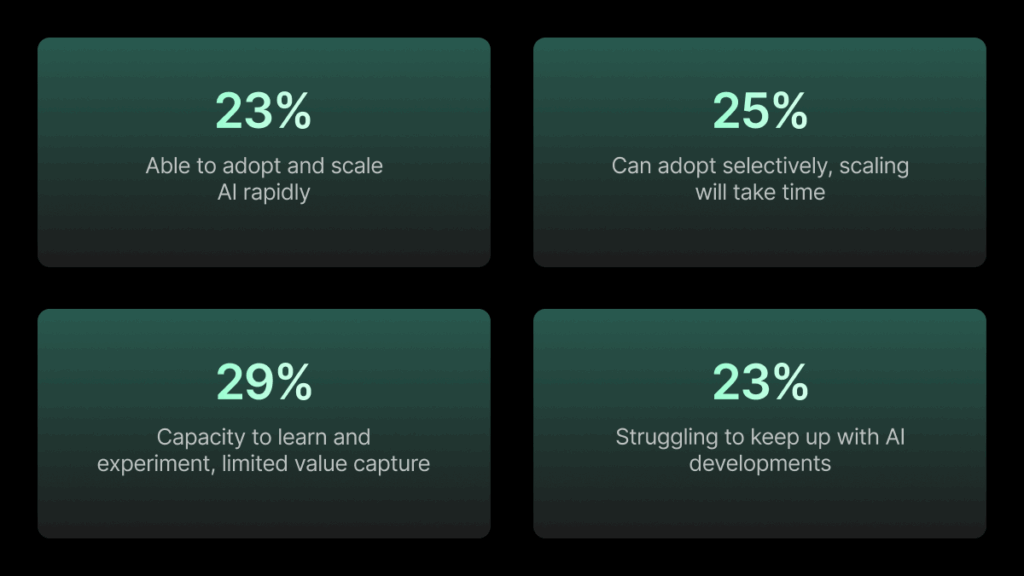
The complexity of AI transformation is clear: it requires change not only in technology, but across operations, processes, and people. Unsurprisingly, fewer than a quarter of FSI respondents to our survey believe they can scale AI rapidly.
In this environment, aligning with the right technology partner is often the key to achieving success. HTEC helps FSI leaders translate technology ambition into measurable business value by combining deep financial-domain expertise with world-class engineering, data, and AI capabilities. We enable organizations to move faster, reduce uncertainty, and build comprehensive, secure, and scalable solutions that actionize data, optimize processes, and benefit customers.
Get in touch to explore how our expertise can support your transformation initiatives.