The telecommunication industry is entering a future-defining phase of transformation. Operators have invested billions in infrastructure over the past decade while waiting for returns to materialize at a pace that would at least equal the pace of capital intensity. Compounding this, new demands – from AI-native applications to edge computing and next-generation connectivity – are forcing telecom leaders to rethink how networks are built, operated, and monetized, potentially putting past investments into question.
With artificial intelligence now firmly on executives and consumers agenda the recent findings of HTEC’s global survey of C-level telecoms executives point to some telling trends. Nearly half of telco respondents (47%) report that AI is fully embedded across multiple functions, yet connecting this across the entire organization and scaling remains hard.
For operators regardless of size and geography AI matters; and competitive advantage will hinge on how quickly they operationalize AI to automate networks, enhance customer experience in BSS systems, and unlock new revenue streams through APIs.
Based on insights from HTEC’s State of AI in Telecommunications 2025-2026 study and expert commentary from Mark Abolafia, Senior Partner for Telecommunications at HTEC, several trends are set to define the telecom landscape in 2026.
Monetization Is the Industry’s Defining Challenge
Telecom operators have spent decades building the digital highways of the modern economy. But increasingly, the biggest beneficiaries of that infrastructure have been the digital platforms running on top of it, rather than the operators who invested in building and maintaining it.
As Mark Abolafia explains:
“The industry is fundamentally sick. Operators have spent hundreds of billions on infrastructure while their return on invested capital sits below their cost of capital. The winners in 2026 will crack the code on network monetization and move from dumb pipe providers to high-margin service players.”
The pressure to unlock new value from networks is intensifying as telecom leaders look beyond traditional connectivity services. AI is expected to play a key role in enabling new monetization models, particularly by helping operators:
- extend offerings beyond core connectivity
- personalize customer services and pricing
- deliver industry-specific digital services
- orchestrate complex IoT ecosystems
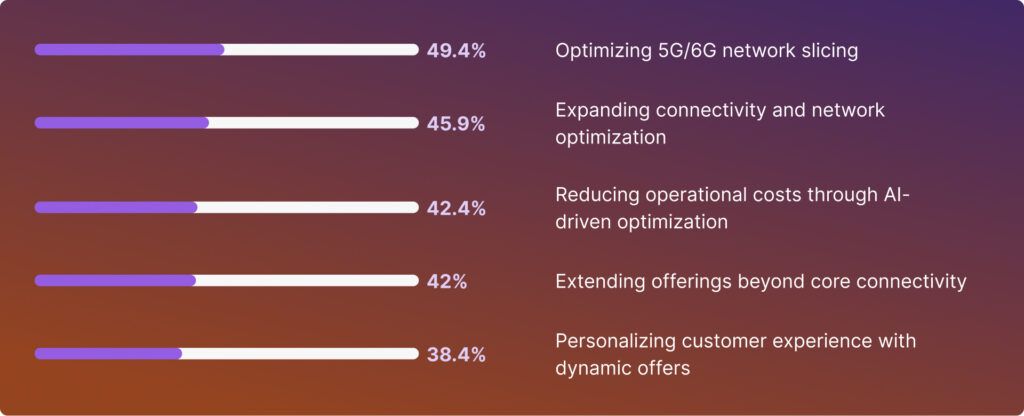
Research shows that 42% of telecom leaders see AI as a way to expand offerings beyond connectivity, while 38.4% prioritize AI-driven personalization of customer experiences.
In other words, the future of telecom revenue growth lies not just in building networks—but in intelligently leveraging them.
Strategic and Pragmatic AI Deployment
In telecom, large-scale transformation programs often stall because operators attempt to implement too many initiatives simultaneously.
Abolafia advises operators to pick their worst pain point, apply AI with a proper methodology, and expand from success. AI transformation in telecom cannot be approached as a big bang. Established operators are working with decades of accumulated systems: complex OSS/BSS environments, multi-vendor infrastructure, and deeply embedded operational processes. In contrast, greenfield operators are building AI-native architectures from day one, without the burden of legacy stacks. As a result, the competitive advantage does not come from adopting AI first—every operator will adopt AI—but from how quickly organizations can identify where to start, prove value, and scale from there.
In practice, telecom operators are focusing AI deployments on three high-impact areas:
- Customer experience improvements in BSS systems
- Autonomous network operations in OSS
- Network asset monetization through APIs
As shown in the chart above, telecom leaders are already prioritizing targeted AI deployments in areas with clear operational impact. According to the research, the top AI priorities include optimizing 5G/6G network slicing (49.4%), improving network performance and connectivity (45.9%), and reducing operational costs through AI-driven optimization (42.4%).
The operators that scale successfully will do so through incremental, results-driven deployments rather than sweeping transformation initiatives.
Edge AI: From Hype to Targeted Value
Edge AI is widely seen as a natural extension of telecom infrastructure. With distributed networks and real-time operational environments, telecom operators are uniquely positioned to deploy AI at the edge. Indeed, confidence is extremely high: 93% of telecom leaders are familiar with edge AI ,while 96% of those executives say they are confident in their ability to deploy edge AI solutions, according to HTEC’s research.
But as operators move from experimentation to deployment, the industry is beginning to take a more pragmatic view of where edge AI actually delivers value.
Technology vendors—most prominently NVIDIA—are pushing powerful edge AI architectures that could place significant compute capacity at the network edge, potentially even at individual cell sites. While the technology is impressive, the economic reality of operating large-scale edge infrastructure is forcing operators to think carefully about where such deployments make sense.
Rather than rolling out compute-heavy edge environments everywhere, operators are increasingly focusing on use cases where real-time processing clearly delivers operational value. According to the research, telecom leaders expect edge AI to primarily improve network reliability and uptime (42.2%), strengthen data privacy and security (39.7%), and create competitive advantage through faster services, improved efficiency, and better user experience (36.7%).

As Abolafia puts it, “Less hype, more focus on specific use cases that actually generate ROI.”
Network APIs Open New Revenue Ecosystems
One of the most significant opportunities for telecom operators lies in exposing network capabilities directly to developers. Initiatives such as GSMA’s Camara APIs and the TM Forum Open Digital Architecture (ODA) are enabling telecom providers to package network functionality—such as location, quality of service, or security—as programmable services.
According to Abolafia:
“The convergence of GSMA Camara APIs and TM Forum’s ODA represents the biggest unlock in telecom since the smartphone. Operators can finally expose their network capabilities to developers and create ecosystems that monetize infrastructure investments.”
These APIs allow telecom operators to transform network capabilities into Network-as-a-Service (NaaS) offerings, enabling developers and enterprises to integrate connectivity features directly into applications.
As AI expands the complexity and intelligence of networks, programmable interfaces will become increasingly important for unlocking new digital business models.
Partnerships for AI Scales
Despite growing momentum behind AI transformation, execution capacity remains a major constraint across telecom organizations. Technical skill shortages are widespread. Nearly all telecom executives report gaps in critical capabilities such as cybersecurity, AI/ML, and data engineering, which are already increasing costs and slowing innovation.
At the same time, telecom operators must maintain existing networks while building the next generation of AI-driven systems. The result is a widening divide between organizations that remain trapped in proof-of-concept cycles and those that move quickly into production deployments through strategic partnerships.
Research supports this shift toward collaborative models. 68.8% of telecom leaders say they prefer partnering with technology or service providers when integrating edge and cloud architectures.

In a sector defined by complex infrastructure and rapid technological change, partnerships are becoming a key lever for accelerating transformation.
From Connectivity Providers to AI-Native Telecom Operators
In telecommunications, AI is moving beyond isolated applications to become a core operational layer, shaping how networks allocate capacity, how services are delivered, and how operators create value from their infrastructure.
Yet despite growing adoption, only 22% of telecom executives believe their organizations can scale AI rapidly across the enterprise.
Over the next two years, the operators that succeed will be those that:
- focus AI on their most pressing operational challenges
- modernize networks for intelligent orchestration
- unlock monetization through APIs and new services
- build hybrid ecosystems of partners, platforms, and internal capabilities
The telecom industry has long provided the foundation for the digital economy. The next phase will determine which operators evolve into AI-native service platforms and which remain infrastructure providers in a market defined by diminishing returns.
In this environment, aligning with the right technology partner is often the key to success. HTEC helps telecom leaders turn AI ambition into measurable business value by combining deep domain expertise with world-class engineering, data, and AI capabilities.
Get in touch to learn how we work alongside operators to modernize network and platform architectures, operationalize AI across OSS and BSS systems, and unlock new revenue opportunities through programmable networks and intelligent services.