
How to scale AI from pilot projects to production without remaining in pilot purgatory
Scaling AI from pilot projects to full production demands six things working together: ROI-led prioritization that cuts through experimentation noise, data readiness that can sustain enterprise-grade models, clearly defined deployment lanes that separate pilots from production, explicit production readiness standards that determine when a system is ready to deploy, real-time monitoring infrastructure that catches failure early, and disciplined change management that brings people along at every stage. Most pilots stall not because the AI is weak, but because organizations treat scaling as a technology problem when it is a systems problem.
Why this matters now
AI is everywhere, and many companies now call themselves ‘AI-first.’ Still, leaders often report that pilots stall, adoption is slow, and the return on investment is unclear.
A common pattern appears: teams experiment more than they execute. They launch pilots and build impressive demos, but often struggle to make a real impact. This situation, often called pilot purgatory, means there is a lot of activity but little value in production.
Conversations with executives and real-world experience show that scaling AI is more about building strong systems than just improving models. Without solid foundations in data, deployment, measurement, and adoption, even good pilots can stall.
Why AI pilots fail (and why it is rarely the model)
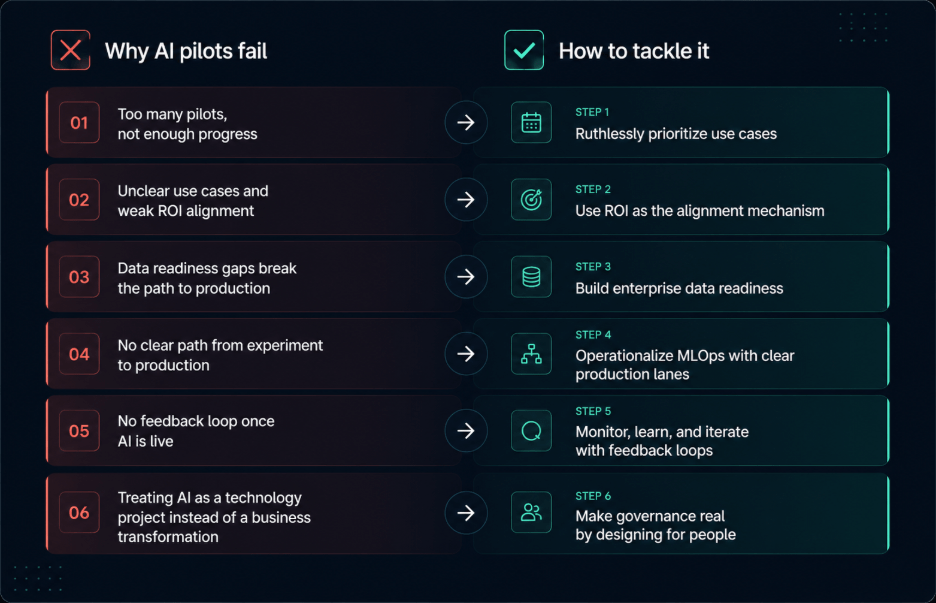
1. Too many pilots, not enough progress
One common problem is running too many pilots at once. Instead of focusing on two or three projects that could make real progress, organizations often spread their efforts too thin.
The result is predictable: resources get stretched, the return on investment is unclear, and teams lose momentum when results do not match their efforts. Over time, leaders get frustrated and lose confidence in AI projects.
2. Unclear use cases and weak ROI alignment
Pilots can lose focus if there is no shared idea of what success looks like. Without a clear vision, specific use cases, and a clear idea of expected ROI, teams find it hard to justify moving to production.
ROI is important because it gives everyone a common way to talk about value. It helps leaders agree on where to begin and move from just exploring to actually doing. If value cannot be measured, adoption slows down.
3. Data readiness gaps break the path to production
Pilot projects often do not show the real challenges of the business. Carefully chosen datasets can make demos look good, but they can hide bigger data problems that show up later in production.
AI at the enterprise level needs data that is well-managed, easy to access, consistent, and complete. This means investing in data systems, shared definitions, and clear ownership. Without these, pilots stay as flashy demos instead of becoming reliable systems.
4. No clear path from experiment to production
Most pilots are built to prove a concept, not to survive production reality. The data is cleaner, the scope narrower, and the success criteria looser than anything a live system would face. When deployment time comes, teams discover that the questions they never asked — about deployment standards, monitoring requirements, and decision rights— are exactly the ones that block progress.
Without a clear definition of production-ready, organizations either deploy prematurely and erode trust, or delay indefinitely waiting for alignment that never comes.
5. No feedback loop once AI is live
Many organizations treat deployment as the finish line. Once a system is in production, there is no structured process for tracking what the model recommended, what decisions were actually made, and what outcomes followed.
Without that data, models cannot improve, failure modes go undetected, and the case for continued investment becomes harder to make over time.
6. Treating AI as a technology project instead of a business transformation
AI initiatives stall when viewed solely as engineering projects rather than drivers of operational change. The main obstacles are organizational readiness, process design, decision rights, and data maturity.
AI changes how work gets done, who is responsible, and how teams work together. Teams will only adopt AI if they trust it, understand how it fits into their work, and get real support during the transition.
A practical pilots‑to‑production playbook leaders can actually run
HTEC’s six-pillar framework for scaling enterprise AI defines the conditions organizations need before production becomes viable: strategic clarity on which use cases justify the investment, cross-functional alignment using ROI as a shared decision language, data readiness, well-defined operational lanes that separate experimentation from production-grade delivery, continuous monitoring, and change management across people and processes. HTEC uses this methodology to consistently move organizations from AI experimentation to measurable production value, and it is the right architecture for making AI scaling repeatable.
Step 1: Ruthlessly prioritize use cases
Scaling does not work if everything is treated as a priority. The solution is to focus.
Pick two or three use cases that have real business impact and a clear problem that AI can solve. Do not use AI just for the sake of it. Let value, not fear of missing out, guide your priorities.
Where to start
Select two to three high‑impact use cases and pause the rest
- Define success in business terms, not model metrics
- Build adoption planning into the pilot from day one
Step 2: Use ROI as the alignment mechanism
ROI helps everyone get on the same page, even when opinions differ. A shared value framework lets leaders discuss ideas, agree on what comes first, and commit resources confidently.
Early successes are important. They build trust and help create momentum, making it easier to scale later.
Where to start
- Write a one‑page ROI hypothesis for each use case
- Agree on how value will be measured in the first 30–90 days
Step 3: Build enterprise data readiness
Even the best AI cannot make up for poor data foundations. Organizations need to know where their data is, who is responsible for it, and if it can be used at scale.
By investing in data systems, shared definitions, and controlled access, teams can work faster and reuse data across different projects.
Where to start
- Map key data sources and ownership
- Standardize definitions and access paths
- Build data assets that can be reused to avoid cleaning up the same data over and over.
For a deeper dive, see our perspective on data foundations in Navigating the AI‑First Journey.
Step 4: Operationalize MLOps with clear production lanes
HTEC applies a set of production readiness questions that teams must be able to answer before any AI system moves to deployment: What are we building?
- Where does the data come from?
- When is something “ready” for production?
- What will we monitor once it is live?
Having clear standards for readiness and production metrics turns experiments into reliable delivery.
Where to start
- Work through the four production readiness questions for each active pilot.
- Treat any question your team cannot answer clearly as a blocking item.
- Set a go/no-go date based on when those gaps can be resolved.
Step 5: Monitor, learn, and iterate with feedback loops
AI systems get better with feedback. Tracking what the model suggested, what decisions were made, and what actions followed gives the data needed to improve both models and processes.
Overrides and exceptions are not failures—they are chances to learn.
Where to start
- Implement a simple feedback loop for decisions and outcomes
- Track exceptions and overrides as inputs for improvement
Step 6: Make governance real by designing for people
Governance is effective when it matches how work really happens. This means having clear decision rights, human oversight where needed, and real support for teams as they adjust to new ways of working.
Getting frontline teams involved early builds trust, leads to better design, and speeds up adoption.
Where to start
- Engage frontline users early in pilots.
- Build transition support, so change works for everyone, not just early adopters.
Why this approach works
This approach works because it tackles the real reasons pilots stall: too many unfocused experiments, weak ROI alignment, poor data foundations, undefined production standards, missing feedback loops, and underinvestment in people and process change.
Treating AI as a technology project keeps organizations stuck. Designing it as an operating system for work makes scaling repeatable.
For more context, see From AI Pilots to Impact and Unlocking AI ROI on our Insights page.
Closing thought
If you want to move AI from pilots to production, the most important factor is not building another model. It is creating the system that makes AI easy to deploy and adopt: clear priorities, ROI alignment, strong data foundations, disciplined production, feedback loops, and careful change management.
This is why the real challenge in scaling AI is not the technology itself, but everything that surrounds it.
FAQ
What is “pilot purgatory”?
Pilot purgatory is a state where experimentation is widespread, but production deployments are less frequent, leaving organizations stuck in early adoption despite strong interest and investment.
Why do AI pilots fail to scale?
Common reasons include lack of focus, unclear use cases, weak ROI alignment, insufficient data readiness, no defined path from experiment to production, missing feedback loops once systems are live, and underinvestment in workforce and process change.
Is the biggest scaling problem MLOps?
MLOps matter, but the deeper blockers are foundational: data readiness, deployment decisions, production tracking, feedback loops, cross-functional collaboration, and culture all shape whether AI becomes operational.
What should we track when AI is in production?
It’s important to define what is tracked in production and use metrics suited to AI-augmented environments, such as exception resolution time and frequency of AI overrides, supported by feedback loops for continuous improvement.
How do we pick the first use cases to scale?
It’s best to avoid dozens of parallel pilots and instead select a small number of use cases that yield tangible impact, prioritized using ROI as a shared language for leadership alignment.
What is data readiness in AI, and why does it matter?
Data readiness refers to the state in which an organization’s data is accessible, accurate, consistently structured, and governed well enough to support AI deployment at scale, and without it even well-designed models will fail to move from pilot to production.
How long does it take to scale AI from pilot to production?
The timeline varies by use case complexity and data maturity, but most enterprises take several months because foundational gaps in data readiness, MLOps practices, or cross-functional alignment must be resolved before any AI system is production-ready.
How do you measure the ROI of an AI project?
ROI measurement requires defining value in business terms before the project begins, agreeing on a clear hypothesis about what the AI system will change, tracking those outcomes once live, and accounting for the full cost stack including data preparation, integration, monitoring, and change management.