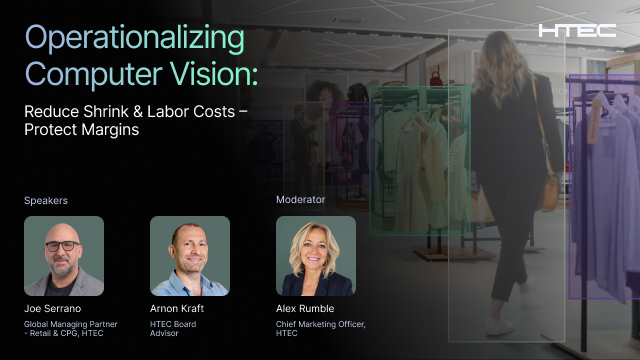
Operationalizing Computer Vision: Reduce Shrink and Labor Costs—Protect Margins
Retail margins are being squeezed by rising labor costs, persistent shrink, and inaccurate inventory. Despite heavy investment, retailers still lose over $112B USD annually to shrink and stockouts, and frontline teams remain bogged down by manual tasks that add little operational value. The answer may already be in their stores.
Most retailers have 20–50 cameras installed, yet less than 10% of their potential is tapped for real-time operational intelligence through computer vision. While interest in computer vision is growing, many programs stall at small pilots or visibility-only use cases that fail to deliver measurable business impact.
HTEC experts will explore why scaling computer vision is challenging—and what sets successful retailers apart from those stuck in pilot mode. Using real-world examples, attendees will see how tightly scoped, integrated deployments drive ROI by reducing shrink, optimizing labor, and improving on-shelf availability.
Attendees will also learn how to turn existing cameras into strategic assets with HTEC’s three-phase adaptive store infrastructure framework, enabling a smooth path from activation to enterprise adoption while ensuring control, security, and compliance.
When implemented effectively, retailers typically achieve:
- 20–40% shrink reduction
- 20–30% labor efficiency gains
- Payback within 12–18 months
Who Should Attend:
Senior retail leaders responsible for operational performance and large-scale transformation who want to move beyond experimentation and operationalize computer vision at scale.
What You’ll Gain:
- Practical guidance for deploying computer vision beyond pilots
- Proven approaches to embedding insights into store and enterprise workflows
- A clear framework to assess risk, align stakeholders, and scale with confidence
Plus:
A live Q&A to explore implications for your organization—architecture, scale, and commercial considerations.