

By Alex Dukic, Chief Digital Officer
Private equity moves fast. Deals compress into weeks. The pressure to move with conviction is real. The firms that win consistently are the ones who build that conviction on the most complete picture of an asset, including what’s inside the technology.
The greatest opportunities to create value are often hiding there.
After years of working with investment teams and operating partners on digital and AI evaluations, one pattern holds: the gap between what a company claims about its technology and what is actually true is almost always wider than expected. Closing that gap before a deal closes is where significant value is found, and protected.
The Due Diligence Opportunity
Traditional diligence is thorough in many dimensions. Financials are stress-tested. Legal risk assessed. Commercial assumptions challenged. But when it comes to digital and technical foundations, the depth of scrutiny rarely matches the scale of the opportunity.
Technical complexity hides behind surface-level metrics. A company can show impressive digital revenue, strong software margins, and a confident product roadmap while sitting on architecture that, with the right investment, could become a genuine competitive advantage. The numbers look clean. But the real story, the one that shapes the value creation plan, is deeper.
MILESTONE 1
The product roadmap tells you where a company wants to go. An independent, AI-augmented read of the architecture tells you whether it can get there.
Why AI Readiness Is Now a Pricing Variable
According to Bain’s Global Private Equity Report 2026, buyout value climbed 44% to $904 billion in 2025. In a market with rising asset prices and intense competition, the ability to accurately assess technology upside — including AI upside — is a genuine edge.
AI is now central to how companies present themselves. The firms that can distinguish genuine AI capability from a compelling pitch will pay the right price, invest in the right areas, and realize the returns the model assumes.
What’s often underpriced isn’t just current capability. It’s pace potential. A target with AI-ready infrastructure can be transformed materially faster than one rebuilding from the foundation, and that difference translates directly into what the asset is worth today. The firms that capture it treat AI investment with the same discipline as any other capital allocation decision: clear value lever, defined timeline, measurable return.
MILESTONE 2
Most targets can demo AI. Far fewer have the data infrastructure and engineering depth to run it in production. That distinction is increasingly what the valuation should reflect — and what rigorous AI readiness assessment makes visible.
What Rigorous Technical and Product Due Diligence Actually Reveals
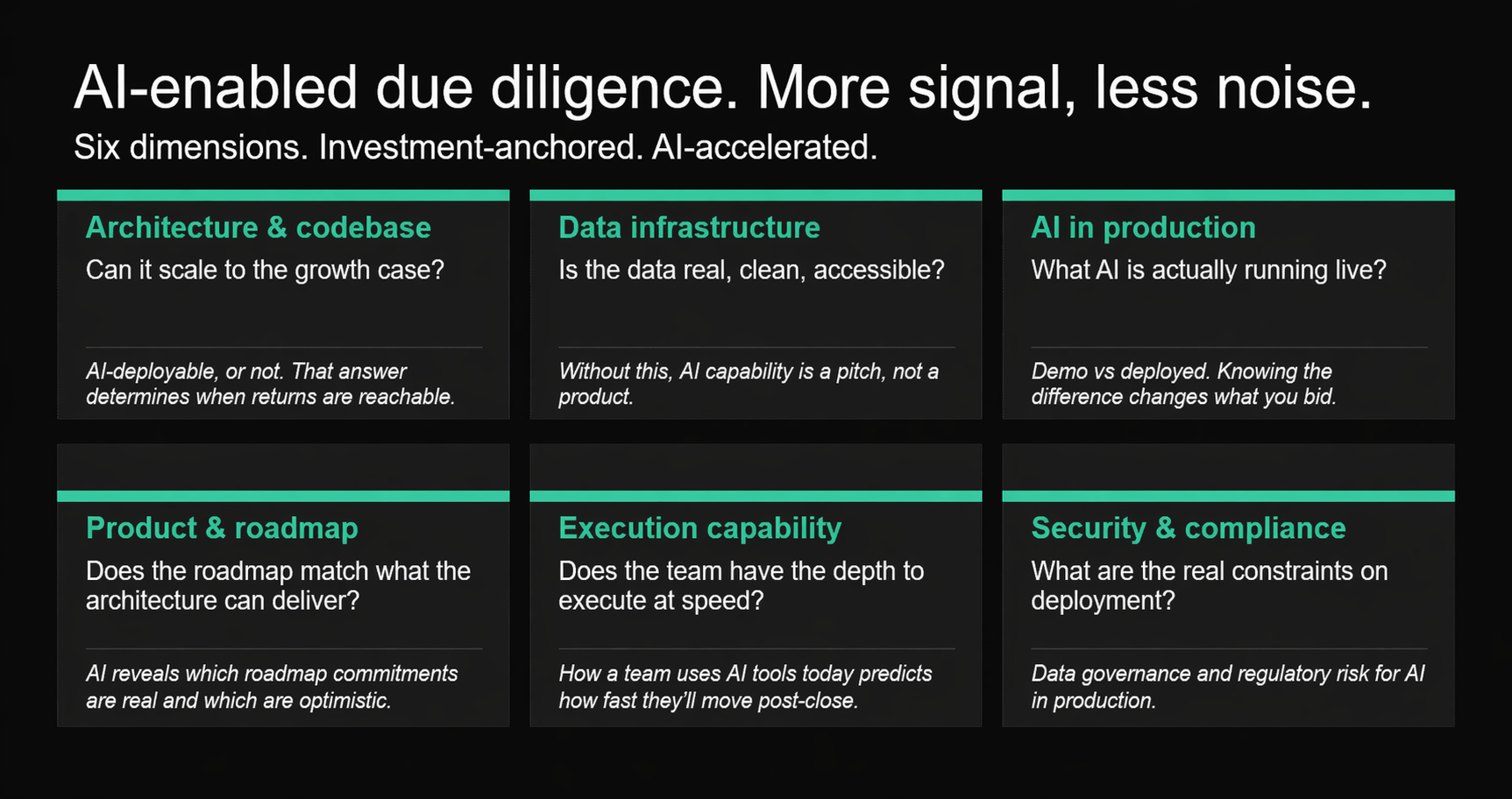
A serious evaluation of a company’s digital and AI readiness goes far deeper than reviewing the product roadmap or asking the CTO a few standard questions. It is an independent, structured evaluation of the real state of the business: architecture, codebase, infrastructure, data, security, and team, tested against the assumptions embedded in the deal.
Done well, it validates where the technology genuinely supports the thesis. It maps engineering strengths to specific value creation levers. It quantifies the real modernization investment — including what it takes to operationalize AI at scale — so capital allocation is accurate from day one, not revised eighteen months post-close. And it stress-tests whether the technical foundation can support the scale the model assumes.
MILESTONE 3
The three questions worth anchoring every evaluation to: does the architecture support the growth case, is the AI capability real and production-ready, and what does modernization actually cost?
Speed Is Not an Excuse to Skip Depth
Competitive processes move fast. But depth and speed are not in conflict.
A focused rapid evaluation, one to two weeks on the highest-priority dimensions, surfaces what matters before a bid is submitted. The more comprehensive six to eight week evaluation delivers the conviction required on larger or more complex transactions. The return on either investment is significant.
MILESTONE 4
A rapid AI-assisted read on the top technical dimensions costs a fraction of what a mispriced entry does. And it changes what you put in the bid.
Getting the Entry Right
Technical and product due diligence creates the most value when it is treated as a core part of investment decision-making, not a support step. It requires practitioners who have built and scaled digital products in production, who understand AI beyond the pitch deck, and who can translate engineering reality into investment language: value, capital, timeline, ROI.
Firms that approach it this way make better entry decisions. They price with accuracy, move faster post-close, and find the value others miss. For some firms, HTEC’s role starts at diligence. For others, it begins the week the deal closes. In both cases, the objective is the same: compress the timeline from investment to demonstrable value – and make that compression part of how the deal was underwritten in the first place.
MILESTONE 5
The firms getting this right bring technical diligence in alongside commercial and financial workstreams, not after. Those that will consistently outperform, treat AI-led value realization not as an aspiration, but as a deal underwriting assumption.
AI-Accelerated Diligence Is Itself a Competitive Weapon
The same AI capability that defines a target company’s upside is now reshaping how diligence gets done. Automated codebase analysis, AI-assisted architecture review, and pattern recognition across data infrastructure can compress the diligence timeline, without sacrificing the depth that matters.
Firms that deploy AI-native diligence workflows aren’t just faster. They’re operating with a higher signal-to-noise ratio. Inconsistencies between what’s documented and what’s deployed surface earlier. Technical debt that would take a human team days to map gets quantified in hours. The confidence going into a bid is qualitatively different.
The speed advantage is real. But the accuracy advantage is what actually moves the needle on pricing. This isn’t a claim about using AI tools. It’s how HTEC’s own delivery model is structured. The triage process itself runs on AI-powered agents for stakeholder interviews, transcript analysis, and architecture review, which is what makes the compression in timeline real rather than theoretical.
MILESTONE 6
The firms arriving with better information aren’t working harder. They’re using the same AI that defines their targets’ upside to run the diligence itself.
Looking closely, before the deal closes, is what separates a well-priced entry from an expensive lesson. If that’s a conversation worth having on a deal you’re evaluating, reach out to HTEC or connect with Alex Dukic, HTEC’s Chief Digital Officer, leading digital value creation strategy for private equity firms and their portfolio companies.