Executive Summary: The State of AI in the Automotive Industry in 2025–2026
AI is becoming embedded across vehicles, manufacturing, and mobility ecosystems—but scaling it across complex, safety-critical systems remains the defining challenge for automotive leaders.
In Brief
Based on insights from 267 C-level automotive executives.
The findings show that automotive organizations have mostly moved beyond experimentation. AI is now actively pursued across ADAS, autonomous driving, manufacturing optimization, predictive maintenance, and connected vehicle services.
Yet, most organizations are still working through fragmented deployments, integration complexity, and capability gaps that limit enterprise-wide impact.
In automotive, AI is a systems challenge. Success depends on how effectively organizations integrate it across hardware, software, edge environments, and cloud infrastructure, while meeting strict requirements for safety, latency, and reliability.
Download this Automotive Report
Complete the form below to access the report.

Download Cross-Industry View of the State of AI in 2025-2026 Report
KEY FINDINGS
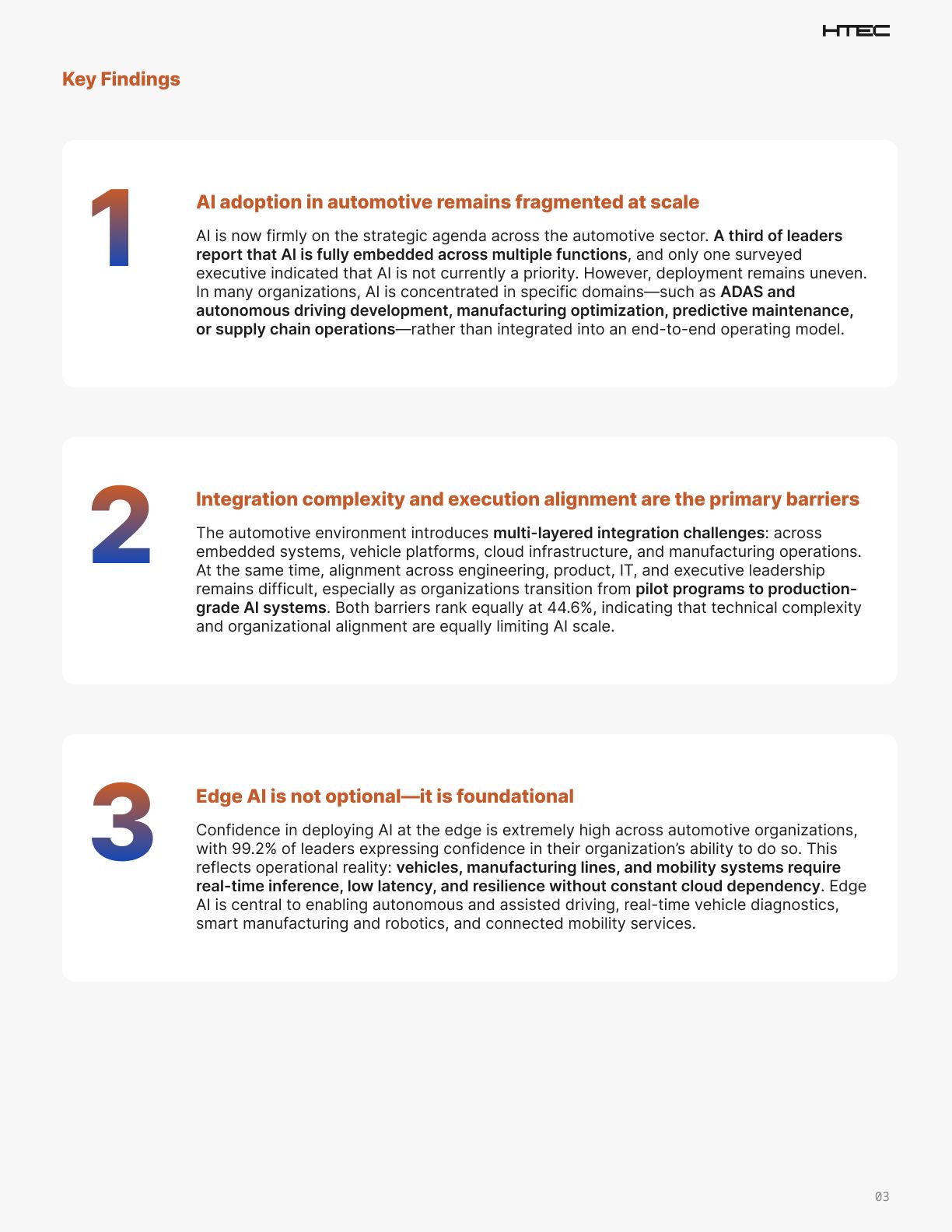
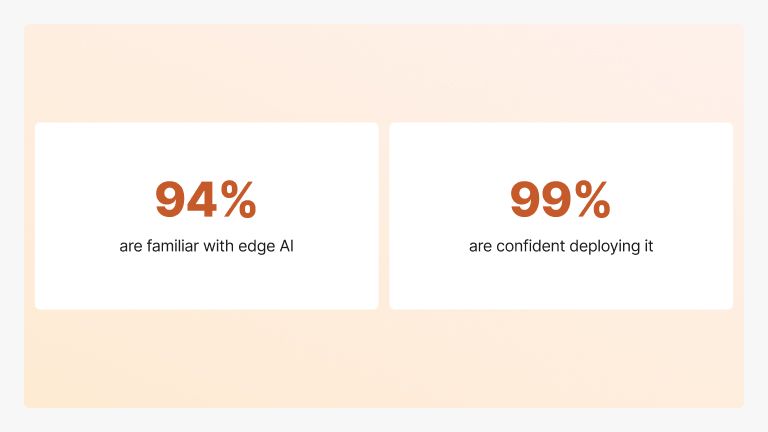
AI adoption remains fragmented at scale
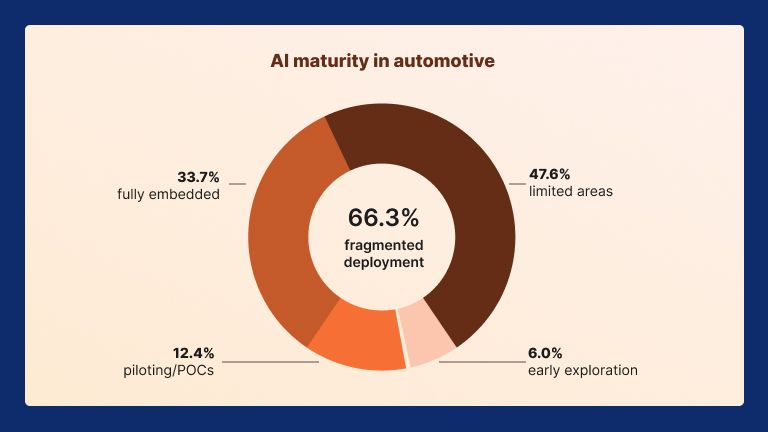
Top Barriers to Deeper AI Integration
Edge AI: Enabling Precision and Control Across Automotive Systems
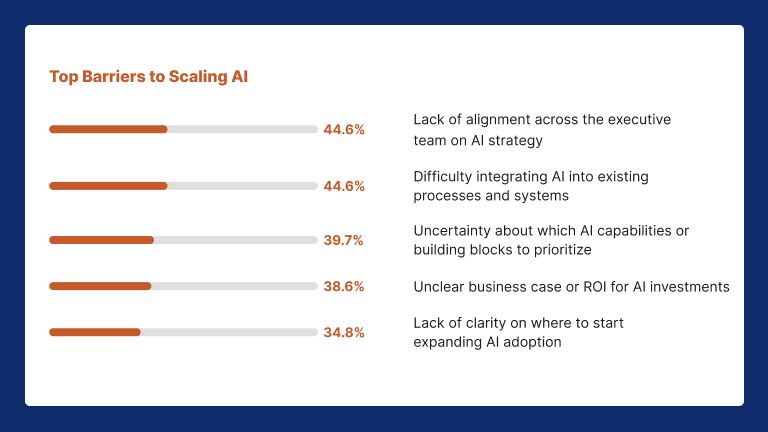
With 99% of leaders confident in deploying AI at the edge, real-time, low-latency intelligence is now central to vehicles, manufacturing, and mobility systems.
Familiarity and Confidence in
Deploying AI at the Edge
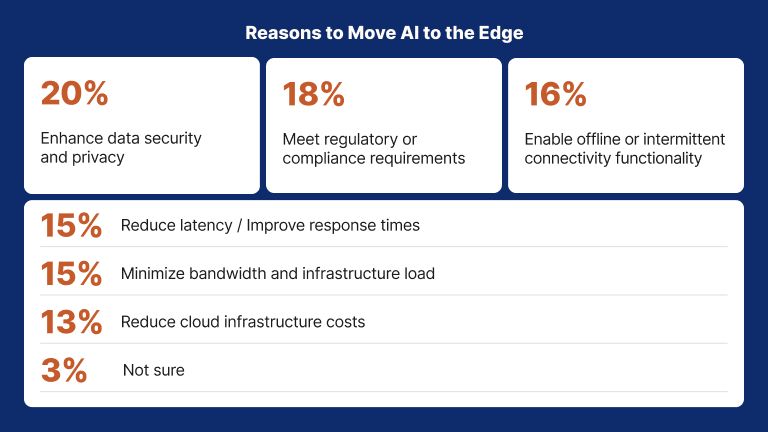
Why Automotive Organizations
Move AI to the Edge
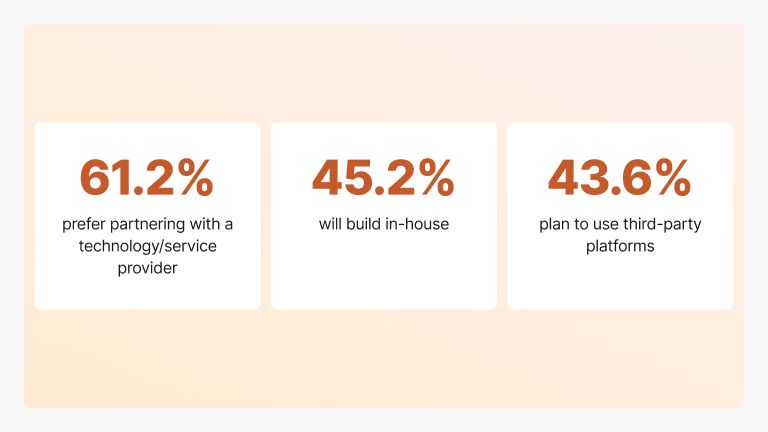
How They Approach
Edge-to-Cloud Integration
AI Execution Is a Race Against Time
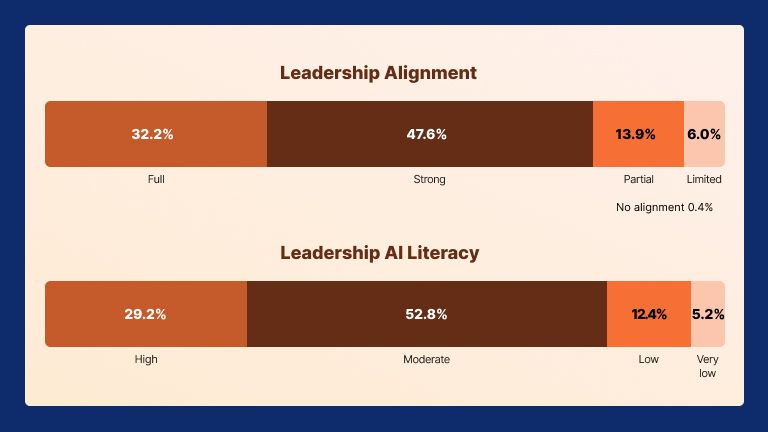
Executive AI Literacy
Keeping Pace with AI is Getting More Urgent
Leaders estimate that falling behind on AI and edge initiatives would set their organizations back by nearly
1.87 years on average
Only
27.8%
believe they can adopt and scale AI rapidly.
Automotive leaders show strong alignment, but AI literacy remains uneven, with 70.4% reporting only moderate or low levels of understanding. This suggests that while strategic intent is clear, the depth of expertise needed to translate AI into effective execution is still developing.
Methodology
The report was commissioned by HTEC and conducted by Censuswide.
It includes insights from 267 C-level automotive executives, gathered as part of broader global research into the perspectives of 1,529 C-suite executives across the USA, UK, Germany, Spain, Saudi Arabia, and the UAE, spanning CEO, CIO, CTO, CDO, CFO, COO, CPO, and CSO roles.
For the cross-industry executive view on AI transformation, please see our Cross-Industry View of the State of AI in 2025-2026.
What’s next?
The next phase is not about isolated innovation, but embedding AI into real-world systems by connecting engineering, data, and operations into a unified, production-ready environment.
The organizations that lead will be those that:
- Bridge hardware and software into integrated systems
- Align strategy with execution across teams and platforms
- Build the capabilities needed to deploy AI safely at scale
Download the full report to explore how automotive leaders are navigating this transition, and what it takes to move from fragmented adoption to scalable AI transformation.
Download this
Report