


HTEC Finds AI is Everywhere in FSI, but Scaling Across the Enterprise Remains the Industry’s Biggest Hurdle
In brief
- To understand how AI is reshaping financial services and insurance, HTEC analyzed insights from 250 C-suite leaders across the USA, UK, Germany, Spain, Saudi Arabia, and the UAE—drawn from our broader study of 1,529 executives spanning CIOs, CTOs, CDOs, CPOs, CFOs, COOs, CEOs, and CSOs.
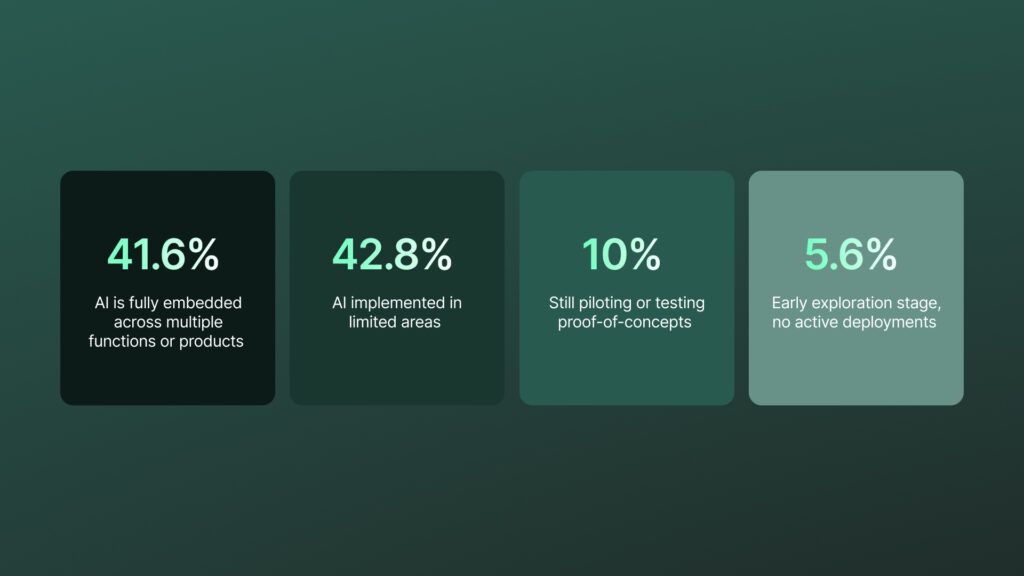
- AI adoption has reached critical mass: 85% of FSI organizations already have AI deployed in at least some areas, and none say AI is not a priority—clear evidence that AI is now foundational to competitiveness.
- AI may be widely deployed, but value extraction lags: integration hurdles (40%) and leadership misalignment (36%) remain the top barriers, and as a result, only 22.6% of leaders believe their organizations are prepared to capture AI value at an enterprise level over the next 2–3 years.
From adoption to enterprise impact
AI may now be embedded across much of financial services and insurance, but uncertainty persists beneath the surface. Adoption remains uneven, integration is fragmented, and leaders are still navigating how to turn early progress into enterprise-wide value. Across markets and institutions, maturity varies widely: while some have embedded AI deeply into their operations, others are still contending with legacy systems, unclear priorities, and organizational misalignment that slows momentum at every level. These gaps are exactly why the institutions moving fastest are the ones anchoring their AI efforts in a clear, outcomes-driven strategy.
This report examines how FSI leaders are working to close those gaps and move from fragmented adoption to enterprise-grade execution. The next wave of competitiveness will come not from using AI, but from operationalizing it—turning ambition into execution and enabling the data, platforms, and people required to deliver sustained value across the enterprise.
The hidden friction inside AI transformation
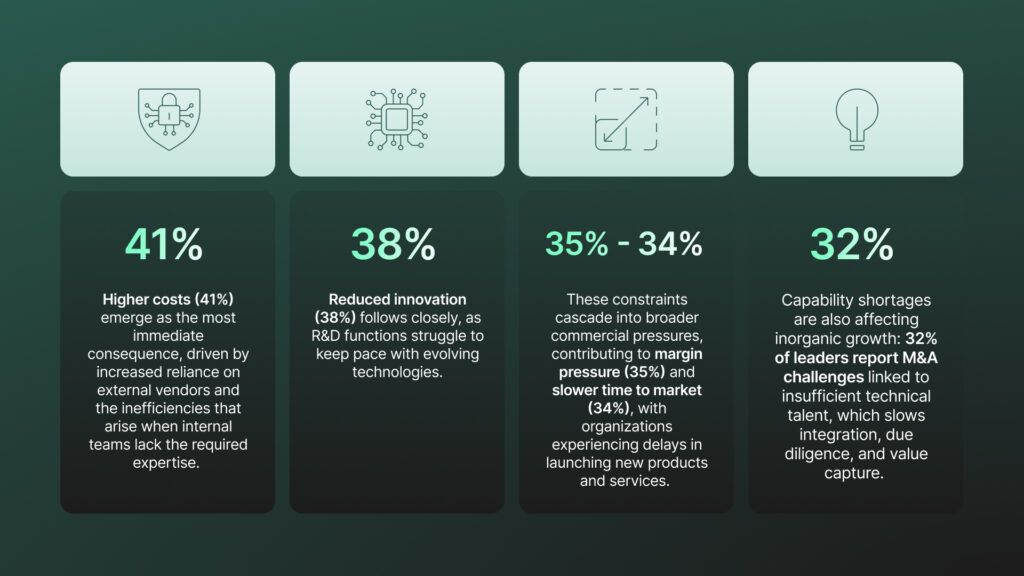
Talent and integration gaps are the biggest brakes on AI progress. Leaders consistently point to shortages in data engineering, cybersecurity, DevOps/automation, edge computing, and AI/ML expertise—skills that sit at the heart of turning AI from isolated pilots into enterprise-grade systems. Without them, institutions struggle to modernize legacy architectures, secure sensitive data, or move models into production with reliability and scale. The consequences compound quickly: costs rise as teams lean more heavily on external vendors, innovation slows as internal capacity is stretched thin, and time to market slips as engineering bottlenecks accumulate. Over time, these gaps erode margins, limit competitiveness, and create an execution disadvantage that widens with every quarter. In other words, the AI talent gap is no longer a technical deficit—it’s a financial and strategic liability.
The strategic gap at the top
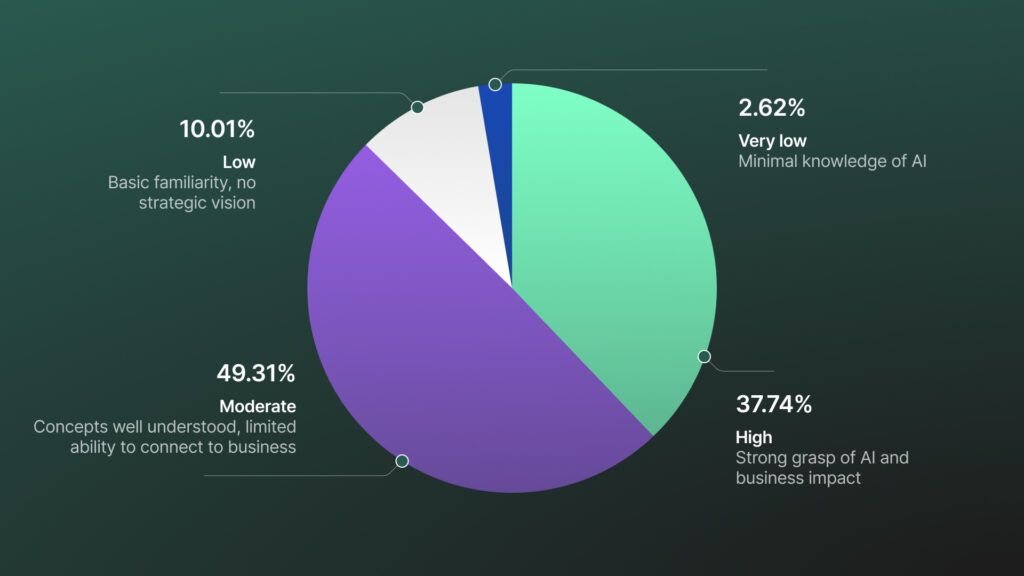
Leadership alignment is strong, but AI literacy and readiness are uneven. More than eight in ten leaders (82%) report full or strong alignment on AI transformation. However, only 38% rate AI literacy within their executive team as high, and readiness to keep pace with the AI landscape is mixed: only about a quarter (22.6%) feel able to adopt and scale rapidly, while the largest group—28.8%—is still in a “learn and experiment” phase with limited value capture. Without deeper literacy and shared understanding, alignment alone isn’t enough; decisions stall, priorities drift, and momentum is lost. For many institutions, this disconnect is now one of the biggest risks to realizing AI’s enterprise-wide value.
Compressed timelines to act
The window to act is short, and institutions are planning accordingly. Leaders estimate that failing to act on AI opportunities would set them back 1.92 years in competitiveness. In response, they are targeting compressed timelines of 1.6–1.7 years to validate use cases, finalize AI roadmaps, deploy strategies, empower their workforce, and develop new AI-enabled revenue streams.
Yet even with accelerated plans, one reality is clear: no single institution can deliver this transformation alone. Most leaders expect to rely on third-party platforms (56.9%) and technology and service partners (56%), while only 37% believe they can build the necessary capabilities internally. The path forward depends on combining external scale and expertise with focused in-house strengths to move at the speed AI now demands.
What next?
The results reflect a sector in transition: confident in its AI ambitions, but still working through the complexities of scaling, integration, and organizational alignment. While most FSI leaders view AI as foundational to future competitiveness, translating that belief into fully operational, connected systems remains a work in progress.
Download the FSI Report
Access the full report for deeper data, leader perspectives, and actionable guidance for AI transformation.

Download Cross-Industry View of the State of AI in 2025-2026 Report
Download the FSI Report
Access the full report for deeper data, leader perspectives, and actionable guidance for AI transformation.