Even the most ingenious solutions will fail to gain traction if they don’t answer a specific and pressing need. Our client, a winery technology startup, had an excellent solution for small wineries, but no solid information to confirm a specific need from that market segment.
HTEC designed and conducted comprehensive research to unearth insights that would inform the product strategy, preventing costly misassumptions while shaping both the product’s features and its market entry strategies.
Project: Validating product vision before building
A wine technology startup approached HTEC with an ambitious vision – to build production software tailored specifically for small wineries. They’d identified what they believed was a gap in the market, but had no validation for their assumptions. Before investing significant resources into product development, the client needed answers to fundamental questions about market viability, target audience, and product-market fit.
The client wanted to understand whether the problem they’d identified was genuine, who would actually pay for a solution, and what features would drive adoption. With established players already in the wine tech space, getting these answers right wasn’t optional – it was critical to avoiding costly missteps and positioning for success in a competitive market.
HTEC partnered with the client to conduct comprehensive market and user research, providing the strategic product insights needed to move from assumptions to a validated product strategy.
Challenge: Building in the dark without market validation
The client faced a classic early-stage product challenge – strong conviction about an opportunity but no hard evidence to back it up. They believed small wineries were underserved by existing software solutions, but couldn’t answer critical strategic questions:
- Was the problem real enough that wineries would pay to solve it?
- Who specifically was the target customer?
- What features would matter most to them?
- How big was the actual addressable market?
The wine tech landscape was already crowded with established competitors, each claiming to solve winery production challenges. Without clear market validation, the client risked building yet another solution that looked good on paper but didn’t fit how small wineries actually operate.
Solution: Mixed-method research uncovering what small wineries actually need
HTEC designed a comprehensive research program combining market analysis with deep user insights to answer the client’s most pressing strategic questions.
We started with a competitive landscape review, analyzing 12 existing wine production software solutions to map their pricing strategies, feature sets, and market positioning. This revealed where competitors were overserving enterprise customers while leaving smaller operations behind, and identified specific gaps in workflow flexibility, implementation complexity, and pricing transparency.
To quantify the business opportunity, we built a detailed market sizing analysis across the US, Europe, and Australia. The TAM/SAM/SOM model revealed a $12.6 billion global market for wine production software, with a $9.8 million serviceable market specifically for small to medium wineries – confirming the opportunity was substantial if the right product could be built.
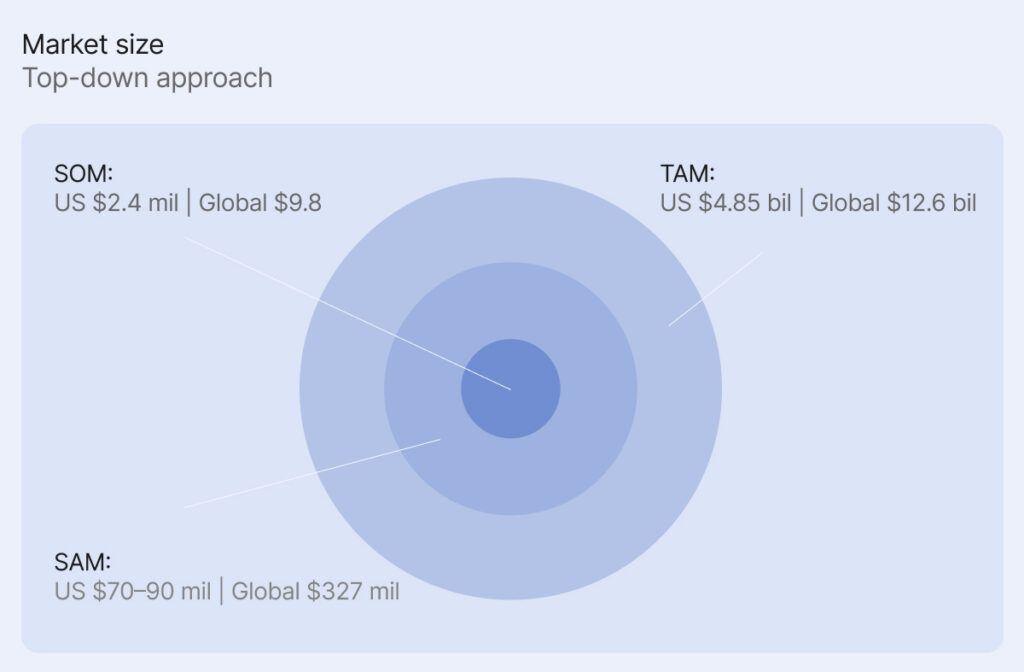
| TAM Total Addressable Market represents the entire winery management software market. It includes all wineries regardless of size and represents 100% of spending in winery software. |
| SAM Serviceable Addressable Market represents spending in winery software among only small/medium wineries. It’s calculated as the number of small/medium wineries multiplied by average annual spend (~32,725 × $10k). |
| SOM Serviceable Obtainable Market represents a realistic market capture for a new entrant. Here, we used a conservative 3% estimation based on: Industry benchmarks: Successful SaaS startups in fragmented markets typically capture 1–5% within 5 years. Competitive reality: With established players, aggressive targets aren’t realistic. Adoption curve: Given that 63% still use Excel, market education takes time. Phased approach: Year 1–2: 0.5% ($1.6M) – Early adopters, proof of concept Year 3–4: 1.5% ($4.9M) – Word of mouth, case studies build Year 5+: 3% ($9.8M) – Established player status |
The core of our research involved 10 remote interviews with small winery operators, exploring their workflows, pain points, and decision-making around software adoption. But we didn’t stop at interviews. We conducted three on-site visits during active winemaking operations, observing how winemakers actually work – wet hands and paper forms in WiFi-less cellars and the stark disconnect between their operational reality and what software companies assume they need.
One finding immediately stood out: 63% of wineries still rely on Excel spreadsheets despite numerous available software solutions. This wasn’t about preference or resistance to technology – it signaled a fundamental mismatch between what’s being built and what actually works for small winery operations.
The research uncovered something counterintuitive – the problem wasn’t a lack of software options. It was a lack of software designed for how small wineries operate in reality. Wineries producing under 5,000 cases are dramatically underserved because existing solutions were built for large operations, bringing enterprise-level complexity and pricing that makes no sense at boutique scale.
One particular insight reframed the entire product strategy: winemakers don’t want production management software. They want a digital memory. They already know how to make wine – their real challenge is remembering what they did, quickly finding past recipes, and tracking work without drowning in paperwork or compliance documentation. This distinction fundamentally changed what needed to be built.
The on-site observations revealed a non-negotiable technical requirement most competitors had overlooked: offline-first functionality. Cellars have no WiFi. Wine is made in spaces where connectivity is unreliable or nonexistent, so software requiring constant internet connection becomes useless precisely when winemakers need it most – during actual production work.
Research also exposed a dual audience challenge. Winemakers prioritize simplicity and workflow integration – they need tools that don’t disrupt how they work. Business owners focus on ROI and regulatory compliance – they need justification for every dollar spent. Any successful solution must speak convincingly to both, remaining simple enough for daily use while demonstrating clear business value.
Success: From assumptions to validated strategy and confident product decisions
The research delivered exactly what the client needed – clarity on where to focus and confidence in what to build.
We confirmed the problem was real and pinpointed the exact target audience – not based on assumptions but drawn directly from market data and user interviews. Instead of building features that seemed logical on paper, the client gained a prioritized MVP feature list based on the workflows observed in working wineries. Features were ranked by genuine user impact rather than technical convenience. The research identified opportunities for advanced AI and machine learning technologies, but crucially showed these innovations should come later – after solving fundamental workflow problems first. This sequencing prevented over-engineering for a market not yet ready for complexity.
Beyond features, we delivered a concrete market entry strategy. That $9.8 million serviceable market came with clarity on which segment to target first, why they’d switch from current solutions, and how to position against established players. The research revealed that capturing just 3% of this market would mean reaching 980 wineries globally – a solid, sustainable business for a focused solution.
Most importantly, the research prevented expensive mistakes. Without these insights, the client would have built enterprise features for boutique customers and prioritized the wrong workflows entirely. Instead, they moved into MVP development with validated assumptions, a defensible roadmap, and a differentiation strategy grounded in real market gaps rather than guesswork.
The upfront investment in research accelerated all subsequent product decisions, enabling the team to move decisively with confidence. Market sizing confirmed the opportunity was both real and viable at scale. User insights shaped not just individual features but informed the entire go-to-market strategy. Competitive analysis showed exactly where and how to differentiate in a crowded market.
Ready to validate your product strategy with product insights?
Get in touch to explore how HTEC’s Market Research and Product Insights services can de-risk your next big move and transform market uncertainty into strategic advantage.