
Every major technology shift has carried the same assumption: once the tools are in place, adoption will follow. Cloud migrations, ERP rollouts, even the move to digital workflows all began with the belief that capability equals readiness. The systems were deployed, access was granted, and in theory, the organization was good to go.
AI is following the same pattern, only faster, and with higher stakes.
Organizations track deployment timelines, model performance, and adoption rates with considerable precision. What gets far less systematic attention is the variable that quietly shapes whether any of it works in practice: the degree to which employees believe the intention behind the AI transformation and see it as beneficial for them.
When that trust is low, resistance follows as a predictable outcome, and no communication campaign reverses it while the underlying conditions stay the same. In most AI rollouts that stall, the limiting factor is not the technology but the human side of the equation.
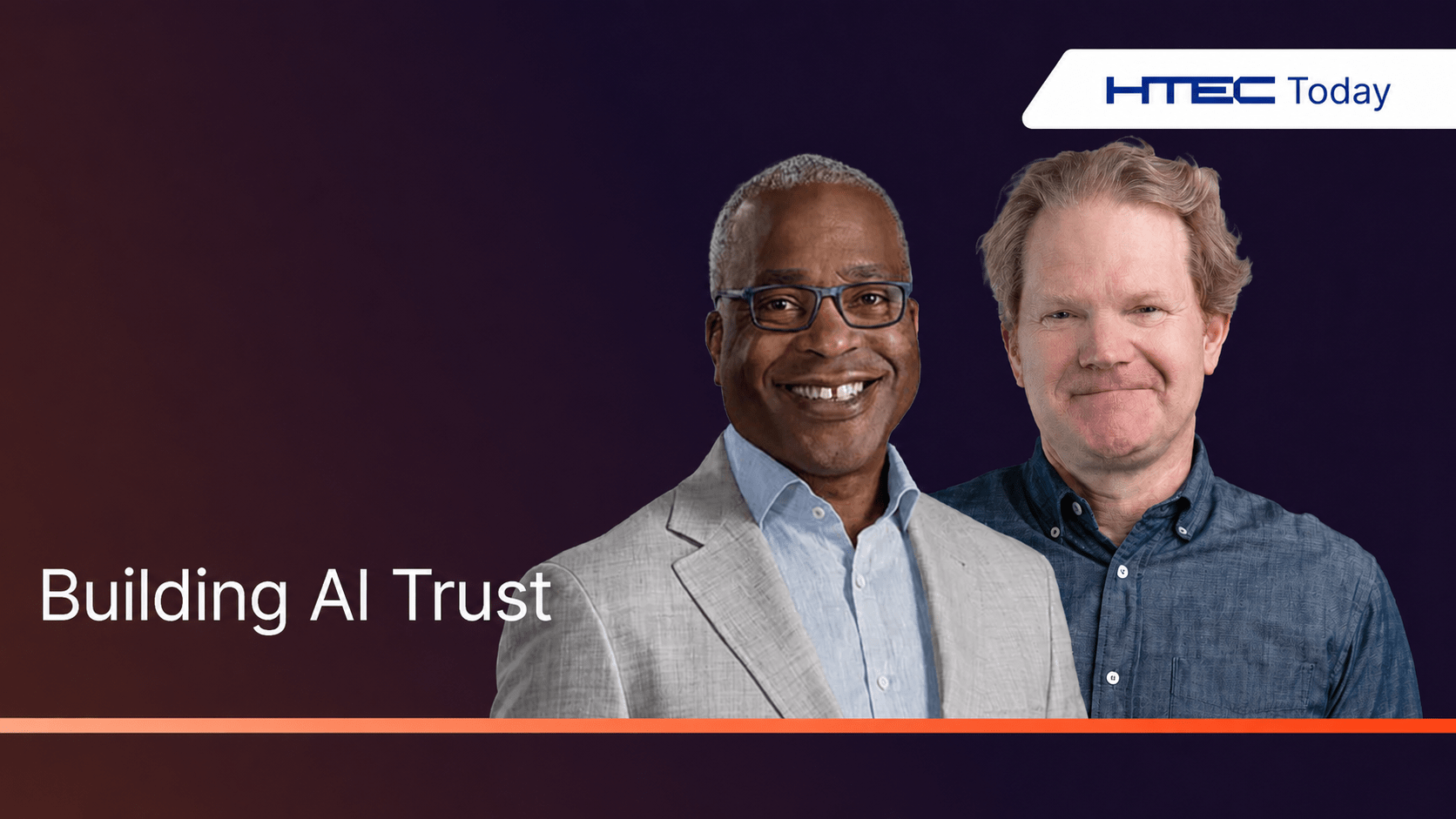
HTEC’s Chief Product and Design Officer, Carsten Wierwille, explored this with Michael Bush, CEO of Great Place to Work, and what emerges from that conversation cuts across industries and adoption stages alike.
A trust deficit that is widening
The pattern is consistent regardless of region or industry: something significant is shifting in how work gets done, and most employees are not being prepared for it. Leaders are announcing transformation while training falls behind, tool access remains uneven, and many of the executives driving these initiatives are not yet deeply proficient in the technology themselves. That discrepancy between what is announced and what is resourced is where trust breaks down.
There is also a structural dimension worth acknowledging. Executives are close to the strategy, invested in the outcome, and operating with early access to information. Frontline employees are working with far less context and far more exposure. To the people doing the work, that gap is not an oversight. It is a message.
Trust is a performance variable
Great Place to Work has been measuring these signals for over 30 years through its Trust Index, used by more than 22,000 organizations across 60 countries. What that research consistently shows is that high-trust organizations outperform on every meaningful dimension: retention, productivity, innovation, and, most recently, AI adoption. Low trust does not just slow transformation down. It produces a workforce that is technically present while fundamentally disengaged.
The more useful framing is that trust is buildable, and the behaviors that build it are learnable.
What effective leadership looks like
Leaders making real progress on AI adoption share a few recognizable behaviors. The first is honest communication in a specific sense: when employees raise hard questions about job security or direction, the instinct is to reassure. The more effective approach is to acknowledge genuine uncertainty while being clear about intent and accountability. Employees are not expecting complete answers, and a leader who says “I don’t have all the answers, but here is what I believe and what I am committed to” often earns greater trust through that openness.
The second behavior worth noting is closing loops through active listening. Trust accumulates through visible follow-through, when employees see that their input doesn’t just get heard, but actively shapes decisions and actions. A single all-hands or an open-door policy will hardly ever suffice.
The third is storytelling. Abstract reassurances about the future of work do not land for employees navigating a moment with no clear historical parallel. What resonates is hearing from leaders who have moved through genuine uncertainty and can speak honestly about what that experience taught them.
Training as a trust signal
The training that moves adoption is role-specific. Showing someone how AI makes their particular job more impactful is qualitatively different from explaining how the technology works in the abstract. When people can draw a direct line between a new capability and their own professional growth, something in the relationship shifts. It becomes evidence that the organization is building with them, not around them.
The bottom line
The technology is capable enough, and the strategic case is strong enough.
What determines whether an AI transformation can succeed is whether the people inside the organization trust the institution enough to engage honestly and take the risks that real change requires.
That trust cannot be mandated or manufactured; it accumulates through consistent behavior over time, and the organizations investing in it seriously now are building a meaningful advantage that others will find genuinely difficult to replicate.
To hear Michael Bush, CEO of Great Place to Work, explore this further, watch the full conversation here.