

AI as a technology is blurring the lines that previously defined industry-specific requirements. This evolution is creating an opportunity for executives to learn from each other and share experiences like never before. And since it is also those same executives who are spearheading their own organization’s AI-driven transformation, clarity in strategy and the end goal, followed by concrete and pragmatic action, are critical.
HTEC’s AI-first executive series panels were designed to shift the AI conversation away from the hype and associated promises of transformative value, towards practical steps that help C-level executives identify the strongest ROI opportunities, define impactful models of integrating AI into business operations, and navigate the organizational change necessary to realize value.
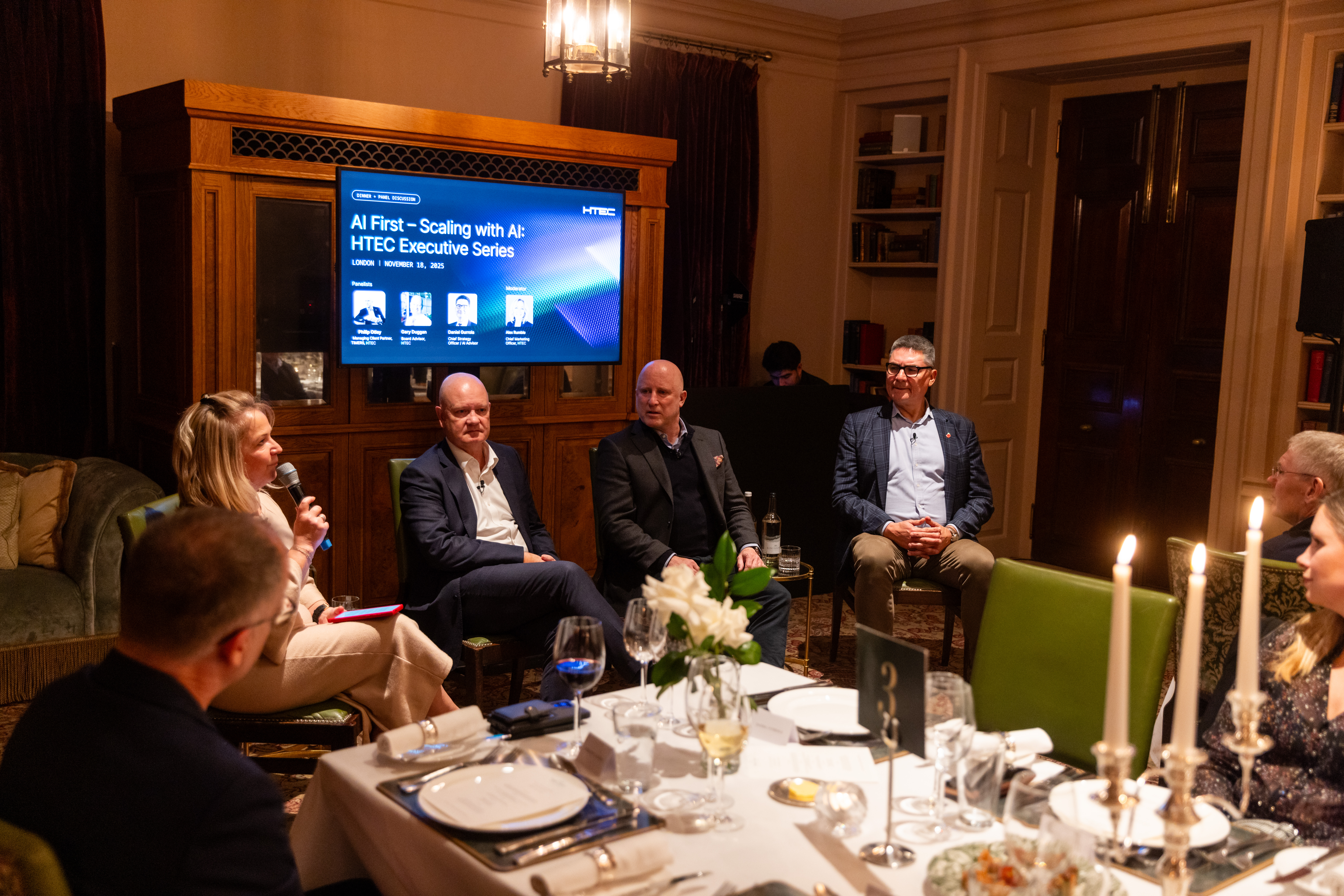
The previous AI-first events gathered close to 250 executives across panels in London, New Jersey, San Diego, Munich, and Palo Alto. On November 18, the series came back to London for another round of impactful and level-setting discussions about effective ways to scale AI.
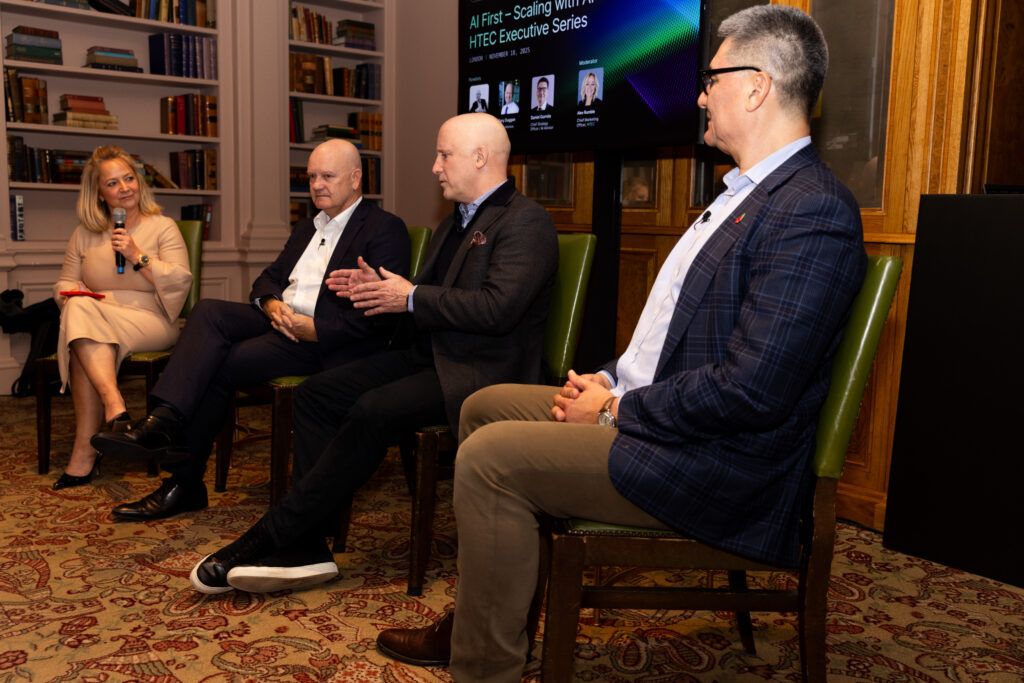
The panel once again featured a heavyweight lineup of executives with vast collective experience in AI implementation and technology-led organizational change. The panel was hosted by HTEC’s Chief Marketing Officer, Alex Rumble, and featured Gary Duggan, HTEC’s Board Advisor and former CEO of Tesco Insurance, Daniel Gurrola, former CSO of Verizon Consumer Group, and Philip Otley, HTEC’s Global Managing Partner. While the first edition of the London gathering focused on the practical steps towards becoming an AI-first organization, this second panel was dedicated to scaling AI based on ROI and achieving executive alignment.
ROI as the common language of organizational alignment
The path towards successful integration of AI into business processes is obviously led by novel technology, but it is rooted in a far more traditional concept: organizational alignment. Philip Otley kicked off the conversation by emphasizing that AI adoption should be approached as any other strategic shift within the organization, with the same pragmatic focus on two pillars: the investment and the expected returns on one side, and collective internal buy-in on the other. Following these two guide rails enables quality conversations on an executive level that lead to strategic alignment.
Gary Duggan highlighted the importance of looking at ROI from a more comprehensive perspective of the 4 C’s: customer, colleague, community, and company. He detailed how defining and implementing solutions that focus on all four pillars ultimately leads to a cumulative positive outcome that extends beyond immediate ROI and sets organizations up for long-term success.
Closing the imagination gap
While organizations have generally shown a willingness to invest in AI and the necessary organizational change that enables effective AI adoption, there is widespread uncertainty and a lack of clarity on how to best utilize AI to drive value.
The key step towards achieving strategic alignment on an organizational level often lies in turning the abstract into concrete and gaining a clear vision on how potential can translate into value. Philip Otley refers to this as “closing the imagination gap”. He recounted his experiences in working sessions with executives where he presented tangible use cases for the adoption of industrial AI and emphasized how providing practical examples can help lift the veil and pave the way towards the adoption and effective implementation of AI solutions. While efficient execution of AI strategies remains the key challenge for most organizations, gaining a collective clarity of vision and alignment on what that strategy should be is the key prerequisite.

The art of possible
Daniel Gurrola made note of the clear and present pressure on executives to lead the change and introduce effective AI solutions, which can lead to attempts to adopt AI without a clear idea of how to generate value. Through its interactions with clients, HTEC has developed an approach designed to help executives visualize concrete and detailed AI implementations to advance their business. This approach has been very effective in replacing confusion with clarity and providing a pathway towards effective adoption.
Daniel recognized that most organizations are experimenting with AI on different levels and that is perfectly fine, but what is necessary is a cohesive strategy and an overall perspective of where the organization wants to go in order to unite those efforts and ensure that they all relate to the overall goals. He also emphasized that the organizations’ time for experimentation with AI has just about expired, and that now is the time for early-stage development.
The value of partnerships
The panel has also recognized that AI is changing the industrial landscape faster than ever and that most, if not all, organizations simply don’t have the full internal resources to execute the full-scale organizational transformation on their own. The pace of transformation is so high that taking the time to build sufficient internal resources can have a negative effect on the organization’s ability to adopt AI fast enough.
Rather than identifying partnerships as a weakness, the panelists encourage organizations to embrace partnerships as a way to accelerate AI adoption. Building an AI-powered system is different from traditional software development to the point where it makes more sense to leverage partnerships to accelerate one’s own efforts, rather than spending the time to build skills and capacities that are readily available elsewhere.
Effective adoption of AI remains a complex, multi-faceted challenge for organizations. While panelists agree that there are no quick-fix solutions and that organizations must consider their specific circumstances to define their own answers for the questions on every executive’s mind, they also agree that achieving a collective clarity of vision rooted in practical steps and a focus on generating value is the foundation of successful implementation.
As the panelists have collectively concluded, the question of an organization’s AI maturity is as much organizational as it is technological. Approaching AI adoption solely as a technology challenge can lead to organizational blind spots and a lack of strategic direction. In other words, a good AI strategy is actually a strong business strategy with AI placed at the heart of its operations. Even as AI is transforming business operations across the board, focusing on ROI and people and change management remains the core of organizational success.
We wish to thank our panelists for using their experiences and perspectives to create a platform for meaningful discussions that lead to a better understanding of how to navigate the industry-wide AI transformation. We are looking forward to continuing the AI-first series and new opportunities to engage executives in realistic talks about the delicate art of AI scaling.