
The Shift: From “Best Model” to “Most Efficient Inference“
The AI conversation has shifted, with the shift happening primarily at the infrastructure layer. Training a model is a one-time event. AI inference — running that model in production, at scale, for every user request — happens constantly. And the economics reflect that reality: major model providers are currently subsidizing inference costs, with real expenses substantially higher than what customers pay. That cannot continue indefinitely. As AI adoption grows, context windows extend, and reasoning models demand more compute per query, the cost of inference will only climb. The companies that build a durable advantage won’t just choose the right model. They’ll choose the right hardware to run it on.
Why General-Purpose Hardware Is Losing Its Edge
Nearly all AI inference today runs on NVIDIA GPUs. This is largely a historical artifact: models were built and trained on NVIDIA hardware, so inference defaulted to the same architecture.
Training and inference are fundamentally different workloads. Training demands massive parallelism over long runs. Inference demands low latency, high throughput, and energy efficiency — often at the edge, often under real-time constraints. Purpose-built inference chips from companies like Infineon, Sima.ai, D-Matrix, and AMD are being designed specifically for this profile, and they can run certain workloads 10 to 100 times more efficiently than generalized GPU clusters. The business case for specialized hardware is becoming impossible to ignore.
WORKLOAD COMPARISON
TRAINING
Compute:
Massive parallelism
Duration:
Long-running jobs
Optimization:
Accuracy
Deployment:
Centralized
INFERENCE
Compute:
Low-latency execution
Duration:
Real-time or near real-time
Optimization:
Speed + cost efficiency
Deployment:
Distributed/edge
WHY THIS MATTERS
Purpose-built inference chips from Infineon, Sima.ai, Dimensional Matrix, and AMD are designed specifically for this profile — running certain workloads 10–100× more efficiently than general-purpose GPU clusters.
The Hidden Bottleneck: No Generalized Compiler Exists
Here is what most discussions about inference hardware miss: the chip is only half the problem.
Unlike ARM or x86, there is no generalized compiler for AI inference hardware. Every chip vendor designs their silicon differently, and because most compilers are immature, deploying real applications on specialized hardware requires deep manual workload optimization. Integrating a new model today takes four to twelve weeks, and by the time it’s done, a newer model has often already been released. This is not a temporary inconvenience. It is a structural challenge, and the reason most organizations default back to NVIDIA. Not because it is technically superior, but because the path to deployment is well understood.
Where the Real Competitive Advantage Lives
The advantage in creating specialized hardware is only realized when the customer workload is running. That requires a software stack that works and is usable.
Speech-to-text, LLM inference, and real-time fraud detection all require workload-specific optimization that cannot be abstracted away. Companies that can map AI workloads to hardware architecture efficiently unlock cost and performance advantages unavailable on generalized platforms.
Why Inference Expertise Is Harder to Build Than the Hardware Itself
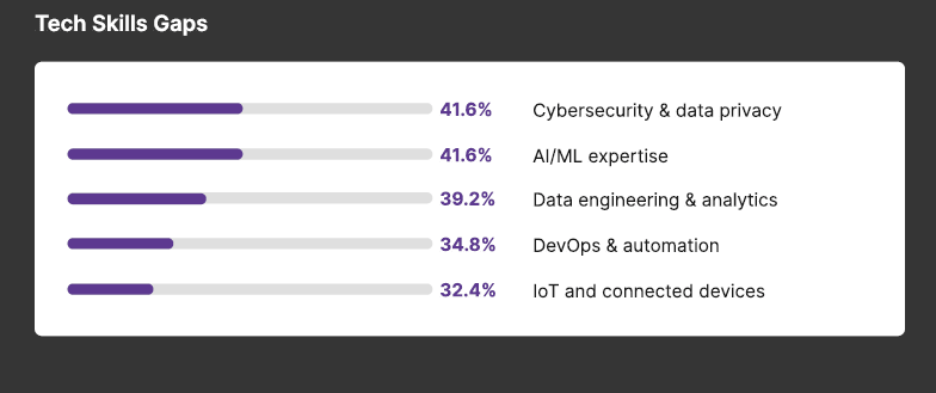
The strategic question for AI users is not simply which chip to buy. It is whether the organization can exploit the benefits of the hardware by running commercially interesting models. We see across the custom AI ASIC space that companies building cutting-edge platforms all struggle to find talent in compiler expertise, hardware architecture knowledge, and AI workload mapping. These are among the rarest skills in the market — and industry is moving faster than most hiring plans. In fact, HTEC’s recent research report on the “State of AI in the Semiconductors Industry 2025-2026” finds that AI/ML expertise, data engineering, and DevOps are among the widest talent gaps in the industry — the exact skill clusters that inference deployment depends on most.
The value of the right partner is not the acceleration of an existing process. It is enabling a capability most organizations currently cannot access at all — compressing years of internal capability-building into a deployable team that can deliver efficient implementations from day one.
Hardware Is Strategy
Inference hardware is no longer an infrastructure detail. It is a strategic decision that affects cost structure, product performance, time to market, and the types of applications you can viably build. Looking ahead, as AI moves from pilot to production across entire organizations, inference will become the dominant line item in AI infrastructure budgets — not training. The companies that treat hardware as strategy will compound advantages in efficiency, capability, and reach that competitors running generic stacks simply cannot match.
The window to build this advantage is open now. The question is whether your organization has the expertise to step through it.
HTEC works with enterprises and inference hardware vendors to close the gap between specialized silicon and production-ready AI. If inference cost, latency, or deployment complexity is a constraint for your organization, let’s talk.
FAQ
What is AI inference hardware?
AI inference hardware is the compute infrastructure — GPUs, CPUs, or specialized chips — used to run trained AI models in production, generating predictions or outputs in real time or at scale. Unlike training, which happens once, inference runs continuously every time a model serves a user request. For enterprises, it is where AI delivers actual business value, and where cost, latency, and scalability challenges emerge.
Why are GPUs not always ideal for inference?
GPUs were originally designed for graphics processing and adopted for AI training because of their massive parallelism. Inference workloads have different requirements — low latency, high throughput, and energy efficiency — that general-purpose GPUs are not optimized for. Purpose-built inference chips can run certain workloads 10 to 100 times more efficiently than GPU clusters.
What makes specialized inference hardware more efficient?
Specialized inference chips are designed from the ground up for the specific computational patterns of running AI models in production. This allows them to allocate silicon resources more precisely, reducing energy consumption and improving throughput per dollar. The tradeoff is that they require deeper technical expertise to deploy than general-purpose hardware.
What is the biggest challenge in using specialized inference hardware?
There is no generalized compiler for AI inference hardware the way there is for x86 or ARM architectures. Every chip vendor builds their own software stack, and most are still immature. This means deploying a real application on specialized hardware requires deep manual workload optimization — a process that can take four to twelve weeks per model integration.
When should companies consider specialized inference hardware?
Companies should evaluate specialized inference hardware when inference costs, latency, or energy consumption become meaningful constraints in production. This is typically when AI is serving external users at scale, when real-time response is critical, or when running AI at the edge — outside a central data center — is a product or compliance requirement.