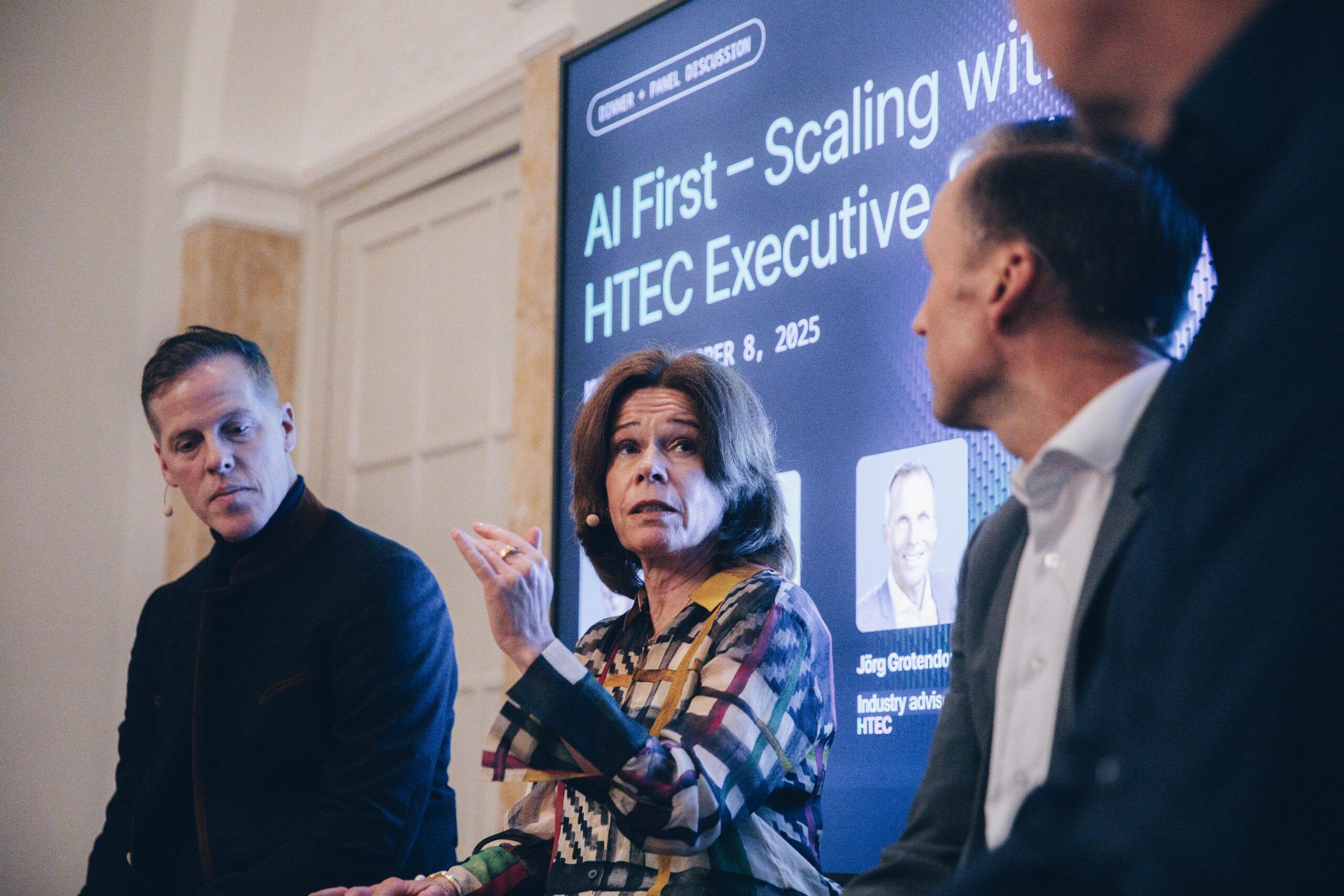
Following the success of HTEC’s AI-first Executive Dinner series in London, New Jersey, and San Diego, the conversation moved to Munich, where leaders from automotive, insurance, and technology sectors explored what it takes to translate AI ambition into impact. Moderated by Sebastian Seutter, HTEC’s Managing Partner, DACH, the panel brought together Jörg Grotendorst (Advisor, Automotive Industry at HTEC), Susan Wegner (Head of Group Data and AI, Allianz), Martin Gutberlet (Industry Principal Manufacturing, Snowflake), and Ronny Fehling (Partner and VP of Artificial Intelligence, BCG X) for an evening of candid conversation and knowledge sharing.
The discussion revealed a shared challenge across industries: how to move beyond isolated AI experiments toward enterprise-wide transformation.

The conversation explored what it truly means to adopt an AI-first mindset: how businesses can embed intelligence across operations, product development, customer interaction, and decision-making; why scaling AI requires leadership and cultural transformation as much as technical capability; the critical role of human-AI collaboration; and how organizations must evolve their operational models to realize AI’s full potential.
The AI transformation challenge
AI adoption is accelerating, but industries with deeply embedded processes, like automotive and insurance, face a unique dilemma. As Jörg Grotendorst observed, the European automotive sector’s process and safety-oriented culture are both its strength and its constraint. “We’re masters of regulation,” he said. “But this cautious approach can sometimes slow innovation.”
Meanwhile, Martin Gutberlet, Industry Principal Manufacturing at Snowflake, emphasized the need to move beyond isolated AI experiments to more strategic, business-driven implementations.
“We need to stop chasing use cases and start with ambition,” he argued. “What do we want to achieve from a business perspective?”
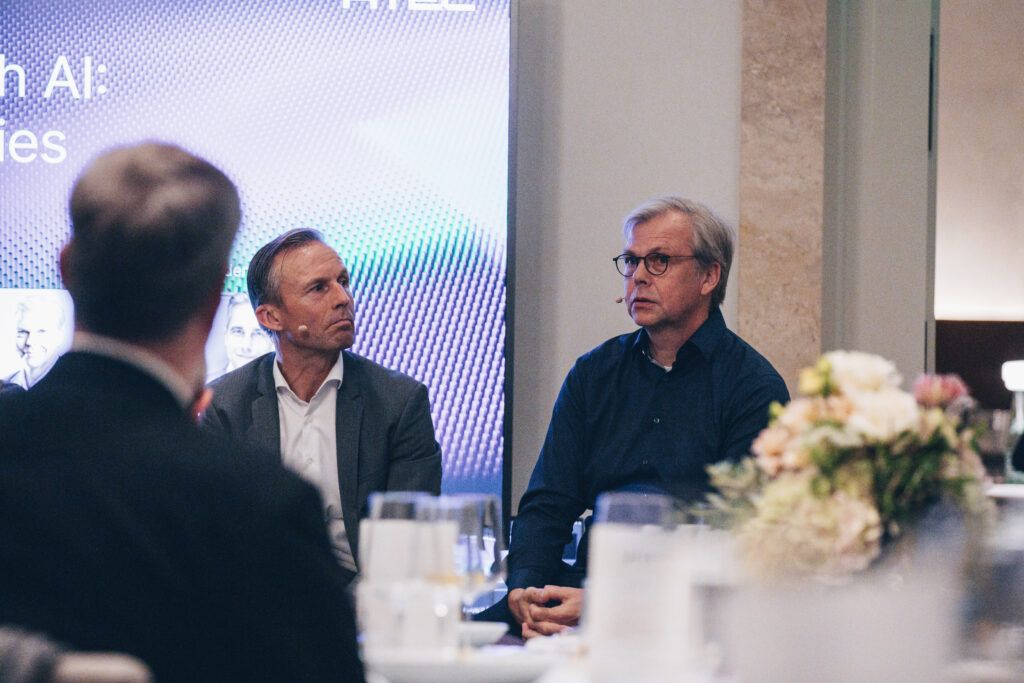
Jörg Grotendorst and Martin Gutberlet
This tension between caution and innovation, between isolated experiments and strategic transformation, is at the heart of the AI challenge facing major industries today. The path forward requires a delicate balance of embracing new technologies while managing risks and regulatory requirements. In the insurance sector, where vast amounts of data flow through every process, companies are finding that successful AI adoption depends as much on building a culture of trust, with both employees and customers, as on technical sophistication. In Germany’s automotive industry, where caution stalls progress, lessons from global car manufacturers show that greater openness to experimentation, faster decision-making, and closer integration of software and hardware innovation can significantly accelerate transformation.
Data strategy and AI success
If there was one clear consensus, it was that robust data strategy is the foundation of every AI success story.
Susan Wegner, Head of Group Data and AI at Allianz, offered a powerful case from the global insurance leader:
“We’ve identified strategic data points in areas like life and health insurance, and implemented a mandatory worldwide governance structure to ensure these key data points are processed consistently across all country operations.”
The conversation emphasized that robust data management is not just a technical exercise but an organizational imperative and it involves a few crucial steps:
Step 1: Identifying strategically important data points
Step 2: Implementing consistent governance structures and scaling them across the organization (globally)
Step 3: Fostering a data-driven community within the company
Step 4: Establishing KPIs to measure data quality and utilization
Even the most advanced AI algorithms will struggle to deliver meaningful results without a solid data foundation. Companies looking to leverage AI must first invest in organizing, standardizing, and governing their data assets.
Human-AI collaboration on the factory floor
The discussion then shifted from data to practice, how AI can be integrated into the existing workflows to improve outcomes. Jörg described how automotive manufacturing is evolving: from market data–driven vehicle design to AI-supported production, where robots and humans now share tasks seamlessly.
“It starts with market data analysis when designing a new car, then moves into testing design through digital twins instead of physical models. In product design, we’re optimizing engines and market solutions using AI.”

Ronny Fehling, Susan Wegner, Jörg Grotendorst, and Martin Gutberlet
He concluded that the true potential lies in human-AI collaboration rather than full automation. “In manufacturing, we’re at the forefront with robotics control and cooperative robots working alongside humans.”
Martin shared a compelling example: when a quality issue arose in car painting, AI-powered data analysis identified the cause within 30 minutes, a process that used to take weeks and halted production.
The consensus was clear: AI doesn’t eliminate human role. The key is finding the right balance and creating systems that leverage the strengths of both human intuition and machine processing power.
Cultural shifts: overcoming fear and building enthusiasm
The biggest obstacle to becoming an AI-first company isn’t technical but cultural. While technology can be developed, deployed, and scaled, transforming people’s mindsets takes time. Across industries, one of the most persistent challenges is employees’ fear and resistance toward AI, including concerns that range from job security to the relevance of their skills in an AI-driven world. Overcoming these fears and building trust in AI’s role as a collaborator, not a replacement, is one of the defining cultural hurdles on the path to actual AI adoption.
The panelists agreed that building trust is essential. That means transparent communication about AI’s role, showcasing success stories, involving employees in the development and implementation of AI solutions, and investing in training and upskilling to help workers adapt. Martin summarized it well: “Start learning about AI. It’s a joy to learn, and I think it’s a mandate for all of us to engage with it a little bit every day.”
Companies can transform skepticism into excitement by reframing AI as a collaborative enabler rather than a threat.
Cross-industry insights and bold ambition
The Munich discussion also benefited from its cross-sector diversity. The panelists agreed that looking beyond one’s own industry can provide fresh perspectives and innovative approaches to AI implementation.
Ronny Fehling, Partner and Vice President Artificial Intelligence at BCG X and consultant with experience across multiple industries, shared a key insight:
“The success and enthusiasm come when you start with the board and set an ambitious goal – say, 100 million in impact over two or three years. Then, interestingly, in a truly agile moment, you work backwards.”

Ronny Fehling
Susan highlighted the value of cross-industry events and podcasts in gaining new perspectives. While Martin pointed to examples from finance and telecommunications as potential sources of inspiration for the automotive sector, particularly in areas like data processing at scale.
The path forward: embracing AI-driven innovation
The discussion closed with a call to action. Jörg urged European companies to “dare a little more,” encouraging a shift from hesitation to experimentation, applying AI positively, and making it available for customer testing to spark enthusiasm. Martin reminded attendees about the rapid pace of AI advancement, which will bring technologies “we can’t even imagine today” in the next 12 months alone.
The evening underscored that leading in the AI era means coupling bold ambition with disciplined execution. The key takeaways:
- Build a comprehensive data strategy as your AI foundation
- Foster a culture of continuous learning and adaptation
- Set ambitious goals and work backward from impact
- Emphasize human-AI collaboration over automation
- Communicate and educate to overcome fear and resistance
- Look beyond your industry for inspiration and fresh perspectives
Munich’s panel proved that while each industry’s path may differ, they share a future where human insight and machine intelligence combine to reimagine what’s possible.
The leadership imperative: aligning strategy, culture, and data to drive AI-first change
A recurring question during the evening was where to start and what to prioritize when embedding AI within a company. Both the panelists and participants agreed that it begins with leadership alignment. Executive teams must define what to build, why it matters, and how it will drive growth before scaling AI across the organization.
Ultimately, thinking about AI should go beyond metrics and KPIs. It requires rethinking how technology, people, and culture interact. Scaling AI is a cultural transformation. And that message, echoed throughout the evening, is one that transcends industries, inviting every organization to take its first step toward an AI transformation.
As the panel concluded, the journey to becoming truly AI-first isn’t about quick wins; it’s about helping everyone transition, aligning strategy, culture, and data to drive lasting transformation.