
The Missing Piece in Digital Transformation
Most digital transformation work done over the past decade rests on an assumption few executives state out loud: that transformation happens in software, while the hardware underneath stays fixed and someone else’s concern. Cloud migrations, application modernization, and data platform overhauls were all built on that division of labor, and for a long time it held up well enough.
It does not hold up anymore. AI workloads are leaving the lab and entering production at a pace that exposes how much performance actually depends on what is happening below the application layer. Edge computing has pulled processing away from centralized data centers and onto distributed hardware that needs to be engineered with intention rather than treated as an afterthought. A team can write flawless code and still watch the experience fall apart in deployment because the chip, sensor, or network underneath it was never built with that workload in mind.
End-to-end transformation is the response to that exposure. Put simply: end-to-end transformation is the integration of hardware and software engineering, from silicon to cloud applications, into a single, coordinated effort that delivers scalable, AI-enabled systems. The companies building systems that hold up under real-world load are the ones treating hardware and software as one continuous engineering problem rather than two departments that meet occasionally.
What Is End-to-End (Sand-to-Cloud) Transformation?
End-to-end transformation, often called “sand-to-cloud” engineering, refers to the coordinated design and optimization of systems across semiconductor hardware, embedded systems, software platforms, and cloud infrastructure. The name traces the actual physical journey a product takes: from sand, the raw material of silicon wafers, all the way to the cloud environments where data is processed, stored, and turned into a usable experience.
That journey runs through five layers, and a system is only as strong as the coordination between them:
- Silicon and hardware: the chips and sensors that set the ceiling on what a system can do
- Embedded systems and firmware: the low-level software that controls hardware behavior and determines how efficiently it runs
- Connectivity and edge infrastructure: the networks and edge devices that move data between where it’s generated and where it’s processed
- Cloud platforms and data systems: the infrastructure that stores, processes, and scales data once it leaves the edge
- Applications and user experience: the layer most people think of as “the product,” sitting on top of everything beneath it
When these layers are designed in isolation, the seams show up later, usually in production, usually at the worst possible time.
Why This Matters Now
Three forces are converging at once, and each one raises the cost of treating hardware and software as separate concerns.
AI is moving out of pilot programs and into production systems, where it requires tight integration with the infrastructure running it. A model’s accuracy in a notebook means little if the inference hardware underneath can’t deliver results at the latency the business actually needs.
Edge computing is expanding the map of where processing happens. Compute is no longer centralized in a handful of data centers; it’s distributed across devices, gateways, and local infrastructure that each need to be engineered for the specific workload they carry.
Products themselves are becoming systems rather than discrete pieces of software. A connected device, an autonomous vehicle, or a real-time diagnostic tool is only as good as the hardware performance it sits on, which means software teams are now accountable for constraints they used to be able to ignore entirely.
Ignore this shift and the outcome is predictable: fragmented engineering produces fragmented, and ultimately broken, systems.
The Problem: Fragmented Engineering Models
In most organizations, hardware teams and software teams still operate on separate tracks. Hardware gets designed against a spec that gets handed off. Software gets built and optimized independently, often without full visibility into the constraints baked into the hardware it will eventually run on. Integration becomes the final step instead of a starting principle, so the two sides of the system meet for the first time when it’s already too late to make meaningful changes.
The consequences show up reliably: performance bottlenecks nobody predicted because nobody was looking at the full stack, higher costs from late-stage rework, slower time to market as integration problems surface during testing rather than design, and AI systems that underperform their potential because the hardware running them was never part of the original conversation.
What End-to-End Transformation Looks Like
The shift from fragmented to integrated engineering plays out differently at every layer of the stack.
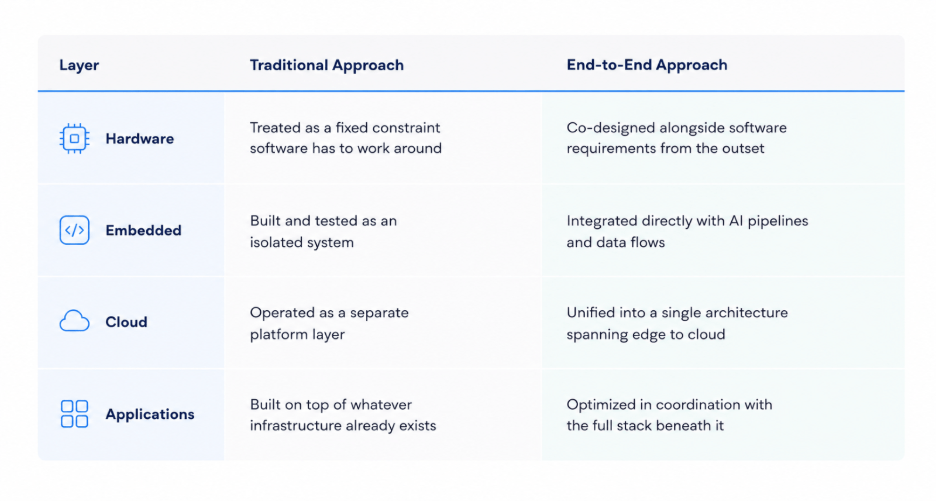
The pattern across every row is the same. Decisions that used to be made independently, often by teams that rarely spoke to each other, are now made jointly and early, with full visibility into how a choice at one layer affects performance at every other layer.
The Role of AI in Hardware and Software Transformation
AI workloads make the case for end-to-end engineering more urgent than almost any other category of software, because AI performance is inseparable from the hardware running it. A production AI system needs efficient inference hardware capable of handling the model’s computational load, data pipelines optimized to feed that hardware without becoming the bottleneck, and processing fast enough to support real-time decisions where that’s required.
None of that gets solved at the software layer alone. Inference efficiency is as much a function of system architecture as it is of model design, which means the teams responsible for AI performance now need real fluency in hardware constraints, edge deployment patterns, and system-level optimization, not just model training and tuning.
Real-World Use Cases
The industries furthest along in adopting end-to-end engineering tend to be the ones where hardware and AI performance are inseparable from the product itself.
Semiconductor companies are applying this thinking directly to chip design, optimizing AI workloads for specialized silicon where even marginal gains in efficiency translate into real performance and cost advantages at scale.
Automotive manufacturers building autonomous systems live or die by the tight integration of sensors and AI models, where a delay measured in milliseconds at the hardware level can be the difference between a safe decision and a dangerous one.
Telecom networks are pushing toward distributed AI at the edge as the default architecture, moving intelligence closer to where data is generated instead of routing everything back to a centralized core.
Healthcare devices running real-time diagnostics increasingly depend on embedded AI, where the hardware inside the device has to be engineered with the same rigor as the algorithm it runs.
The Hard Part: Why Few Companies Can Do This
End-to-end transformation sounds like an obvious idea once it’s explained, which makes the scarcity of companies actually doing it somewhat striking until you look at what it requires. Genuine sand-to-cloud capability needs hardware engineering expertise, software engineering depth, real AI and machine learning capability, and the systems integration skill to make all three work together without losing context along the way.
Those four capabilities rarely live inside one organization, and even when they do, they often sit in separate divisions with separate leadership, separate incentives, and separate definitions of success. Building or partnering for genuine end-to-end capability means assembling a team where hardware engineers, software architects, AI specialists, and systems integrators work from the same brief from day one, rather than handing a finished piece of work down a chain to the next group in line.
Decision Framework: When Do You Need End-to-End Transformation?
End-to-end transformation isn’t the right answer for every system, but a few signals reliably point toward it.
Performance is limited by hardware constraints that software optimization alone can’t solve, no matter how much engineering time gets thrown at it.
AI workloads aren’t scaling efficiently, and the bottleneck traces back to infrastructure decisions made without the AI use case in mind.
Systems require real-time processing where the cost of delay, whether measured in safety, user experience, or revenue, is high enough to justify rethinking the architecture from the ground up.
Products depend on embedded intelligence as a core feature rather than an add-on, which means hardware and software have to be designed as one system instead of two.
If any of these describe where an organization sits today, the conversation worth having isn’t about which software vendor to choose next. It’s about who can actually engineer across the full stack. .
Frequently Asked Questions
What is end-to-end transformation?
End-to-end transformation is the coordinated design and optimization of a system across hardware and software layers, from semiconductor design through embedded systems, cloud infrastructure, and the applications built on top of them, rather than treating each layer as a separate project.
What does sand-to-cloud mean?
“Sand-to-cloud” describes the full engineering journey of a connected, AI-enabled product, starting with silicon (made from sand) at the hardware level and ending with the cloud infrastructure and applications that deliver the finished experience to users.
Why is hardware and software integration important?
Hardware sets the physical ceiling on what software can achieve, and software determines how efficiently that hardware gets used. When the two are designed separately, performance, cost, and time to market all suffer, often in ways that only become visible after a product is already in production.
How does AI impact system design?
AI workloads place new demands on inference hardware, data pipeline design, and real-time processing, which means system architecture decisions now have to account for AI performance requirements from the start rather than getting adjusted after the fact.
When should companies adopt this approach?
Companies should consider end-to-end transformation when hardware constraints are limiting performance, AI workloads aren’t scaling efficiently, systems require real-time processing, or the product itself depends on embedded intelligence as a defining feature rather than an added capability.