

For most enterprises, the challenge with AI is no longer access to technology; it is understanding whether AI is actually creating value.
Organizations are investing heavily in AI tools, copilots, agents, and automation platforms, yet many leaders still struggle to answer fundamental questions: Is AI improving delivery? Is it increasing productivity? Are we spending more than we are gaining? And perhaps most importantly, how do we know? The absence of clear answers often creates uncertainty, slows decision-making, and prevents organizations from scaling AI beyond isolated experiments.
The root cause is a lack of transparency.
Today, most organizations track a growing number of AI and engineering metrics. They measure token consumption, code generation, pull request throughput, adoption rates, DORA metrics, and tool utilization. However, each metric exists in isolation. A rise in token usage may indicate increased AI adoption or simply increased cost. More lines of code may appear productive, but reveal nothing about quality. Faster pull request activity may hide bottlenecks in reviews or technical debt. Looking at any single metric independently creates an incomplete and often misleading picture. As a result, enterprises find themselves surrounded by data but lacking meaningful insight.
The reality is that no single metric can provide a truthful measure of AI impact.
What matters is correlation.
True understanding emerges when quantitative signals are connected with qualitative signals and interpreted together. Delivery velocity, code quality, AI adoption, productivity metrics, project risks, engineering sentiment, customer feedback, and business outcomes must be viewed as parts of the same system rather than as separate measurements.
This is the challenge that OneLoopAi was designed to solve.
At its core, OneLoopAi creates a continuous feedback loop that combines objective operational data with subjective human insight. On one side are quantitative signals pulled directly from engineering and delivery systems such as Jira, GitHub, Bitbucket, AI coding assistants, quality platforms, and development environments. On the other side are qualitative signals, including risk assessments from delivery managers, technical health evaluations, engineering feedback, and team sentiment. These inputs are enriched by accumulated delivery expertise and proven engineering practices built over years of real-world execution.
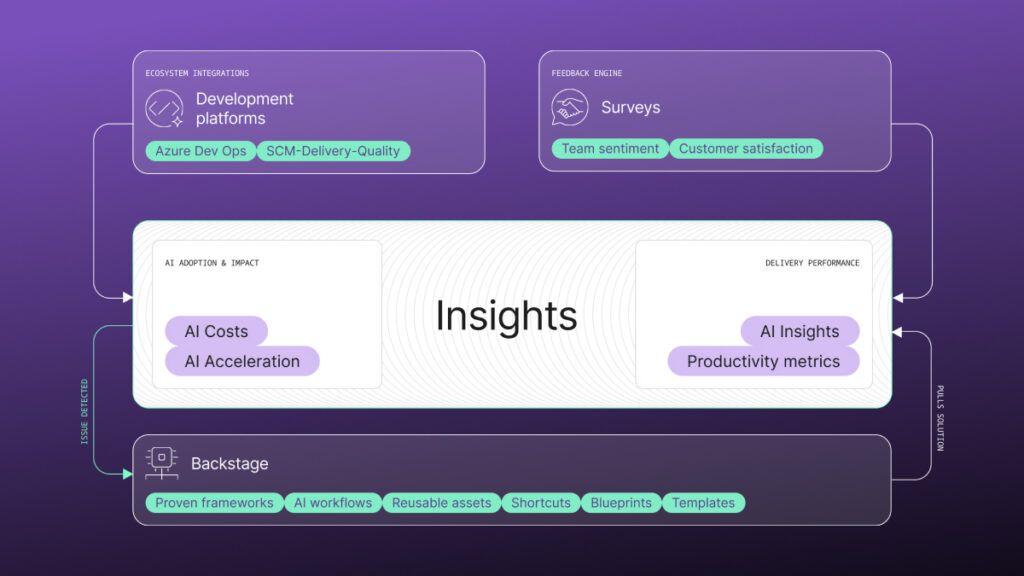
The power of the platform is not in collecting this data. It is in continuously correlating and interpreting it.
By analyzing all these signals together, the platform separates vanity metrics from meaningful indicators of performance. It identifies relationships that would otherwise remain hidden. A decline in team sentiment, combined with increasing AI usage and deteriorating quality scores, may reveal an adoption challenge. Rising productivity alongside improving quality and reduced cycle times may demonstrate genuine value creation. The insight comes not from any individual measurement but from understanding how the signals interact.
The result is a continuous loop of detection, insight, action and ultimately value creation.
Rather than relying on retrospective reporting, organizations gain a live view of project health, delivery performance, risks, forecasts, AI adoption, costs, and business impact as work progresses. Issues can be identified weeks before they become escalations. Leaders can understand where intervention is required. Delivery teams can make decisions based on evidence instead of assumptions. Most importantly, everyone operates from the same source of truth.
This level of transparency fundamentally changes how enterprises approach AI adoption.
One of the biggest barriers to scaling AI is trust. Leadership teams are often hesitant to invest further when outcomes remain unclear. Engineering teams become skeptical when productivity claims fail to match day-to-day experience. Finance leaders struggle to connect increasing AI expenditure with business value. Without transparency, AI initiatives frequently stall between pilot projects and enterprise-wide deployment.
HTEC OneLoopAi is a continuous loop that addresses this challenge directly. Every insight is grounded in observable signals. Every trend can be traced back to the source data. Performance, adoption, quality, risk, and value become visible, measurable, and explainable. Rather than relying on inflated ROI figures or anecdotal evidence, organizations gain a defensible understanding of how AI is influencing outcomes over time.
This is why transparency is not simply a reporting capability; it is an operational requirement for AI at scale.
Getting AI into production requires organizations to continuously learn, adapt, and improve. Teams need visibility into what is working, what is not, and where interventions can create the greatest impact. HTEC OneLoopAi combines quantitative evidence, qualitative feedback, and accumulated organizational knowledge to create that capability. It transforms AI from a collection of disconnected tools into a measurable system for an ongoing improvement loop.
Ultimately, enterprises will not succeed with AI because they adopt more tools. They will succeed because they create a transparent environment where value, risk, performance, and human experience can be understood together. When organizations can see the complete picture, from every angle, they gain the confidence to move beyond experimentation and scale AI into production with clarity, accountability, and continuous improvement at its core.
Learn more about HTEC OneLoopAi