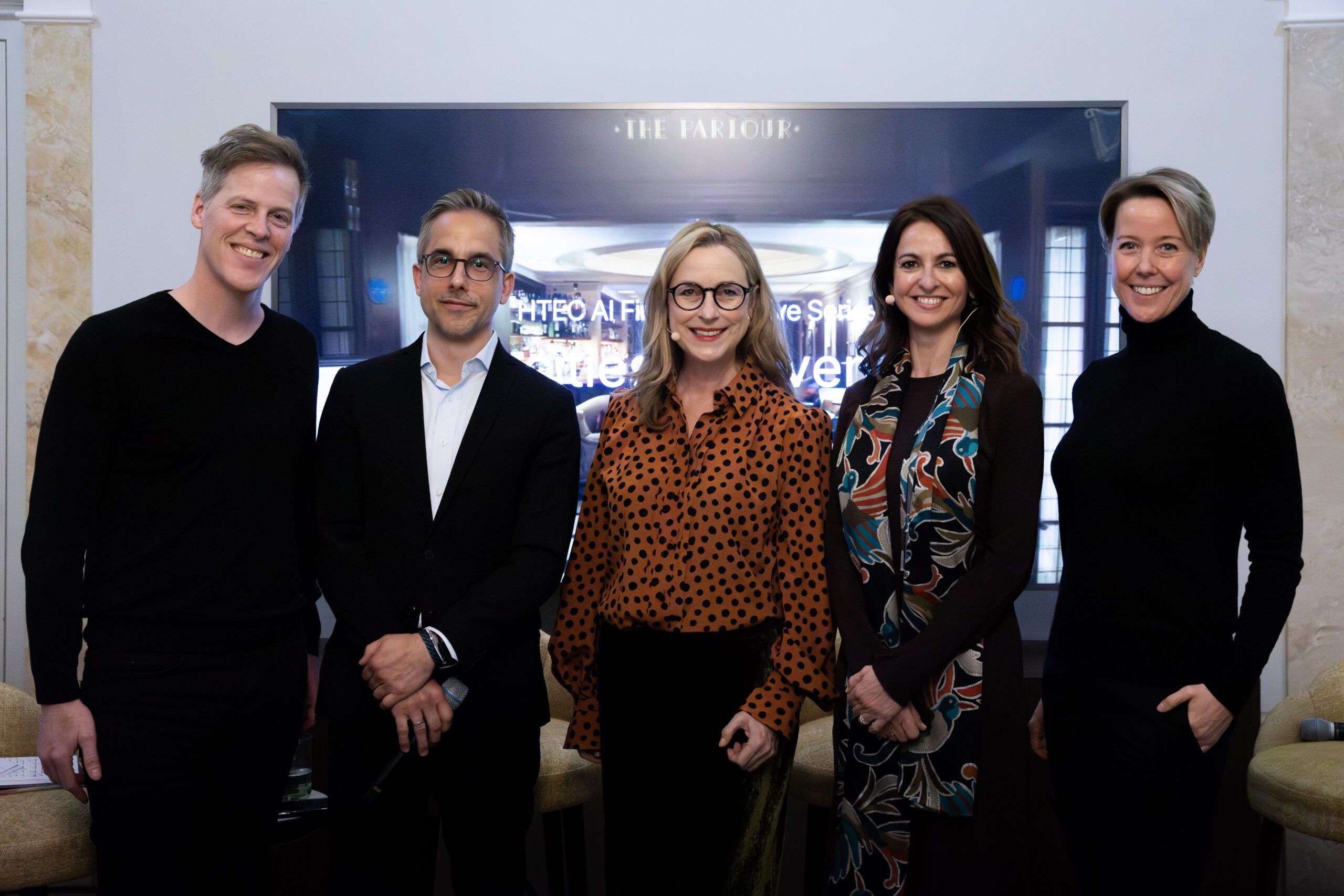
From the very beginning of HTEC’s AI-first executive series, the power of bringing diverse perspectives into one room was more than evident. Following London, New Jersey, Munich, Palo Alto, San Diego, and then back to London, the series continued in Minneapolis. For an executive panel focused on healthcare, the city choice seemed obvious – although our panel respectfully disagreed about whether Minneapolis is a hub or the hub of healthcare innovation.
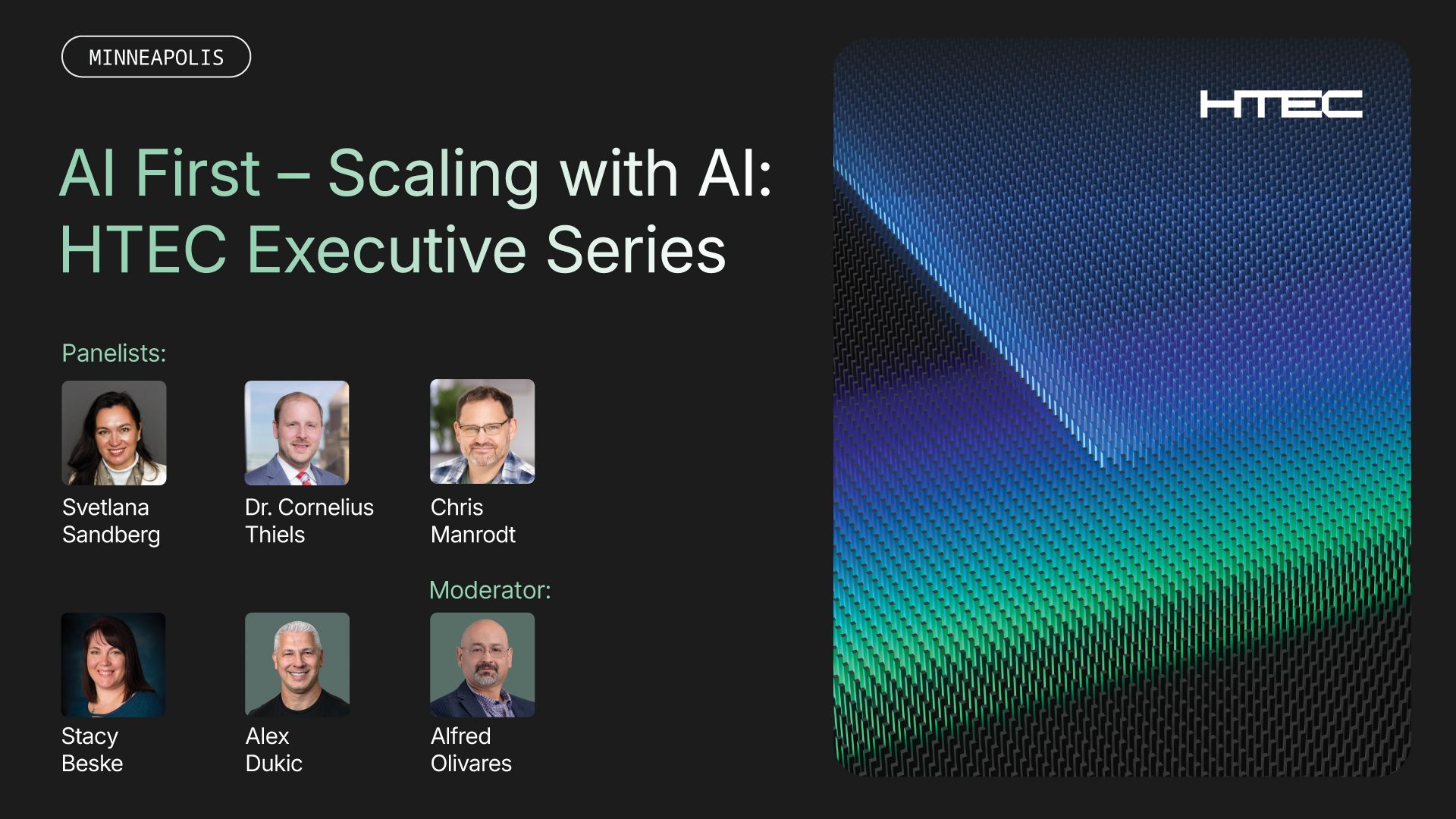
Alex Dukic, HTEC’s Chief Digital Officer, opened the panel with a question of where the healthcare and life sciences (HLS) sector currently sits on the AI adoption scale. With experts spanning every part of the healthcare ecosystem, the panel was uniquely positioned to explore AI adoption and impact from multiple angles – medical device development, regulatory, payor and adjudication workflows, big data and AI development, and even the realities of the operating room. Let’s explore the ideas of the esteemed panel:
- Stacy Beske, SVP and business leader, image-guided therapy devices, Phillips
- Svetlana Sandberg, VP of Innovation and Strategy, UnitedHealth Group
- Chris Manrodt, Chief Technology and Innovation Officer, Head of RWE, 3PH
- Dr. Cornelius Thiels, Pancreas and Sarcoma Surgeon, Head of Innovation in Surgery, Director of Surgical AI lab, Mayo Clinic
- Moderator: Alfred Olivares, Managing Partner, HLS, HTEC.
Huge promise, limited adoption
The panel was unanimous: building an AI model or tool, no matter how advanced, is not enough. Real value emerges only when technology is thoughtfully embedded into nurses’ and clinicians’ everyday workflows. That means aligning with how care is actually delivered, i.e., integrating seamlessly into existing processes, reducing cognitive load, and supporting decision-making without disrupting pace or priorities.
Simply put, when AI fits naturally into clinical routines, it becomes an enabler of focus and efficiency. When it doesn’t, even the most sophisticated solution risks being sidelined. Adoption, the panel agreed, isn’t just about technological capability; it’s practical usability in real-world care-delivery settings that makes or breaks a product.
This also places responsibility on people to actively shape how AI complements human work, deciding where it adds value and how it supports sound judgment across real-world workflows.
As Alfred observed:
“We often hear about ’human-in-the-loop’. I would argue that a more correct approach would be ‘AI-in-the-loop’ – because AI is there to assist, streamline, and complement – rather than replace human expertise.”
Why aren’t we further along with AI adoption?
As the experts explored the reasons behind the limited adoption, three challenges stood out: unclear ROI, limited trust, and building solutions ahead of problems.
The panel noted that the industry is moving beyond initial experimentation, entering a phase where boards and leadership expect tangible returns on AI investments. Demonstrating value requires more than presentations or statistics of uncertain reliability; clear, measurable outcomes are essential. Without demonstrable ROI, discretionary investment in exploratory initiatives is unlikely to continue.
Another issue raised by the panelists is data quality and availability. Although healthcare organizations hold vast amounts of data, much of it remains unstructured, siloed, or constrained by privacy and regulatory concerns—or, as one panelist noted, by fear-driven narratives around data use even when compliance is assured.
Additionally, putting the technology ahead of a clearly defined use case and problem space is setting the product for failure. The journey must be clear: define the use case, pain point, and clear objectives to be achieved – and only then select or design the technology that can address it effectively.
Svetlana sums up the benefits of this approach:
“For me, it’s about achieving the triple aim – expanding patient access, reducing physician burnout, and, ultimately, driving better outcomes.”
Becoming AI-first: From automation to augmentation and agility
Viewed through the lens of claims and adjudication, the proclaimed triple aim looks a bit different: consumer experience, reducing the administrative burden on the provider, and creating transparency around the claims and adjudication process. In other words, what works for one component of the healthcare ecosystem might not directly translate to value for another. For Stacy, it also underscores the importance of identifying the common ground that unites the entire ecosystem.
“Although use cases might differ, what seems to be common across the healthcare ecosystem is that AI can help us with ‘three As’ – automation, augmentation, and agility. We start with simpler use cases that can help us deliver quick wins and build trust, then scale toward more complex, high-impact applications.”
The value of real-world evidence
As one of the panelists observed, the clinical trial landscape is particularly delicate. Traditional trials are expensive and time-consuming, which means they are typically reserved for studying only major breakthroughs, such as blockbuster drugs and devices. Consequently, many other important medical questions receive little attention.
Real-world evidence (RWE) changes that dynamic. When combined with real-world data and AI, data from everyday clinical practice allows healthcare organizations to explore a much wider range of questions. In many ways, RWE represents the starting point for realizing the long-discussed promise of value-based care, providing the evidence needed to align clinical outcomes, patient experiences, and economic value.
Setting teams for AI success – the why and how
Driving efficiency and value through AI-enabled teams is a top objective for today’s leaders – a point on which there is the broadest consensus. Another given is that there has to be organization-wide clarity and buy-in before embarking on any kind of transformation project.
As a practicing sugreon, Dr. Thiels is well aware of how difficult it is to carry out an upskilling initiative without compromising patient care:
“Few will dispute the benefit from AI enablement initiatives. The tricky part is finding the time in doctors’ and nurses’ busy schedules and making sure it will not disturb their workflow”.
The best way to achieve this is through small increments – through “bite-size chunks” that demonstrate value and allow you to build momentum. Initially, saving 1% on one task might not seem like much. However, saving a few more percent on a few more tasks creates an impact that’s immediately evident to every stakeholder.
A more unconventional yet bold approach is to design your AI ecosystem first and then build your teams around it. While this top-down method may not be feasible in high-pressure environments with practicing surgeons, where patient care cannot be disrupted, it can be highly effective in other parts of the healthcare system.
As one of the panelists observed, the benefit of this approach is that it gives the team “no choice but to adapt” – needless to say, with all the support they need. It also encourages collaboration and mutual support. Initially, it might be a bigger mountain to climb, but once the team reaches the summit, the AI adoption curve grows exponentially.
Minneapolis as a Hub for Medical AI
The conclusion was unanimous: the importance of bringing together renowned professionals from across the system – clinicians, regulators, medical device companies, drug researchers, AI experts – paves the way to more efficient, transparent, and secure technology that ultimately benefits all parties involved.
Minneapolis is uniquely positioned to serve as a strong center of gravity for this next wave of progress. It’s more than its dense, world-class ecosystem—spanning Mayo Clinic, major payers like UnitedHealth Group, and global MedTech leaders including Medtronic, Philips, and Boston Scientific. It also brings together leading universities and a vibrant startup community, creating an environment agile enough to keep pace with technology. With “two degrees of separation,” stakeholders can align faster, experiment responsibly, and move promising ideas into practice.
The region’s data-rich institutions already use AI in many areas of care delivery and invest heavily in an AI-ready workforce. Cross-industry programs and discussions like this can bring us one step closer to advancing AI-empowered healthcare on a more global scale.
HTEC is proud to be part of this story and extends a warm thank-you to all the panelists and guests for an insightful and constructive discussion.