Held April 20-24, the Hannover Messe conference attracted well over 100,000 visitors, including leaders from industry giants such as Siemens, SAP, and Deutsche Telekom, as well as the highest-ranking government officials, to explore AI’s role in building a more competitive, lower-carbon industry.
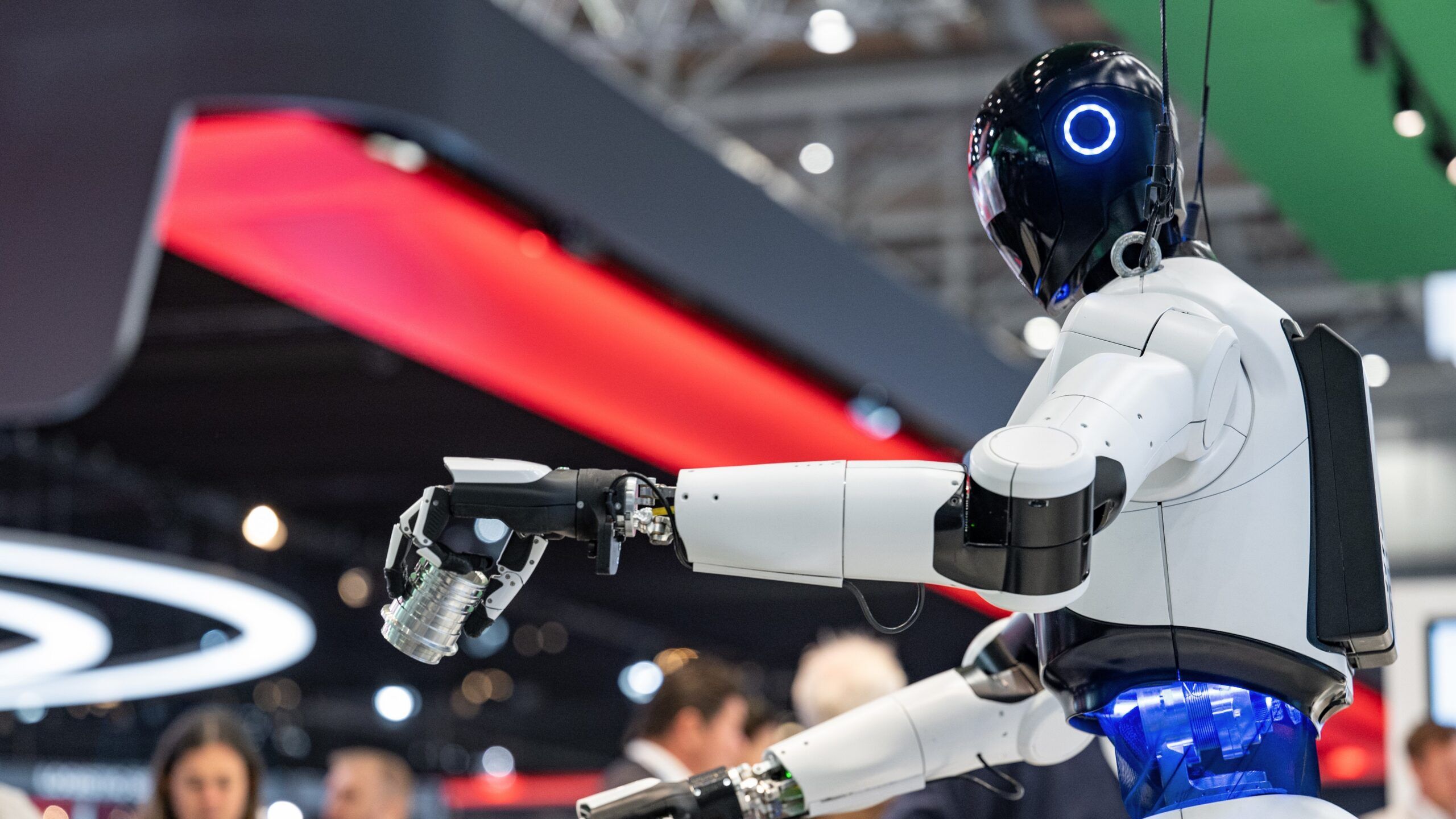
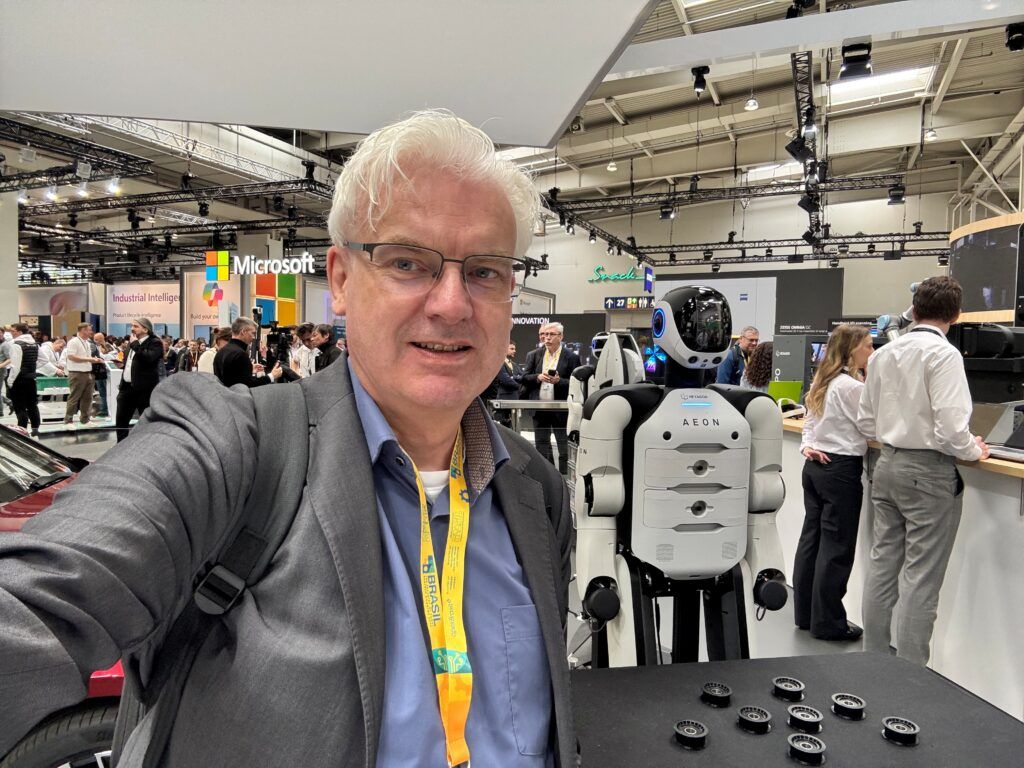
Two themes dominated the floor of the world’s leading industrial trade fair – physical AI and the transition of humanoid robotics from lab to production line. We bring you first-hand insights from HTEC’s experts who were on the ground.
Advancing on three fronts
One of the most obvious takeaways is that the industry is shifting in a more tangible way, shaped by AI, software-defined , and electrification moving forward at once. AI was present across the floor, with many exhibitors showcasing agent-based applications. Still, maturity varied widely. While some solutions were on production lines, others were much closer to polished prototypes.
Another very telling signal is a notable rise of manufacturing data brokers. Today, competitive advantage lies in turning clean, continuous data into actionable insights that allow predicting and preventing equipment failures, detecting defects in real time, optimizing energy use, and sensing demand shifts. This appetite is not unique to manufacturing. Automotive, healthcare, logistics, and other sectors are equally data hungry.
Humanoid robotics nears real-world readiness
The clearest signal of humanoid robotics moving forward came before the show floor even opened. The Hermes Award, one of the most prominent industrial innovation prizes, went to Schaeffler for its platform of highly integrated actuators designed for humanoid robot joints.
“Humanoid-robots-as-a-service” kept emerging in conversations on the floor. German tier 1 suppliers are increasingly positioning themselves as critical component players, not just end-product builders. Working concepts are there. However, the key signal to follow is market readiness. Interoperability will play a key role in moving from isolated projects to industry-wide deployment.
The standardization challenge – is the ecosystem ready?
Humanoid robots are maturing faster than the environments they’re meant to work in. Most factory floors remain a patchwork of legacy equipment, proprietary protocols, and siloed data. Bolting robots onto unprepared infrastructure is a recipe for expensive disappointment.
“The good news is that standardization is moving in the right direction”, said Doraid Gouiaa, Senior Client Partner at HTEC. “Across automotive, automation, and robotics, OEMs are increasingly settling on shared, real-time-capable middleware, i.e., common communication layers that let disparate systems talk to each other without bespoke integration work for every connection.” Important nuance: Standardization is indeed progressing, but it is not yet universal or complete, and adoption varies by industry segment and use case.
However, for manufacturers, the implication is clear. From the shift towards Software Defined Factory concepts to flexible, data driven architectures, digitalization is becoming essential for efficiency, resilience and competitiveness. Unified namespaces, real-time data flows, and edge AI processing are key prerequisites to moving forward.
What this means for manufacturing leaders
The temptation at a show like Hannover Messe is to chase the most compelling demo. The more productive question is: what foundations need to be in place before any of this delivers value?
For Kent Eriksson, Senior Client Partner at HTEC, the answer points in one direction.
“Invest in AI capabilities first. Quality AI that quickly moves into zero defects and unrivaled customer loyalty in B2B; Predictive operations that propose actions to avoid failures before they cost uptime; and the gradual move toward a Software-Defined Manufacturing, where production logic lives in software, not in hardwired configurations.”
Building the ecosystem matters more than betting on any single deployment model. Edge AI, real-time data processing, embedded systems, IoT connectivity, industrial middleware – none of these sit cleanly within a single manufacturer or technology supplier. That was one of the underlying signals at the Hannover Messe.
As physical AI finds its way into factories, healthcare, automotive production, and more, progress will increasingly depend on meaningful partnerships. The talent gap is real – HTEC’s recent research into the state of edge and AI across industries reveals that 99% of C-suite leaders surveyed identify skill gaps – most notably, in AI and machine learning expertise, data engineering, edge computing, and IoT – all critical for moving physical AI forward.
Navigating this transition from AI pilots to scalable, interoperable systems is exactly where HTEC works. Get in touch to explore how we can work together.